Autonomous tractor perception fails when dust, low light, rain, or glare degrade sensor data rather than introduce new objects. Effective all-weather training requires condition-aware datasets covering illumination spectrums, weather severity levels, frame-level metadata, and edge-case mining from production failures across camera, LiDAR, and multimodal sensor fusion.
A tractor that performs flawlessly in a daylight field test can fail in the exact same field an hour later. Dawn light, drifting dust, rain on the lens, or a shadow crossing a crop row doesn’t introduce new objects into the scene. They change how much visual evidence the model has to work with, which is where autonomous tractor failure actually originates.
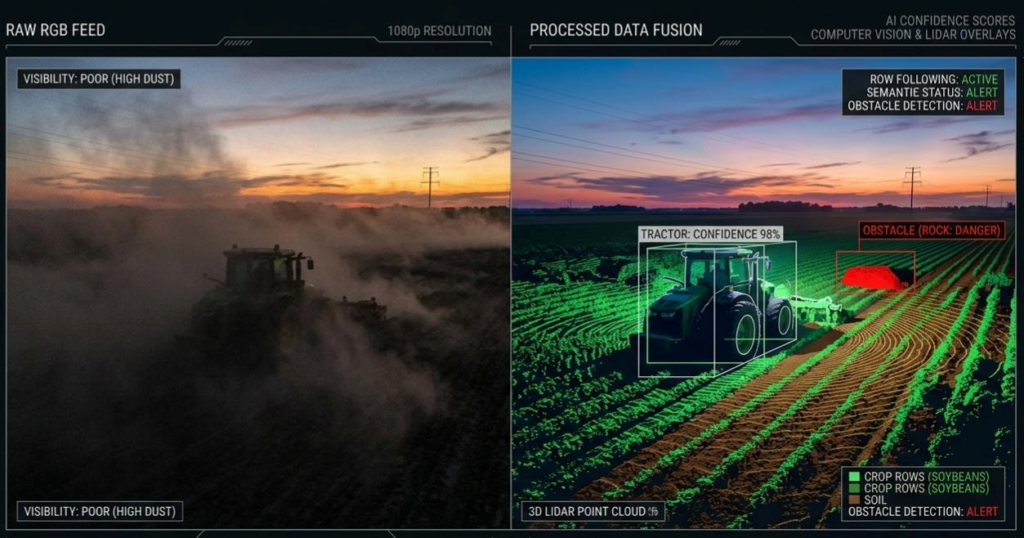
Researchers studying this exact problem mounted cameras inside a tractor cabin and deliberately worked a field with a disc harrow to maximize dust density, specifically to test how dust degrades vision-based perception in real agricultural machinery. Their RB-Dust dataset found that low-density dust could be corrected, but performance still hinged entirely on how well the model had been exposed to dust conditions during training.
That makes all-weather autonomous tractor training data the real differentiator. This article explores how low light, rain, dust, and poor visibility contribute to autonomous tractor perception failure and what training data can help address these edge cases.
How Autonomous Tractor Perception Fails in Difficult Conditions
Autonomous tractor perception depends on extracting reliable features from camera, LiDAR, radar, and other sensor inputs. When environmental conditions change, the underlying objects may remain the same, but their representation in sensor data can change. Rain, fog, dust, and low illumination can reduce image contrast, obscure object boundaries, introduce noise, or alter sensor returns.
Low Light and Autonomous Tractor Low Visibility Performance
Research on illumination-adaptive perception, including SafeDrive-Fusion, shows that perception accuracy can fall when lighting moves outside the conditions represented in training data. At dawn, dusk, or night, images typically contain less detail and contrast. Shadows can merge with objects, while headlights or work lights can create bright areas that overwhelm nearby details.
Glare and backlighting can have a similar effect during daytime operation. A model that learned what a field looks like in bright daylight may therefore interpret the same scene differently when illumination changes. This is one reason autonomous tractor low visibility performance needs to be evaluated across multiple illumination levels rather than through a simple day-versus-night comparison.
Dust As a Distinct Degradation Class
Dust creates different perception challenges from fog or rain. Unlike fog’s uniform water droplets or rain’s larger falling drops, dust consists of fine, irregular solid particles that remain suspended longer, create higher local particulate density near the ground, and induce motion blur as vehicles stir clouds that move with the sensor. Particles can reduce visibility, scatter light, and create motion-related artifacts. Research on BEV-based multimodal sensor fusion in underground mining environments shows that dust, combined with uneven lighting, can degrade sensor fusion performance.
Agricultural dust clouds created by tillage or harvesting can produce a similar challenge. This makes dust-specific training examples important rather than treating dust as generic poor visibility.
Computer Vision Failure in Low Light and Rain
Rain visible in a scene creates problems such as streaks, reflections, wet surfaces, and reduced contrast. Raindrops on the camera lens create a different failure mode. They can distort or block parts of the image and directly compromise the sensor input.
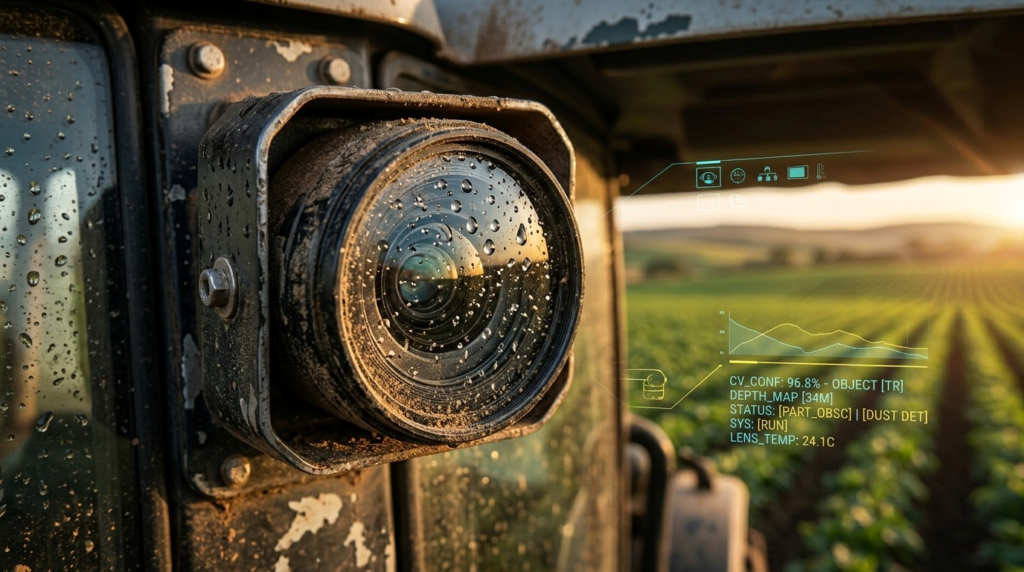
Video de-raining research generally focuses on removing rain streaks or visual artifacts from the scene. For autonomous tractors, however, lens contamination is also an object-level perception problem. The system must remain reliable when part of its visual input is physically obscured.
Compounding Conditions
The hardest field failures often involve multiple conditions at once. Dust combined with backlight, rain on the lens across uniform crop rows, or night operation with shadows from an implement can create failures that single-condition datasets miss. These combinations are rarely collected deliberately, making them an important annotation gap.
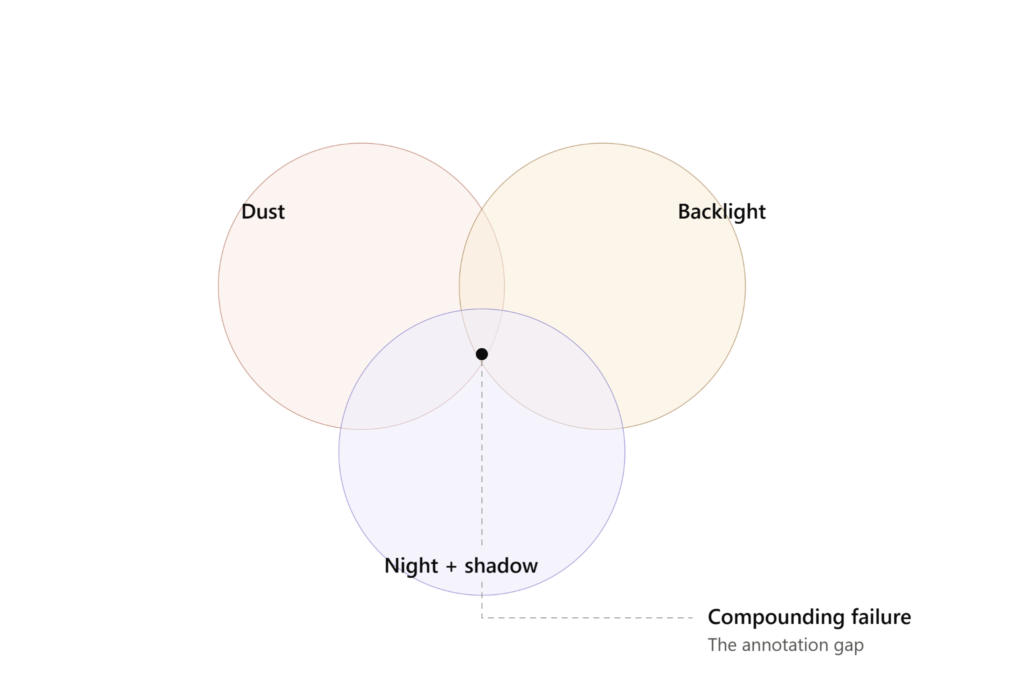
LiDAR also cannot always provide a reliable fallback. Airborne particles such as dust, fog, and snow can scatter the laser signal and reduce detection quality. This means tractor perception systems need training data that captures combined environmental and sensor-degradation conditions, rather than relying on LiDAR to compensate for poor camera input.
What Training Data Does All-Weather Autonomous Tractor Systems Actually Need?
Building all-weather autonomous tractor systems starts with a dataset that reflects the full range of environmental and operational conditions the machine will face. This means going beyond “more images” to structured, condition-aware data that captures how visibility, weather, and terrain interact in real fields. For ML teams, this means treating environmental variation as a set of measurable data dimensions.
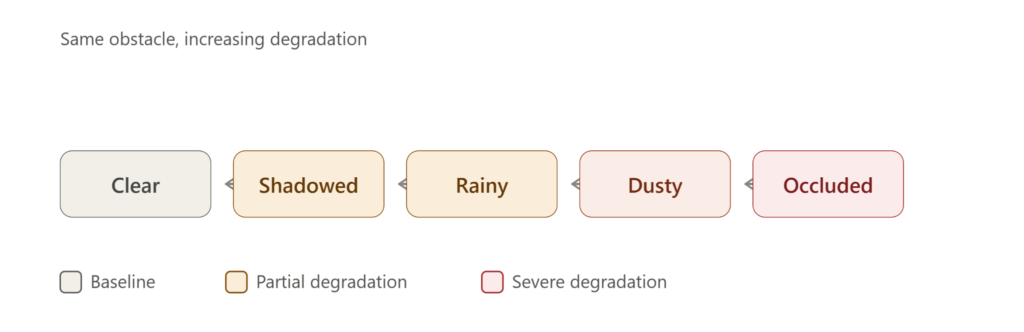
To make that coverage actionable, teams should break environmental variation into specific data dimensions and measure whether each one is adequately represented in the dataset.
1. Lighting Diversity Across the Full Illumination Spectrum
Day and night are not binary operating modes. Illumination changes continuously as the sun rises, sets, moves behind clouds, or creates glare and shadows. Lighting is continuous, and a model needs examples across the transitions between these states, not just at their extremes. Training data should therefore cover:
| Condition | What to Capture |
|---|---|
| Full daylight | Different sun angles and exposure levels |
| Overcast | Flat contrast and muted colors |
| Dawn/dusk | Transitional illumination |
| Night | Work-light/headlight illumination |
| Backlighting | Objects against bright sky/sun |
| Shadows | Crop/tree/machine shadows |
| Glare | Lens flare and reflective surfaces |
This matters because perception performance can degrade progressively as illumination falls rather than suddenly failing when “night” begins. Recent illumination-adaptive perception research similarly evaluates multiple low-light levels rather than treating darkness as a single condition.
2. Weather Severity, Not Just Weather Type
A dataset containing “rain” is still underspecified. Light rain and heavy rain can produce very different visibility and sensor degradation. The same applies to mist, fog, and dust. Training data should capture weather intensity, along with conditions such as wet lenses, water droplets, dust haze, dense dust, and muddy surfaces.
The VARG weather dataset demonstrates why this distinction matters. It contains 6,742 annotated video clips covering rain, fog, and snow, with separate absent, moderate, and high-intensity labels. The researchers note that weather intensity affects the level of sensor noise and downstream computer vision performance. A dataset with ample “rain” examples that are all light drizzle will not prepare a model for a downpour.
For AI training data for agricultural robots, this means weather labels should describe severity and its effect on the sensor, not simply identify whether rain or dust is present.
3. Agricultural Scene Variation Beyond Weather and Light
Agricultural coverage should span crop types, growth stages, soil types, field layouts, row spacing, residue levels, terrain, regions, and seasons. Without this variation, a model can learn shortcuts. For example, it may associate a particular crop or soil appearance with a specific lighting condition or geographic region simply because those combinations dominate the training data.
The scale required can be substantial. iMerit’s agricultural annotation work, for example, includes more than 4.5 million images across 40+ crop types, showing the breadth needed to build robust agricultural datasets.
4. Condition Metadata Attached to Every Frame
Labels alone don’t tell a team why a model failed. That requires structured metadata attached to each relevant frame or object describing lighting, weather type and severity, visibility range, lens contamination, occlusion, motion blur, object distance, camera viewpoint, sensor type, soil and vegetation state, and operational context. It is also useful to distinguish normal examples from failures and near-misses.
This turns a large image collection into a dataset that engineers can query. Teams can, for example, identify whether missed obstacles cluster around heavy dust, backlighting, or partial lens occlusion, rather than discovering the pattern only after deployment.
5. Balancing Real Field Data With Synthetic Augmentation
Synthetic augmentation can increase coverage for rain, fog, low light, and dust, but it should complement and not replace real field data. Generative approaches have been used to create multi-weather datasets for autonomous driving, such as WEDGE, which leverages vision-language models to synthesize diverse weather conditions from base images. Similarly, simulation environments like CARLA have been used to generate paired clear and rainy images for training and testing perception models.
IDD-AW also provides a useful model for this approach. It contains 5000 paired RGB/NIR images with pixel-level annotations across rain, fog, low light, and snow, including safety-oriented hierarchical labels.
For all-weather autonomous tractor systems, the strongest pipeline therefore combines real field captures, controlled synthetic augmentation, synchronized multimodal data where available, and held-out real-world test sets. The goal is not maximum visual variety. It is coverage of the specific conditions under which perception evidence becomes unreliable.
How to Build an Edge Case Annotation Dataset for Autonomous Vehicles
Building an edge-case dataset should not mean collecting a large volume of difficult-looking images. The objective is to create a feedback loop in which actual perception failures determine what data gets collected, how it is categorized, and what remains available for future model versions.
Mine Failures From Production
The most useful edge cases often emerge after deployment. When a tractor misses an obstacle, misidentifies a crop boundary, or becomes uncertain in reduced visibility, the corresponding sensor frames and operating context can reveal a gap in the current training distribution. Teams can use these failures to identify which combinations of conditions are causing errors and prioritize targeted data collection.
This is more effective than trying to predict every possible failure before deployment. Research on autonomous-driving corner cases similarly emphasizes mining difficult scenarios from large volumes of real-world data and identifying whether weaknesses originate in the data or the model.
Stratify by Environmental Condition
“Weather” should not be treated as a single performance category. An aggregate weather score can hide the fact that a model performs adequately in light rain but fails in dense dust or backlit dawn conditions. Evaluation and retraining data should therefore be segmented by low light, rain, dust, fog or haze, visibility range, and combined conditions.
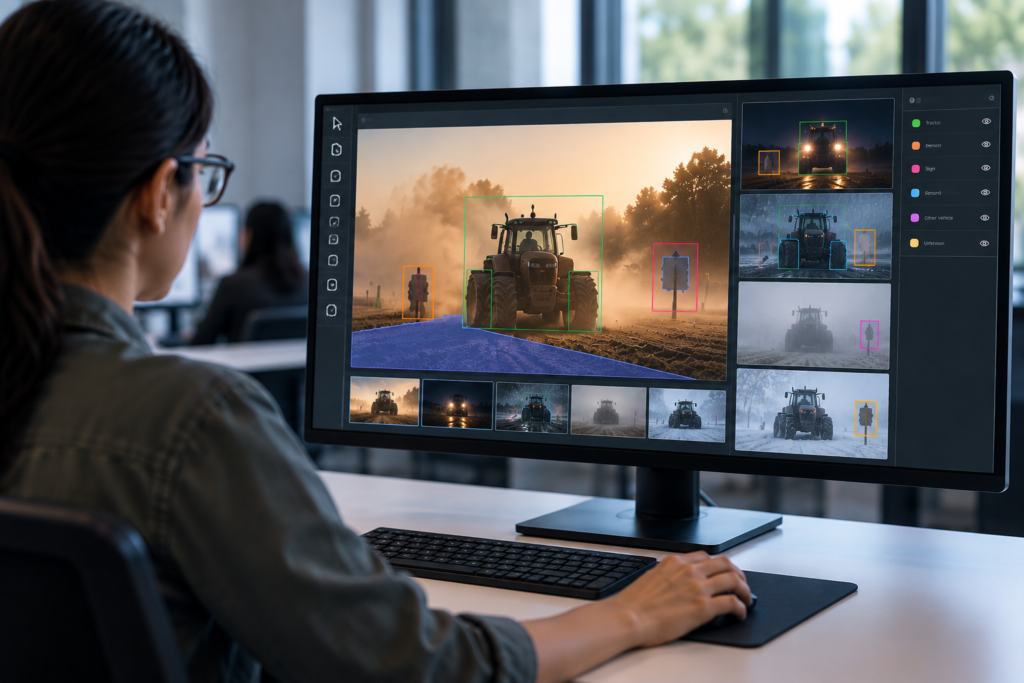
This makes the failure distribution actionable. If false negatives increase specifically when dust and backlighting occur together, the next collection cycle can target that combination rather than adding more generic “bad weather” images.
Maintain an Edge-Case Repository
Once a difficult scenario causes a failure, retain it as a reusable asset rather than letting it disappear after one retraining cycle. Tag it by condition, object, failure mode, and resolution so future model versions can be tested against the same scenario. This creates a growing regression set and prevents recurring failures from being rediscovered in production.
This is where structured edge-case triage becomes valuable. Teams can identify high-value eve
nts, investigate why a model failed, and determine which scenarios require annotation, retraining, or further testing. iMerit’s EdgeCase capability supports this workflow with analytics around edge-case resolution, helping teams track how identified failures are addressed and fed back into model improvement.
Our autonomous-system triage services include event classification, sensor data review, root cause analysis, scenario tagging, data selection, and feedback loop integration. Together, these capabilities provide a practical model for edge case annotation for autonomous vehicles and other autonomous systems, without treating every captured frame as equally valuable.
How iMerit Helps Build Training Data for All-Weather Autonomous Tractors
Building reliable perception for autonomous tractors requires training data that reflects how agricultural scenes change in low light, rain, dust, glare, and poor visibility. iMerit combines agricultural domain expertise with annotation and edge-case workflows that can help teams target these conditions.
1. Agricultural Annotation Under Difficult Conditions
Weather can change how crops, weeds, field boundaries, and obstacles appear to a perception model. iMerit supports agricultural AI annotation for applications including autonomous tractors, crop and weed detection, and field analysis. This provides the domain context needed to label agricultural objects consistently when they are partially obscured by dust, shadows, glare, or rain.
2. Multimodal Data for Degraded Perception
Adverse conditions can affect more than camera images. LiDAR returns may become sparse or inconsistent, while differences between camera and LiDAR data can complicate sensor fusion. iMerit provides 3D point cloud and sensor-fusion annotation for autonomous systems, including workflows for challenging weather and lighting conditions. Its LiDAR annotation work also shows how data can be curated across diverse weather, lighting, reflections, and surface conditions.
3. Turning Weather Failures Into Edge-Case Data
The most useful adverse-weather examples are often those linked to actual perception failures. iMerit’s edge-case handling workflows combine automated detection with human review and feedback loops. Teams can use this approach to identify failures in dust, low light, rain, or combined conditions, annotate the relevant scenarios, and feed them into retraining or evaluation.
iMerit’s Sentera case study also demonstrates this agricultural data workflow. iMerit annotated 1.2 million corn tassels at 95% accuracy, helping improve FieldAgent’s tassel detection accuracy from 80% to 95%.
Conclusion
Reducing autonomous tractor perception failure starts with understanding where perception degrades and ensuring those conditions are represented in training and evaluation data. The goal is not simply more images, but better coverage of low light, rain, dust, glare, occlusion, and combined conditions.
For teams building all-weather autonomous tractor systems, this means identifying failures, capturing the conditions behind them, annotating those cases consistently, and using them to improve future model versions.
Key Takeaways
- Real fields are unpredictable. Lighting, rain, dust, glare, and haze can change how the same object appears to a perception model.
- More images are not always enough. Effective AI training data for agricultural robots must represent the conditions tractors encounter in operation.
- Low-light and bad-weather data matter. Teams need examples that expose computer vision failure in low light and rain, not just clear-weather performance.
- Edge cases reveal data gaps. Difficult or failed examples can show where the model needs additional training data.
- Test models across conditions. Evaluate performance separately for different lighting, weather, visibility, and occlusion levels instead of relying only on overall accuracy.
Building all-weather perception shouldn’t mean waiting for the next field failure to find out what your dataset is missing. iMerit’s agricultural annotation workflows and EdgeCase capability turn model failures under difficult conditions into structured, reusable training data, backed by domain-qualified experts who understand what a crop row looks like under dust, glare, or dusk.
Talk to iMerit to build a training pipeline that holds up in the field, not just in the test set.