Multimodal voice AI is expanding beyond speech as agents process images, PDFs, and other contextual inputs. Research and benchmarks show challenges in audio-visual alignment, temporal grounding, and cross-modal reasoning, making synchronized, relationship-aware annotation increasingly important for reliable training and evaluation.
The input boundary around multimodal voice AI agents is expanding beyond audio. A user can speak to an agent while uploading a PDF, image, form, or other contextual information, or switch between voice and typed input within the same session.

For example, ElevenLabs expanded from only voice and text interactions to ElevenAgents handling multimodal inputs including images, PDFs, and audio messages in a shared conversation context. That shift changes the training data requirements.
In a speech-only pipeline, interpretation depends on the audio stream and derived information such as the transcript, speaker, intent, and acoustic cues. However, multimodal interpretation depends on information outside the audio, such as what “this” refers to in an image or which screen state was visible when the utterance occurred.
The challenge is to create training and evaluation multimodal data that capture these dependencies. Cross-modal annotation preserves the temporal, referential, semantic, and state relationships that connect a spoken utterance to the external evidence needed to interpret it.
This article explores why traditional audio labels fail multimodal voice AI agents, what cross-modal annotation requires, and how to build synchronized data pipelines.
Why Traditional Audio Annotation Breaks for Multimodal Voice Agents
Traditional voice annotation captures acoustic and linguistic information such as transcripts, word timestamps, diarization, and non-speech audio events to supervise individual speech segments. These labels remain valid in a multimodal system, but they do not specify which information outside the audio is required to resolve the utterance.
Consider three examples:
- “Is this damage covered?” + vehicle damage image
- “What does this clause mean?” + insurance or legal PDF
- “Why is this number different?” + financial statement or screenshot
In the first example, standard audio labels won’t show which part of the photo “this damage” refers to. The model must ground the spoken reference to a specific image region before it can interpret the request correctly.
Document interactions face the same challenge. “This clause” could refer to a paragraph on page 5 in a PDF, and “this number” might point to one cell in a large table. Neither modality contains the required supervision independently; it comes from the relationship between a speech span and external evidence.
For this data design, it helps to distinguish three levels of annotation:
- Unimodal Annotation: Labels each input separately (audio gets a transcript, images get object tags, documents get text extraction) with no links between them.
- Parallel Multimodal Annotation: Groups the audio, images, and documents into the same user session, but the annotations still exist independently and do not link specific spoken words to specific image areas or document sections.
- Cross-Modal Annotation: Adds that missing relational supervision. Referring expressions in speech are linked to addressable objects in another modality, and the relationship itself is labeled. That relation can encode reference, evidence dependency, agreement, contradiction, ambiguity, or insufficient context.
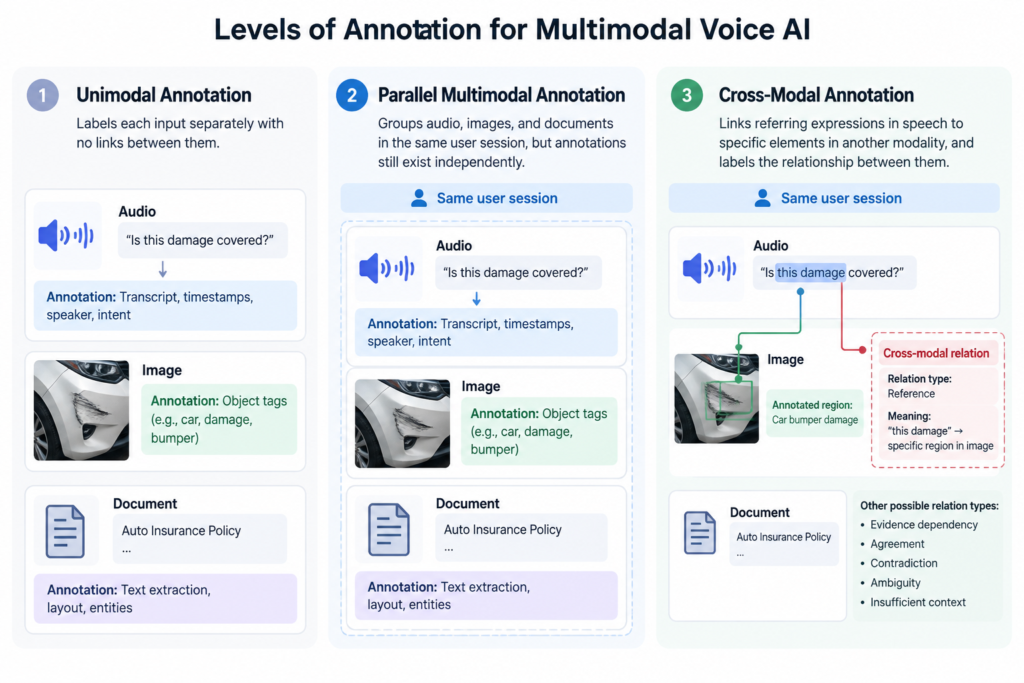
So, the annotation challenge is a cross-modal dependency problem. Multimodal annotation must specify which elements across the assets are related, what that relationship means, and whether the downstream response depends on it.
What Cross-Modal Voice Annotation Needs to Capture
For multimodal voice AI, a production-ready training unit should be a linked multimodal interaction with stable IDs and temporal and structural metadata. This setup allows for the reconstruction of which inputs were available when a spoken request occurred.
Within that interaction, the cross-modal relation connects a spoken reference to the relevant visual or document evidence and should capture the following information:
- Source Reference: Identify the utterance segment and, where possible, the exact referring expression, such as “this,” “that one,” or “the second paragraph.”
- Grounding Target: Resolve that expression to an addressable image region, object, document span, table cell, screen state, or other evidence item.
- Relation Semantics: Specify how the two elements are related, including reference, cross-modal entity identity, supporting evidence, agreement, contradiction, or insufficient context.
- Temporal Relationship: Record whether the referenced visual or document state was active when the utterance occurred, appeared earlier, or changed later in the interaction.
- Annotation Provenance: Preserve the annotator decision, adjudication state, confidence or ambiguity flag, and guideline version so disputed relationships can be audited during evaluation.
The annotation should also define the expected grounded output, such as an answer, action, or refusal. It must also handle ambiguities like multiple visible objects, overlapping speakers, OCR errors, ambiguous pronouns, and contradictory information across modalities.
Building the Annotation Pipeline for Synchronized Audio, Images, and Documents
Once the annotation schema defines how speech connects to external evidence, the pipeline must preserve those relationships as raw assets are processed into validated training or evaluation records.
Multimodal Intake and Provenance
Register related audio, images, and documents under persistent session and asset IDs. Preserve source metadata such as capture timestamps, asset versions, and transformation history so each annotation remains traceable to the exact input available during the interaction. When modalities come from different capture systems, synchronize timestamps to maintain temporal alignment.
Modality-Specific Preprocessing
Prepare each modality for annotation while retaining mappings to the source. Audio can undergo segmentation, ASR, diarization, and timestamp alignment. Documents may require OCR, layout parsing, and table extraction, while visual preprocessing may generate candidate objects, regions, or frames. These derived outputs should remain linked to their original assets.
Candidate Relationship Generation
Use timestamps, extracted entities, OCR matches, document structure, object detections, and model-assisted signals to propose potential links between speech and external evidence. For example, when the user asks about “the total on this invoice,” candidate generation can narrow the target set to amount-related fields on the active document rather than every text span on the page.
Expert Validation and Routing
Reviewers validate proposed relationships using the synchronized utterance and relevant visual or document context. Route ambiguous references, conflicting evidence, or domain-specific content to qualified reviewers when determining the correct relationship requires additional subject-matter expertise.
Adjudication and Ground-Truth Creation
Resolve disagreements at the relationship level and convert accepted annotations into validated records. The final ground truth should preserve the confirmed target and relation type while allowing outcomes such as insufficient_context when the available evidence does not support a reliable link.
Release-Level QA
Before release, validate schema compliance, asset and relationship integrity, temporal alignment, missing modalities, invalid image regions or document spans, and annotation completeness. The final dataset should meet predefined acceptance criteria for both modality-specific labels and cross-modal relationships.
Building this multimodal voice AI pipeline requires a platform that preserves shared context across modalities. iMerit’s Ango Hub supports image, video, text, PDF, and audio annotation with configurable review, benchmarking, and quality controls.
Why Multimodal Voice AI Data Will Become a Bottleneck for 2026–2027 Agents and How to Address It
As voice agents take on richer multimodal tasks, the data challenge shifts from collecting each modality to capturing how those modalities interact.
- Temporal Grounding Becomes a Dataset Problem: FAVE shows that current models still struggle with audio-visual alignment, temporal relationships, and timestamp localization. A model can identify the right evidence but associate it with the wrong point in the interaction.
- How to address it: Synchronize utterance timestamps with versioned visual and document states so each reference can be resolved against the evidence available at that moment.
- Speech Carries Supervision Beyond the Transcript: Pitch, timbre, emotion, volume, and environmental sounds can affect interpretation. MultiVox found that open-source models struggle to combine these speech characteristics with visual evidence.
- How to address it: Retain source audio and annotate task-relevant acoustic and paralinguistic signals alongside ASR output instead of treating the transcript as the complete speech representation.
- Multi-Speaker Interactions Add Another Alignment Requirement: Overlapping speech, interruptions, speaker changes, and multi-turn references make it harder to determine which speaker and previous turn a multimodal reference belongs to.
- How to address it: Bind utterances to speaker identity, conversational roles, turn boundaries, and timestamps before constructing cross-modal relationships.
- Cross-Modal Evaluation Must Prevent Modality Shortcuts: A model can appear to solve a multimodal task while actually deriving the answer from only the transcript, image, or document, masking failures in cross-modal grounding.
- How to address it: Introduce hard negatives and counterfactual pairs that alter one modality while holding the others constant, making shortcut behavior measurable during evaluation.
- Enterprise Agents Add Session and System Context: IBM’s integration of ElevenLabs’ speech capabilities into watsonx Orchestrate shows voice moving into agentic enterprise workflows, where an incorrect response can originate outside the speech or multimodal model itself.
- How to address it: Attach session state, retrieved evidence, tool I/O, and executed actions to the interaction trace so failures can be attributed to the correct pipeline stage.
Together, these requirements make multimodal voice data harder to build at scale, requiring datasets to preserve temporal alignment, cross-modal context, speaker relationships, and agent state.
Operationalize Multimodal Voice Data at Scale with iMerit
iMerit combines multimodal annotation workflows and quality controls with domain expertise to help AI teams build multimodal voice data at production scale.
- Unified Multimodal Annotation: Ango Hub supports image, video, text, PDF, audio, DICOM, and other data types, plus review workflows, benchmark tasks, permissions, pre-label imports, and quality controls. This lets linked assets move through one controlled annotation operation.
- Voice AI Ground Truth and Evaluation: Audio Annotation supports expert-led audio annotation for multilingual ASR gold data, transcription, diarization, conversational intelligence, and voice AI evaluation, with structured review and benchmarking workflows.
- Managed Annotation and QA: Data Annotation Services combine multimodal tooling with managed delivery, multi-stage review, benchmark questions, custom validation rules, and API or webhook integration into downstream data systems.
- Domain-Expert Review: iMerit Scholars provides domain specialists for complex training and evaluation tasks where multimodal relationships require technical, linguistic, medical, or other subject-matter judgment.
Conclusion
Multimodal voice AI changes the unit of ground truth from an isolated speech record to a linked interaction across audio, visual, document, and system context. Reliable datasets pair modality-specific labels with cross-modal relationships including reference, timing, evidence, contradiction, ambiguity, and actions, validated by rigorous QA. As voice agents integrate speech, documents, images, tools, and session context, cross-modal annotation will become part of the production data infrastructure.
Building a multimodal voice AI pipeline that needs reliable cross-modal ground truth? Talk to iMerit’s AI data experts about designing and scaling the right annotation and evaluation workflow.