Multi-turn evaluation for conversational AI moves beyond single-turn accuracy checks to assess context retention, intent tracking, escalation timing, and policy adherence across full conversation trajectories. iMerit combines automated turn-level, trajectory-level, and outcome-level scoring with over 10,000 trained human reviewers to catch compounding failures that single-turn testing consistently misses in production.
A customer asks a support agent to change a flight booking. The agent correctly identifies the request and asks for the booking details. A few turns later, the customer changes the travel date, mentions their loyalty status, and asks whether the change fee can be waived. The agent remembers the booking but loses track of the loyalty status, applies the wrong policy, and eventually escalates the case.
Each individual response may look reasonable in isolation. The failure becomes clear only when the conversation is evaluated as a whole.

This is the gap between single-turn testing and multi-turn evaluation for conversational AI. The problem is not whether the agent can produce a good response, but whether it can maintain accuracy as context accumulates across turns. Research shows that LLM performance can decline by 39% in multi-turn conversations. Production conversational agents must therefore be evaluated beyond response-level accuracy.
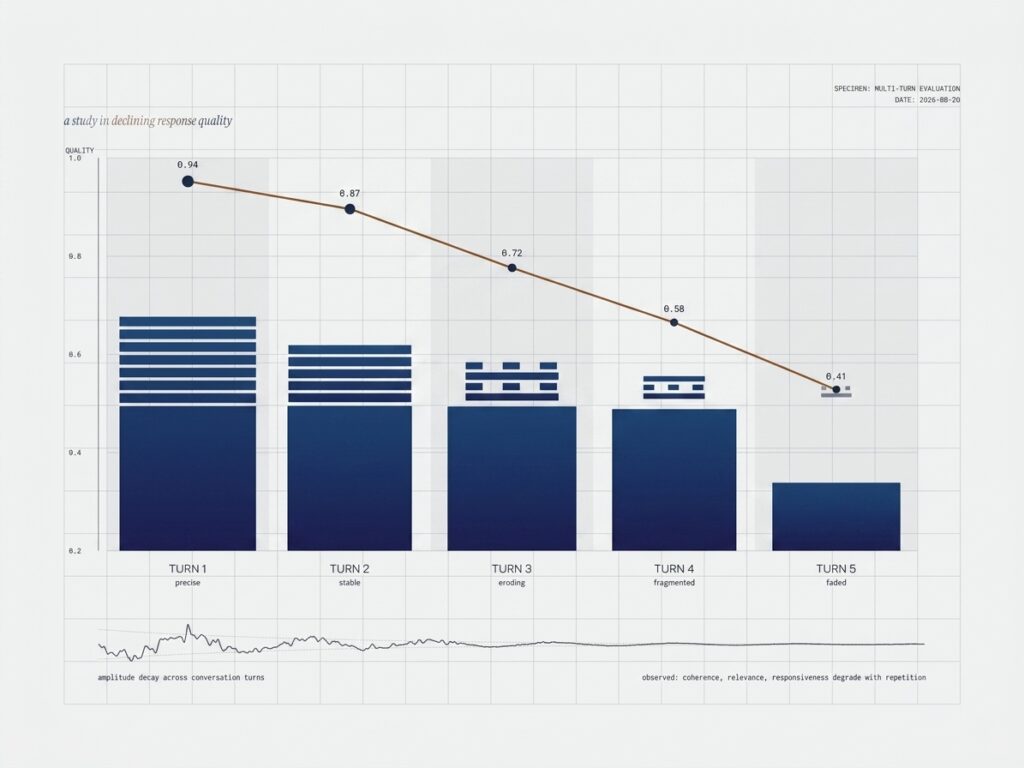
They need to be tested for context retention, instruction following, policy compliance, escalation accuracy, and resolution quality across complete interaction trajectories.
This article examines what single-turn testing consistently misses in conversational AI. It explains how multi-turn evaluation provides a more realistic measure of conversational agent performance across complete interactions.
Why Single-Turn Metrics Miss Conversational Failures
Single-turn testing evaluates a response against one prompt and its expected outcome. That approach is useful for measuring basic capabilities. However, it can be structurally limited when the system has to manage an evolving conversation. Many important failures emerge only when information, instructions, and decisions accumulate across turns.
- Memory and context loss is one of the clearest examples. A user may tell an agent that they are allergic to peanuts. Several turns later, the agent may recommend a meal that contains peanuts. The later response can appear relevant to the immediate prompt while still violating critical context from earlier in the conversation.
- Coherence and consistency gaps create another blind spot. An agent can provide individually plausible responses while contradicting information it gave earlier. It may also drift from its assigned role, tone, or instructions. Per-turn scoring does not evaluate these relationships between responses.
- Goal and outcome blindness is equally important. A conversation can contain accurate responses but still fail to resolve the user’s request. Turn-level metrics rarely determine whether the agent moved the interaction toward the intended end state.
- Tool and policy drift can also develop over time. An agent may select the correct tool initially but later use an inappropriate one, violate a policy, or take an action outside its role. Standard per-turn faithfulness or relevancy scores, including traditional metrics like BLEU or ROUGE, are designed to judge output quality against a reference, not to track behavior changing over time.
Research reinforces these limitations. A survey of dialogue evaluation methods found that automatic metrics often correlate weakly with human judgments in multi-turn QA because they tend to evaluate responses without fully accounting for the dialogue flow or alternative paths to the same outcome.
How Failures Compound Across Turns: The Mechanics of Conversational Degradation
The most important conversational failures are often not visible in a single response. They emerge when the agent has to carry information forward, respond to changing intent, recover from mistakes, or decide when a human should take over. AI agent trajectory evaluation exposes these failures before they affect production users.
A few recurring failure patterns show how small issues can accumulate and degrade an otherwise successful interaction:
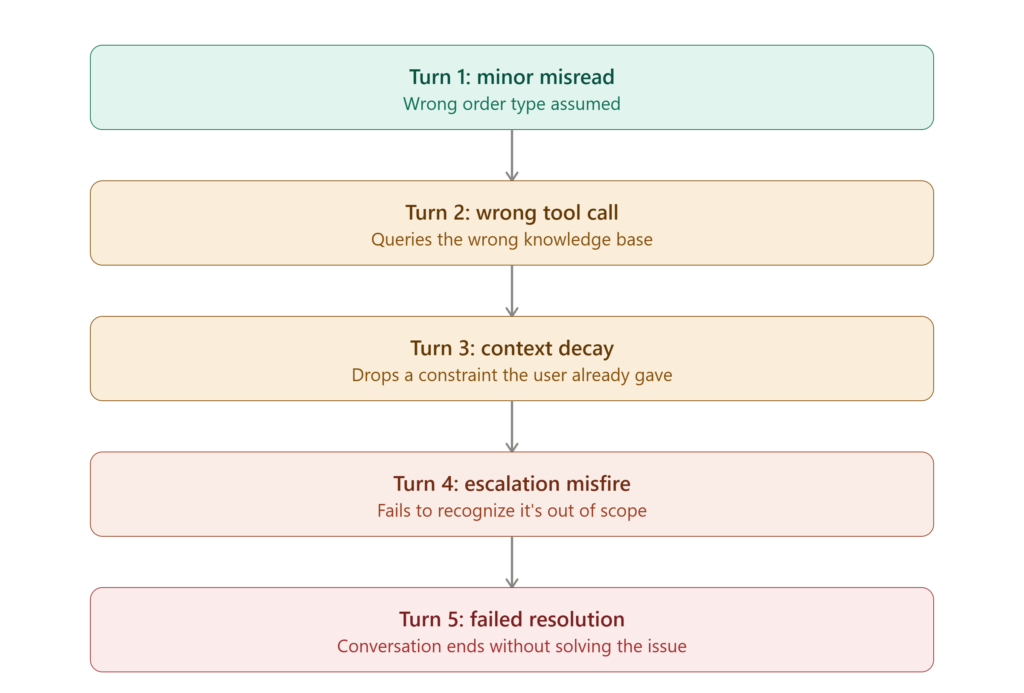
Error propagation:
A minor misunderstanding early in the conversation can trigger a chain of downstream errors. In the flight-booking scenario, if the agent fails to retain the customer’s loyalty status, it may apply the wrong fee-waiver policy. The final failure may appear several turns after the original mistake.Context decay:
As conversations become longer, agents may drop important constraints, re-ask for information already provided, or lose track of user preferences. For example, it may remember the new travel date but forget the customer’s loyalty status. These failures add friction and can reduce the likelihood of resolving the request within the same interaction.Escalation misfires:
Accumulated context loss or intent misclassification can cause an agent to escalate too early, escalate unnecessarily, or fail to involve a human when needed. Evaluating only the final response can miss the earlier decisions that led to the wrong escalation.Policy and safety drift:
An interaction may begin within policy but gradually move toward risky advice, inappropriate PII handling, or inconsistent brand voice. These violations may emerge only after several turns and become visible when the complete conversation trace is evaluated. This makes policy compliance in conversational AI a trajectory-level concern, as violations may emerge only after several turns.
Instacart’s engineering team saw this directly when building their LACE evaluation framework for a customer support chatbot. In one flagged conversation, the chatbot failed to maintain context when the customer asked to “continue where we left off,” instead repeating the same response and failing to advance the interaction. LACE identified these as failures in answer correctness and chat efficiency, showing how conversational problems can emerge across multiple turns.
A Practical Multi-Turn Evaluation for Conversational AI: How to Evaluate Them Across the Full Trajectory
Effective multi-turn evaluation for conversational AI requires a structured approach that measures quality at multiple levels. A practical framework assesses individual turns, complete conversation trajectories, and final outcomes.
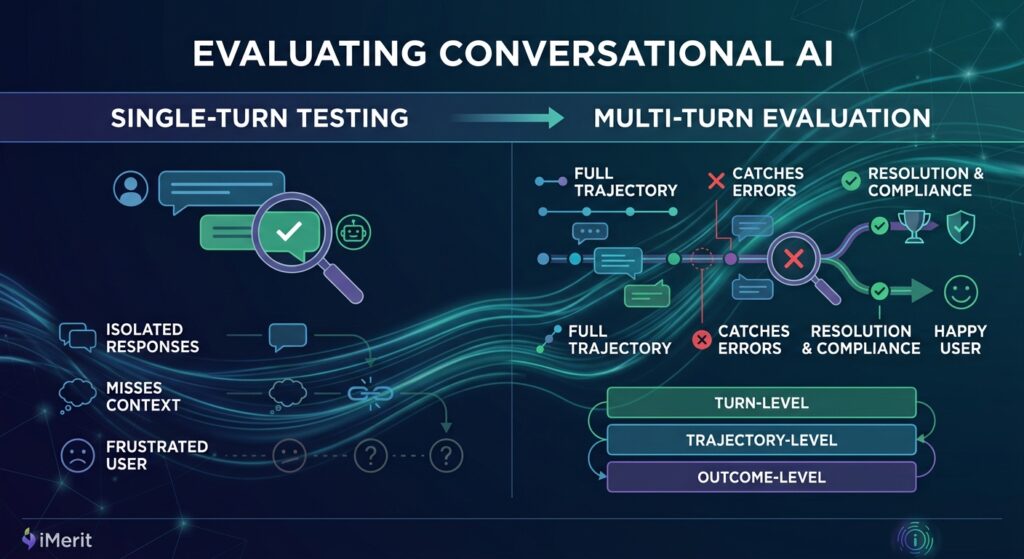
1. Turn-Level Evaluation
Turn-level evaluation examines each response in isolation. It answers questions about immediate quality.
- Is the response helpful?
- Is the tone appropriate?
- Is the information accurate?
- Does it follow formatting and policy requirements?
These checks are useful for identifying obvious errors. They can detect factual mistakes, unsafe content, or violations of brand guidelines. They are also efficient for regression testing. Teams can run large sets of single-turn tests to catch issues before deployment.
However, turn-level scores should not be averaged to estimate conversation quality. A high average score can hide serious trajectory-level failures. Turn-level evaluation is necessary but not sufficient.
2. Trajectory-Level Evaluation
Trajectory-level evaluation examines how responses work together. It assesses whether the agent maintains context, follows a coherent path, and uses tools correctly across multiple turns.
The following dimensions provide a practical way to assess these trajectory-level behaviors:
| Dimension | What to evaluate |
|---|---|
| Context retention | Does the agent remember and correctly use prior information? |
| Intent tracking | Does it follow changes and clarifications in user intent? |
| Consistency | Does it avoid contradicting earlier turns? |
| Recovery | Can it recover after misunderstanding or failed actions? |
| Escalation | Does it hand off at the appropriate point? |
| Policy adherence | Does compliance hold throughout the trajectory? |
| Conversation efficiency | Does it avoid unnecessary loops, repetition, and questions? |
These dimensions should be evaluated using structured rubrics, rather than a single pass/fail score. Rubrics make specific failure modes easier to identify and compare across conversations.
MultiChallenge provides a useful research precedent. Its evaluation uses instance-level rubrics designed around different multi-turn challenges instead of relying only on a general conversational quality score.
3. Outcome-Level Evaluation
Outcome-level evaluation measures whether the conversation achieved its intended result. It connects agent behavior to business metrics.
- Resolution quality: Did the agent satisfy the user’s stated goal by the end of the interaction?
- Escalation accuracy: Was the case handed off at the right time, through the right channel, with an accurate summary for the human agent?
- Policy and compliance: Did the agent maintain brand, safety, privacy, and regulatory requirements across the entire interaction?
- Business impact: Did the interaction improve metrics such as containment rate, mean time to resolution, customer satisfaction, and cost per resolved case?
This layer should also evaluate state changes and not just language quality. τ-bench provides a useful precedent by evaluating whether an agent correctly interacts with tools and produces the intended changes in the underlying system, for example, changing a reservation from confirmed to canceled. This helps distinguish a fluent conversation from one that actually completes the intended task.
These three layers together provide a more complete evaluation model. Turn-level checks identify local response errors. Trajectory-level evaluation reveals failures that emerge through interaction. Outcome-level evaluation determines whether the agent delivered the required result.
Why Human Review Still Matters in Multi-Turn Evaluation
The three-layer evaluation framework provides broad coverage, but not every aspect of a conversation can be judged reliably through automated checks alone. LLM-as-a-judge systems can score thousands of conversations against consistent criteria. They are useful for detecting common errors and monitoring changes over time. But some trajectory-level judgments still require human context and domain expertise.
Human reviewers can assess questions that automated metrics may struggle to capture:
- Did the agent understand the user’s actual goal? A response may be relevant to the latest message but miss the intent that developed across the conversation. For example, the customer asks to change a flight date but later adds a destination change. The agent may incorrectly handle only the date change.
- Was the escalation appropriate? Reviewers can determine whether the agent handed off too early, too late, or for the wrong reason.
- Was the policy handled correctly in practice? An agent may technically follow a rule while still applying it in a way that creates a poor or unsafe outcome. For example, it charges a change fee without recognizing a loyalty benefit.
- Did the conversation remain clear and efficient? Human reviewers can identify confusing explanations, unnecessary repetition, and conversational loops.
- How should ambiguous cases be scored? When the expected outcome is not obvious, domain expertise can provide the context needed for a defensible judgment.
None of these are metric problems. They’re judgment problems, and judgment is where trained human reviewers earn their place in the evaluation pipeline.
This is the operational gap iMerit can help close. More than 10,000 trained specialists across 15 delivery centers use structured rubrics to review conversation trajectories consistently, instead of relying on one-off human spot checks. iMerit’s domain-expert reviewer model, paired with enterprise-grade security certifications including SOC 2, ISO 27001, GDPR, and HIPAA, makes this workable even for sensitive customer support, voice AI, and enterprise chatbot data.
We applied this approach in an RLHF and model evaluation engagement with a leading social platform, where the challenge was to help an LLM-powered chatbot handle socially sensitive topics across diverse languages and perspectives, including unpredictable user interactions. We used structured human feedback to identify issues in model responses and feed those findings back into the improvement cycle, helping enhance conversational quality over time. This continuous feedback loop is important for effective trajectory-level evaluation in production.
Our Ango Hub platform helps operationalize this process through workflow design, automation, and analytics, supporting evaluation pipelines built around the trace-level scoring described above.
Building a Multi-Turn Evaluation Program for Production
A production evaluation program should be designed as an ongoing process of measurement and improvement. The goal is not simply to assign a score to an agent. It is to identify where conversations fail, why they fail, and what should change.
Teams can build a practical production program around five steps that connect evaluation findings to measurable improvements:
1. Define the intended conversation outcome
Establish what successful resolution means for each use case. This could mean completing a transaction, resolving a support issue, providing safe guidance, or escalating a case with the right context.
2. Map critical conversation trajectories
Build evaluation scenarios around realistic paths. Include normal requests, ambiguous inputs, changing user intent, adversarial prompts, tool failures, and escalation cases. This exposes weaknesses that scripted happy-path tests can miss.
3. Create dimension-specific rubrics
Score context retention, intent tracking, resolution, escalation, policy adherence, recovery, and conversational quality separately. Clear criteria make results easier to interpret and compare.
4. Combine automated checks with expert review
Use automated evaluation for high-volume and repeatable checks. Route ambiguous, high-risk, and high-impact trajectories to human reviewers. This balances scale with judgment.
5. Feed failures back into development
Evaluation should produce actionable failure categories. Teams can use these findings to refine prompts, update models and policies, improve tool design, and add regression tests for known failure modes.
The evaluation set should also evolve with the system. Production failures, new use cases, policy changes, and emerging attack patterns should continuously inform new test scenarios. This aligns with NIST’s approach to AI evaluation. The framework treats evaluation as an ongoing process for measuring system performance and risk rather than a one-time test before release.
Conclusion
Conversational agent evaluation helps determine how well agents handle an entire interaction, not just how well they answer individual prompts. Multi-turn evaluation for conversational AI helps teams identify compounding failures, improve reliability, and make better decisions about deploying agents in production. It also connects conversational quality to the outcome that matters, whether the agent actually resolves the user’s request.
Key takeaways
- Evaluate individual responses, complete trajectories, and final outcomes.
- Test how errors compound as conversations develop.
- Use structured rubrics to measure context, intent, consistency, recovery, escalation, and policy adherence.
- Combine automated evaluation with expert human review for ambiguous and high-impact cases.
- Continuously feed production failures into testing and agent improvement.
If you’re shipping customer support, voice AI, or enterprise chatbots, shift evaluation from single-turn dashboards to multi-turn, trajectory-level quality gates tied to resolution and compliance. Talk to iMerit for expert-led, multi-turn evaluation across full conversation trajectories, with structured rubrics and scalable human-in-the-loop operations.