Multimodal AI systems now process documents, images, speech, sounds, medical scans, 3D scenes, and video for autonomous vehicles, healthcare, robotics, content moderation, geospatial analysis, industrial inspection, and many other workflows.
Many teams assume that text, image, audio, and video annotation is the same job with different file types, and that a generic labeling workflow can handle everything. However, using the same labeling strategy across modalities produces inconsistent labels, weak ground truth, and downstream model errors. A strong data annotation strategy changes with the modality, defining the right annotation unit, label structure, workforce expertise, tooling, automation method, and quality metrics.
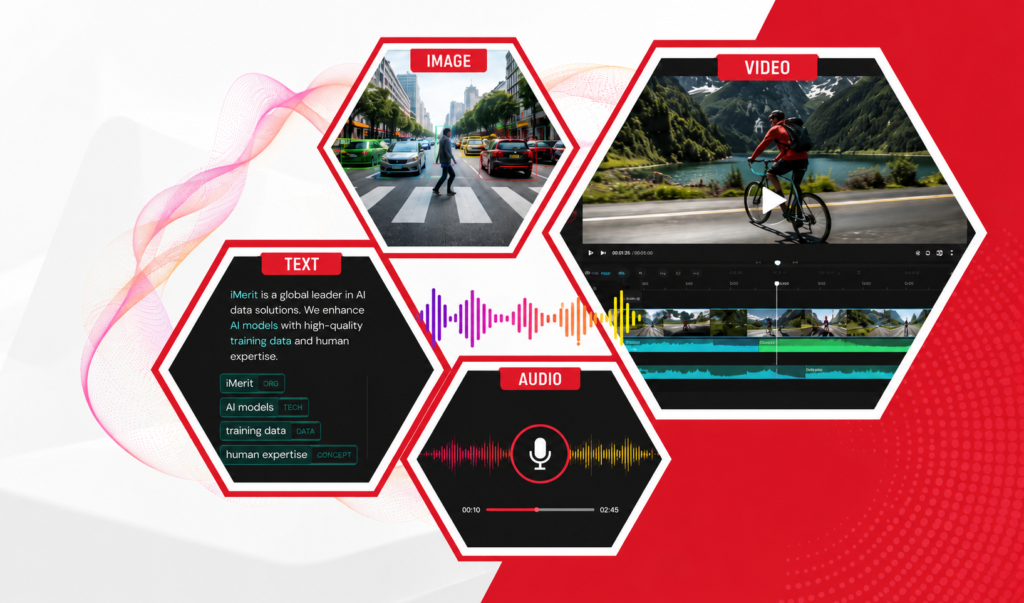
Why the Data Modality Changes the Data Labeling Problem
A data modality is the specific way information is presented to an AI model. Different types of data use different structures.
- Text uses words, syntax, semantics, and discourse. Meaning emerges from linguistic structure, context, and relationships between words and sentences.
- Images use pixels, shapes, positions, and spatial relationships, representing physical light captured by a sensor at a specific moment.
- Audio uses waveforms, frequency, timing, speech, and environmental sounds, capturing physical vibrations traveling through a medium over time.
- Video uses frames, motion, events, and temporal relationships, combining two-dimensional spatial arrays with a chronological time axis.
For example, an autonomous vehicle avoiding a pedestrian needs exact spatial boundaries from image annotation, while a chatbot detecting customer frustration needs text annotation that accurately captures intent and sentiment.
Text Annotation Requires Semantic and Contextual Judgment
Text annotation assigns structured labels to words, phrases, sentences, full documents, or whole conversations. Common tasks include named entity recognition (NER), intent classification, sentiment analysis, relation extraction, and preference ranking for generative AI systems.
- A document classification model needs a label for a full article, contract, or medical note.
- A sentiment model may use a sentence-level label.
- A named entity recognition model may need token or span-level labels.
- A chatbot evaluation workflow uses conversation-level labels for helpfulness, safety, relevance, or policy compliance.
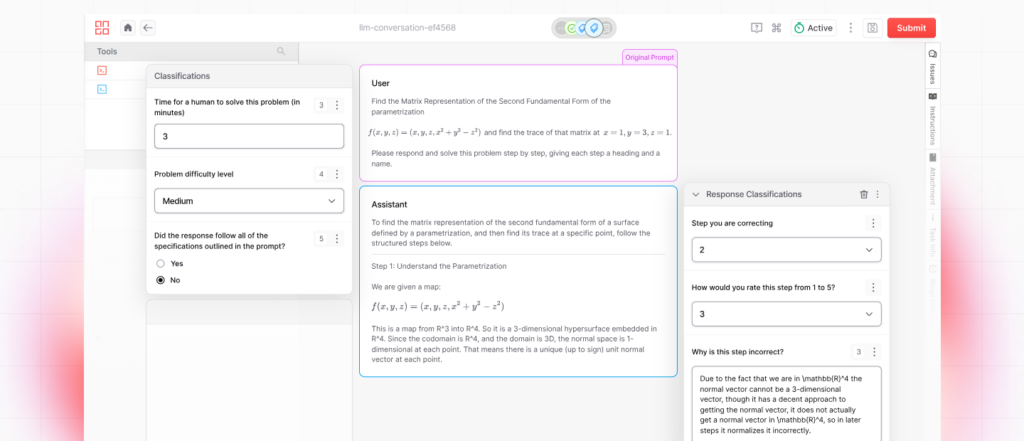
However, language is often ambiguous. Sarcasm, irony, negation, cultural references, and domain terminology can change the meaning of a sentence. Nested and overlapping entities add complexity, especially in medical, legal, and financial documents where multiple entities and relationships may appear in the same passage.
Multilingual text adds further difficulty: real-world conversations often include code-switching, regional expressions, transliteration, and mixed grammar, requiring annotators who understand both the language and the context.
Therefore, text annotation depends on linguistic, cultural, and domain expertise; simple classification may suit general annotators, but clinical, legal, and financial domains require trained specialists.
Quality assurance also changes by task. Some labels are objective: a person’s name either appears in a sentence or it does not – while others, like sentiment, emotion, intent, toxicity, relevance, and answer quality, require judgment. These subjective cases need clear annotation guidelines, multiple reviewers, agreement scoring, and adjudication for edge cases.
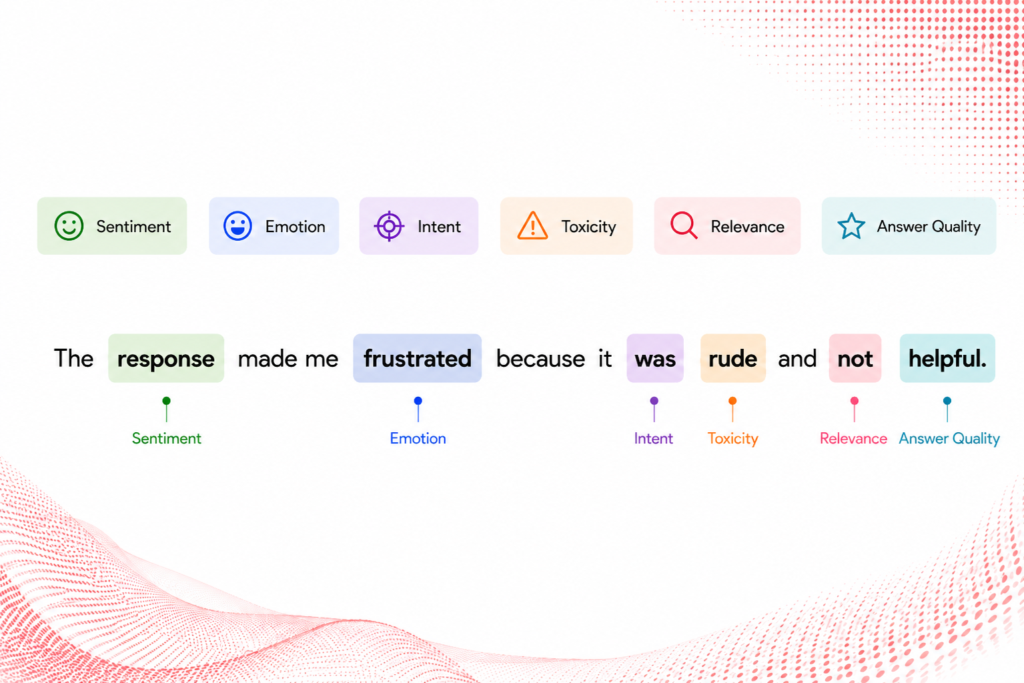
Image Annotation Depends on Spatial Precision
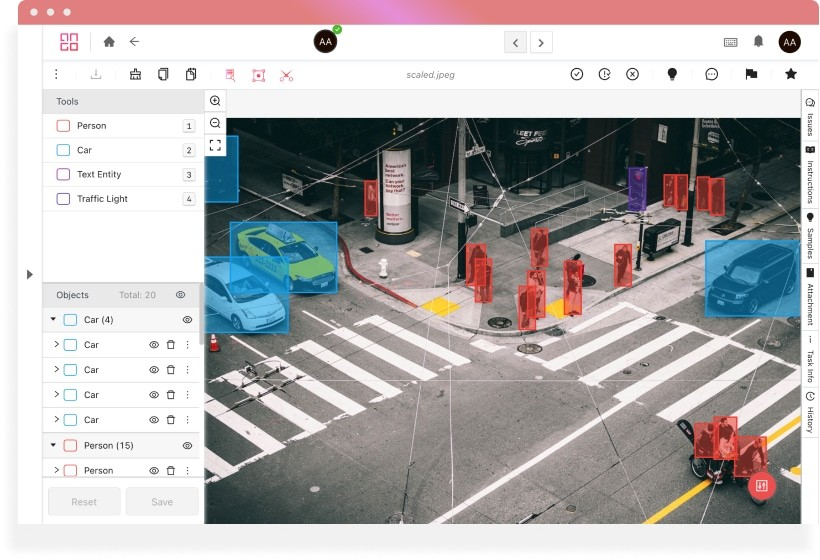
Image annotation identifies and labels objects, regions, structures, and spatial features in visual data. Different input formats change what spatial precision means and which annotation method is needed.
An object detection model needs an object’s location, an image segmentation model needs its exact boundary and a 3D perception model must learn depth, dimensions, and orientation.
- RGB and Multi-Camera Imagery: Autonomous vehicles, robotics, agricultural drones, and industrial inspection systems use camera imagery to capture dense visual information. Depending on the task, annotators use bounding boxes to locate objects, polygons for irregular shapes, segmentation masks for pixel-level boundaries, or keypoints to map structural locations such as human joints.
- Radar Outputs: Automotive systems use radar to measure object range, velocity, and spatial position, including under rain or fog. Radar annotation associates detections with object classes, tracks, or corresponding sensor data across time.
- LiDAR and 3D Point Clouds: Autonomous systems use LiDAR to represent depth, object geometry, and the surrounding environment in three-dimensional space. These datasets require 3D cuboids to capture object dimensions and orientation or point-level segmentation to assign a class to individual points.
- DICOM and Medical Imaging Data: Healthcare workflows process CT, MRI, X-ray, and other clinical images. Annotation often requires segmentation masks, polygons, or keypoints to identify precise anatomical structures, lesions, and clinical landmarks.
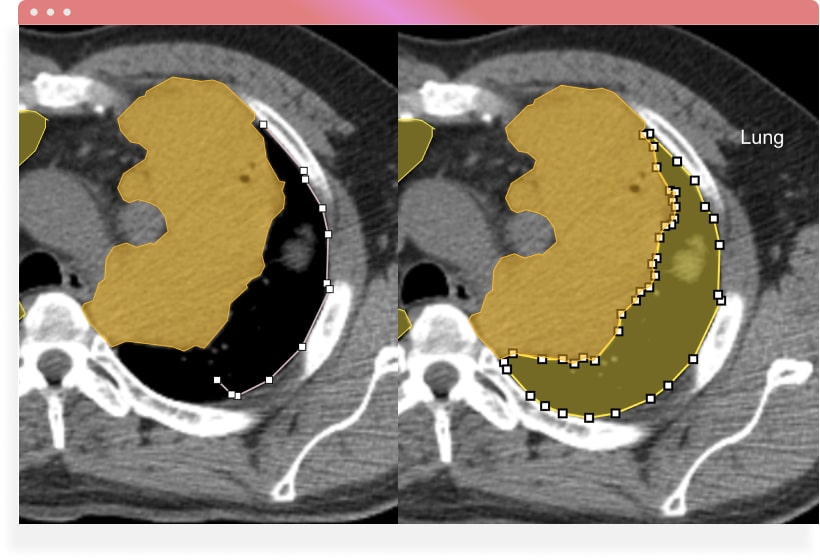
Physical-world complexities shape the annotation guidelines and quality controls. Occlusion, truncation, small or distant objects, crowded scenes, poor lighting, and blur can create inconsistent labels.
Guidelines must define minimum object size, boundary or box tightness, and occlusion handling.
Audio Data Annotation Requires Temporal and Acoustic Awareness
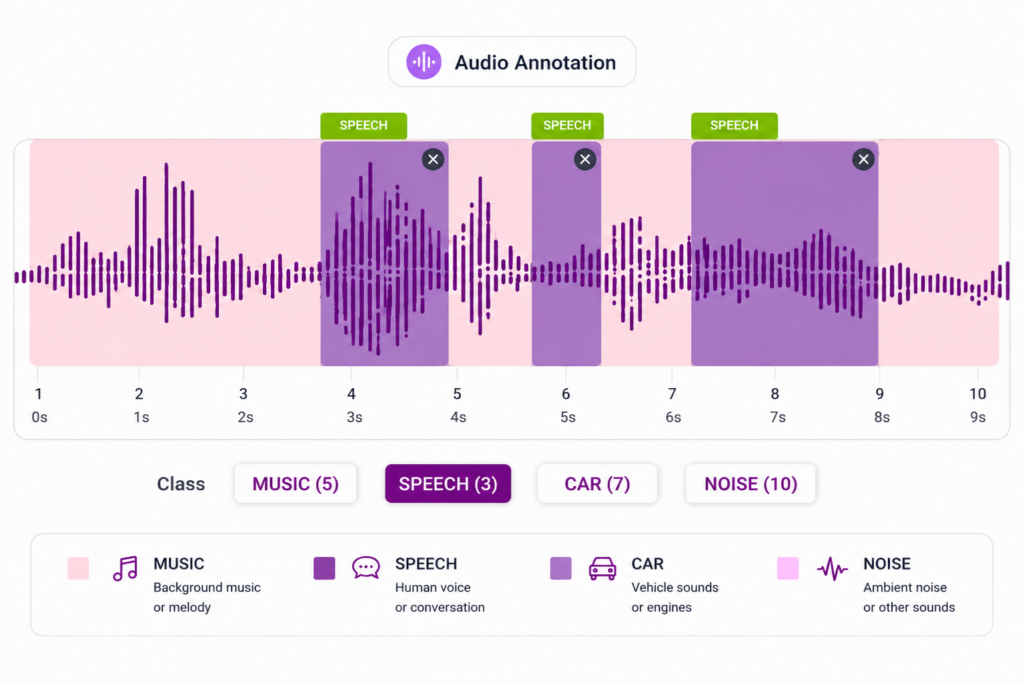
Audio carries layered information: what was said, who said it, how they said it (tone/emotion), when, and what non-speech events occurred (background noise, environmental sounds).
A speech recognition model needs spoken words and timestamps, while speaker diarization requires speaker boundaries. Emotion recognition focuses on tone, and sound-event detection requires the start and end times of specific sounds.
Common challenges shape the audio annotation strategy:
- Overlapping Speech: In real-world conversations, speaker turns and interruptions often lack clear boundaries, which makes it difficult to identify them accurately.
- Linguistic Complexity: Accents, regional dialects, and code-switching require native-language annotators and linguists to ensure high-quality transcripts.
- Acoustic Context: Background sounds such as traffic, machinery, or alarms require project-specific rules that define which sounds to label as relevant events and which to treat as noise.
Annotation guidelines must specify timestamp granularity, silence and pause treatment, filler handling, and overlapping speech rules. Success also depends on annotators with the right expertise.
Video Annotation Requires Spatial-Temporal Consistency
Video annotation labels objects, actions, events, and behaviors across a sequence of frames. Unlike a standalone image, each frame connects to the frames before and after it, as objects move, disappear, reappear, overlap, and interact over time.
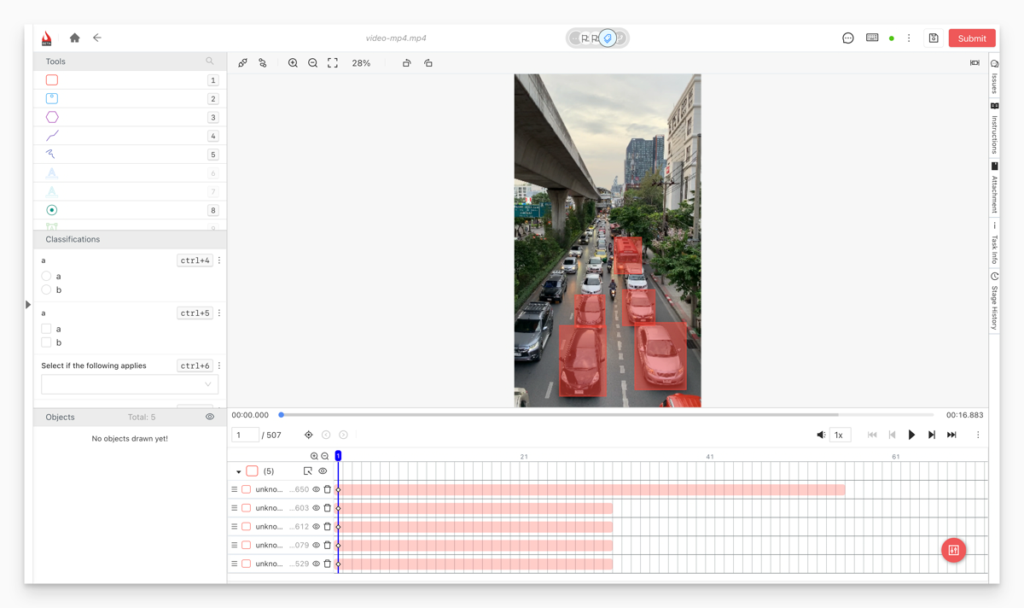
A multi-object tracking model for autonomous mobility needs persistent object identities across frames, while an object action recognition model needs the exact start and end times of a behavior. Similarly, a video instance segmentation model requires pixel-level boundaries that adapt as the object changes shape over time.
The primary challenge is maintaining spatial-temporal consistency. A label must remain spatially accurate in every frame and temporally consistent across the entire clip. If a car receives one ID in frame 10 and a different ID in frame 20, the model learns the wrong object continuity.
Dynamic visual changes require specific annotation rules:
- Occlusion and Visibility: Objects constantly enter, exit, or become obscured by other elements. Guidelines must state when to start or end a track, and whether an ID persists when an object is temporarily blocked.
- Identity Switches: Objects crossing paths, common in traffic or retail scenes, easily confuse tracking algorithms. Workflows require strict reviewer checks to maintain persistent IDs.
- Event Boundaries: Actions unfold over time. Simple clip-level labels often lack detail, requiring precise frame-level boundaries to capture exactly when an event begins and ends.
How iMerit Builds Modality-Specific Data Annotation Workflows
Each modality requires a workflow tailored to its annotation unit, context requirements, domain complexity, and quality risks. And iMerit builds modality-specific data annotation workflows to meet these requirements:
Expert-Led Text Annotation
iMerit provides text annotation services and tools to build high-quality text datasets for NLP, conversational AI, LLM evaluation, or generative AI workflows.
For expert-heavy work, iMerit Scholars brings in subject matter experts, including medicine, STEM, psychology, linguistics, and law; for subjective labeling, prompt-response evaluation, model correction, and other tasks where surface-level annotation isn’t enough.
- Case Study: American Ancestors partnered with iMerit to digitize and index more than 1,300 books of sacramental records from 1789 to 1900. The project’s scale exceeded their traditional volunteer-led approach, so iMerit’s specialists handled the handwritten text annotation, turning the archive into searchable database of over 14 million names.
High-Precision Image Annotation
iMerit helps optimize visual data pipelines using image annotation services tailored to the required spatial precision. Its capabilities span object detection, classification, segmentation, keypoint annotation, LiDAR data annotation, and 3D cuboids. This supports complex visual domains, including autonomous systems, DICOM and medical imaging analysis, geospatial AI, and industrial inspection.
iMerit Ango Hub also supports AI-assisted pre-labeling, including AutoDetect and OCR, to reduce repetitive manual work, while multi-stage QA supports consensus review, benchmarking, and adjudication.
- Case Study: iMerit helped an agricultural AI team process more than 4.5 million images across 40 crop types to improve weeding robots, validating pre-labels and running calibration sessions to resolve overlapping crops and weeds; delivering 98.42% accuracy and better generalization across farms.
Time-Aligned Audio Annotation
The audio annotation workflow supports transcription, diarization, sound-event labeling, emotion annotation, and precise timestamp alignment. Native-language and domain-specialist annotators handle noisy or multilingual recordings for iMerit’s audio annotation workflow.
- Case Study: iMerit helped a Healthcare AI startup boost agent performance by 56% and cut QA staffing needs by 70%.
Frame-Accurate Video Annotation
iMerit can help you build a scalable, model-ready video annotation workflow for faster annotation of suitable footage. It supports bounding boxes, polygons, keypoints, landmark annotation, semantic segmentation, 3D cuboids, polylines, and video interpolation.
Ango Hub adds the workflow layer for workflow automation, multi-stage quality checks, and transparent quality auditing. This helps teams manage edge cases such as partial occlusions, ambiguous object states, unsafe motions, and new behaviors that appear during annotation.
Conclusion
Text, image, audio, and video data require different data annotation strategies due to their unique characteristics and challenges. Combining automated workflows with domain-specific human expertise helps teams maintain semantic accuracy, spatial precision, temporal alignment, and label consistency across modalities.
Contact our experts today to discover how our tailored annotation services can accelerate your AI development!