Sub-second latency doesn’t make voice AI feel natural, accurate turn-taking does. This piece explains why silence-based endpointing fails, and how time-aligned annotation of pauses, overlaps, interruptions, and backchannels gives voice agents the conversational context needed to know when a speaker has actually finished.
A voice agent can respond in a fraction of a second and still feel slow, awkward, or interruptive if it does not know when the user has finished speaking. Consider a user saying, “I need to change my appointment to…” and pausing for 300 milliseconds to check the date. If the agent interprets that pause as the end of the turn and responds, “Sure, what day?”, it may cut the user off. The problem is not response latency, it is turn-taking accuracy.
This is one of the central challenges in real-time voice AI. A natural voice agent needs to balance response speed with turn-taking accuracy: it must respond quickly when the user has finished, but continue listening when a pause is part of an unfinished thought. Recent research makes this tradeoff measurable. In June 2026, LiveKit’s end-of-turn evaluation showed that reducing response latency can increase false cutoffs, while allowing more time can reduce them.
This article explains why low latency alone cannot solve turn-taking problems and how better turn-taking data for voice AI can help models distinguish pauses, turn endings, overlaps, and interruptions with greater accuracy.
Why Low Latency Does Not Guarantee Natural Turn-Taking
Low latency and natural turn-taking are related, but they are not the same problem. A voice pipeline can reduce delays in automatic speech recognition (ASR), model inference, network transport, and text-to-speech (TTS). But these optimizations only make the system faster after it has decided to respond. They do not determine whether the user has actually finished speaking.
A faster ASR system can transcribe a pause sooner, a faster model can generate a response sooner, and faster TTS can speak it sooner, but none of these improvements tell the agent whether that pause is a true end-of-turn or a moment when the user is still thinking. Responding quickly to the wrong endpoint only makes the interruption happen sooner.
The key distinction is between a true end-of-turn and an intra-turn pause. A true end-of-turn means the speaker has completed their thought and is yielding the floor. An intra-turn pause occurs when the speaker is temporarily silent but intends to continue. Silence alone cannot reliably distinguish the two.
A speaker may pause to think, search for a word, correct themselves, emphasize a point, or decide how to continue. They may also use a filler such as “um” or “well” before completing the thought. A system that treats every short pause as an endpoint will often speak before the user is ready.
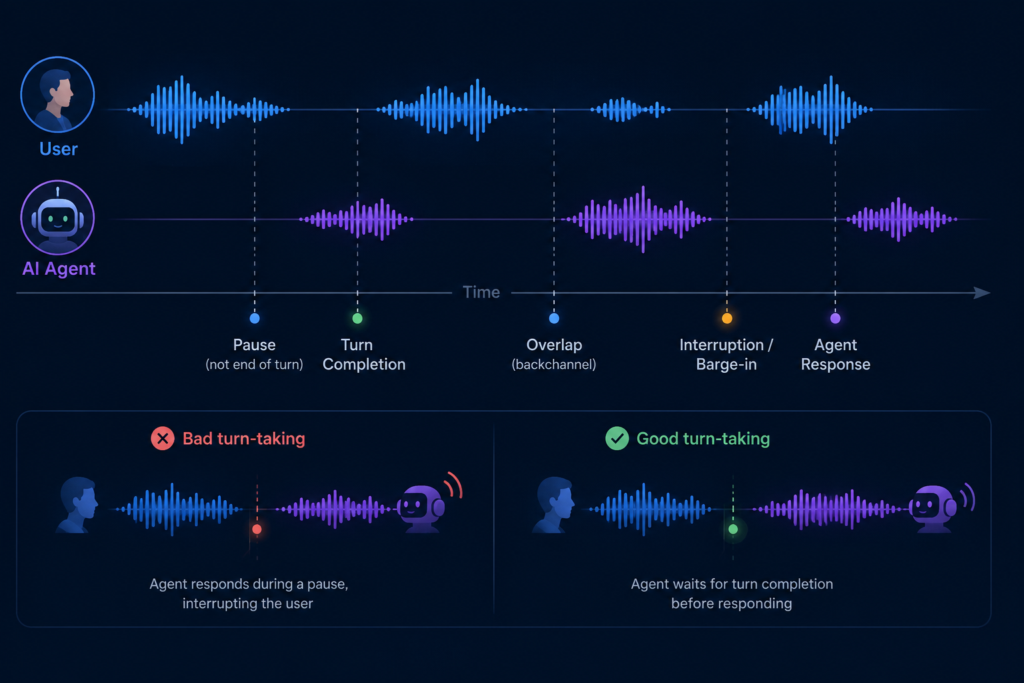
Human conversation shows why this distinction matters. Research across conversational datasets has found that speaker transitions often happen with very short gaps. A large analysis of the CANDOR corpus found a median between-speaker interval of just 80 milliseconds, with both gaps and overlaps forming a normal part of conversation.
This makes a simple silence threshold a poor proxy for turn completion. The system needs to combine acoustic cues with linguistic and conversational context to distinguish an intra-turn pause from a genuine end-of-turn detection. It also needs a separate mechanism for detecting when the user intentionally starts speaking while the agent is talking.
Production systems are moving toward this distinction. Amazon Connect’s current agentic voice guidance describes end-of-turn confidence as the primary signal for deciding that a caller has finished, while a silence timeout acts as a fallback. Amazon also notes that lower thresholds can reduce response time but increase the risk of cutting callers off.
This shows a key tradeoff in voice AI. Lower voice agent latency makes them faster, but accurate voice AI turn-taking makes them feel natural. Improving both requires data that captures pauses, completed and unfinished turns, and interruptions in real conversations.
What Goes Wrong When Turn-Taking Data for Voice AI Is Poor
Poor turn-taking data can create problems even when the underlying speech recognition and language models perform well. If the training data does not clearly distinguish pauses, turn endings, overlaps, and interruptions, the system has fewer reliable signals for deciding when to speak or stop. Research on conversational systems identifies recurrent interruptions and delayed responses as persistent turn-taking problems. The following table describes the common failure modes that can occur due to poor turn-taking data.
iMerit's Role in the Partnership
What started as a five-person proof of concept in 2020 grew into a multi-year engagement supporting over 80 trained specialists. Multi-layer quality review systems kept accuracy consistent as the volume of labeled data grew, and iMerit worked directly with Carbon Robotics to improve the annotation tools themselves, introducing pre-labeling, magnification, and workflow simplification that made each annotation faster without sacrificing accuracy. That collaboration is detailed further in iMerit’s precision weeding case study, which covers the full arc from early labeling work to the scale needed for a plant foundation model.
| Failure mode | Description | Example |
|---|---|---|
| Cutting users off | The system interprets a short pause as the end of a turn. It starts responding before the user has finished their thought. | User: “I wanted to change my flight because…” Agent responds: “Sure, I can help with that.” |
| Waiting too long | The system requires too much silence before deciding that the user has finished. This creates an awkward delay. | User: “I’d like to book a flight to London.” Agent: “…” User: “Hello?” Agent: “Sure, I can help you book that flight.” The agent waits noticeably after the user has finished speaking. |
| Treating every overlap as an interruption | The system treats any simultaneous speech as an attempt to take the floor, even when the second speaker is only acknowledging or encouraging the speaker to continue. |
User 1: “I was thinking about moving the meeting to—” User 2: “Yeah, that could work.” User 1: “—Thursday instead.” The speech overlaps, but User 2 is acknowledging the speaker rather than trying to take the floor. |
| Mishandling genuine interruptions | The system fails to recognize when the user is deliberately taking the floor. It may continue speaking instead of yielding. | Agent: “Your appointment is scheduled for Tuesday at” User: “Wait, change that to Thursday.” Agent: “10 a.m. Would you like me to send a confirmation?” The agent ignores the interruption instead of stopping, processing the correction, and responding to the user's new request. |
| Making fast responses feel robotic | Training data overemphasizes immediate responses without capturing natural pauses, hesitation, and conversational timing. The agent responds before the user has fully finished or before a natural response interval has elapsed. | User finishes speaking. Agent responds almost instantly every time, creating a rushed, mechanical interaction. |
The problem is not simply that these systems respond too slowly or too quickly. They respond at the wrong conversational moment because the training data has not captured those moments accurately. Poor end-point labels can cause premature responses; missing overlap and backchannel distinctions can trigger unnecessary interruptions; and inconsistent timing labels can produce either awkward delays or unnaturally fast responses.
This is why turn-level audio annotation needs to capture more than speech boundaries. It needs to represent what happened at each boundary and why. That gives the model a stronger signal for deciding whether to speak, wait, continue, or yield.
What Good Turn-Taking Annotation Actually Requires
Labeling conversational structure is a different task from standard transcription. It asks annotators to judge intent and timing and not just write down words. That requires a turn-level schema built around timing and conversational intent.
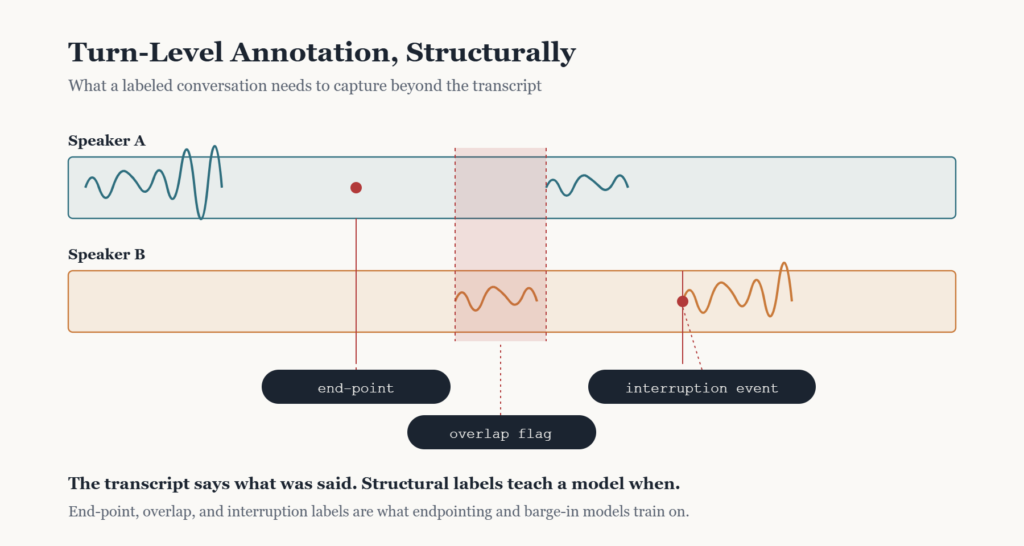
The value of this schema comes from applying these labels consistently to real conversational events. Four areas require particular care during annotation.
Define a turn-level schema
A consistent schema gives annotators a shared framework and makes the resulting data easier to use for training and evaluation. The following is an example:
| Annotation | Purpose |
|---|---|
| Speaker ID | Identifies who owns the turn |
| Start timestamp | Establishes when the turn begins |
| End timestamp | Establishes the actual turn boundary |
| Within-turn pause | Separates hesitation from turn completion |
| Overlap | Identifies simultaneous speech |
| Interruption | Identifies an attempted floor transfer |
| Backchannel | Separates listener feedback from a new turn |
| Barge-in outcome | Shows whether an interruption successfully stopped the other speaker |
These labels work together to capture the temporal structure of a conversation. The most important components are end-point detection, overlap and interruption handling, and the contextual factors that influence turn timing.
Apply Labels to Time-Aligned Audio
Annotators review the audio, waveform, and transcript together to identify speaker changes and conversational events. They mark precise start and end timestamps, then apply labels for pauses, overlaps, backchannels, and interruptions based on the surrounding context.
Ambiguous cases should follow predefined decision rules rather than individual judgment. When an event remains unclear, annotators can flag it for review or adjudication. Quality checks can then compare labels from a second annotator on a sample of recordings, helping identify recurring disagreements and refine the guidelines before scaling annotation across the dataset.
End-Point Labeling
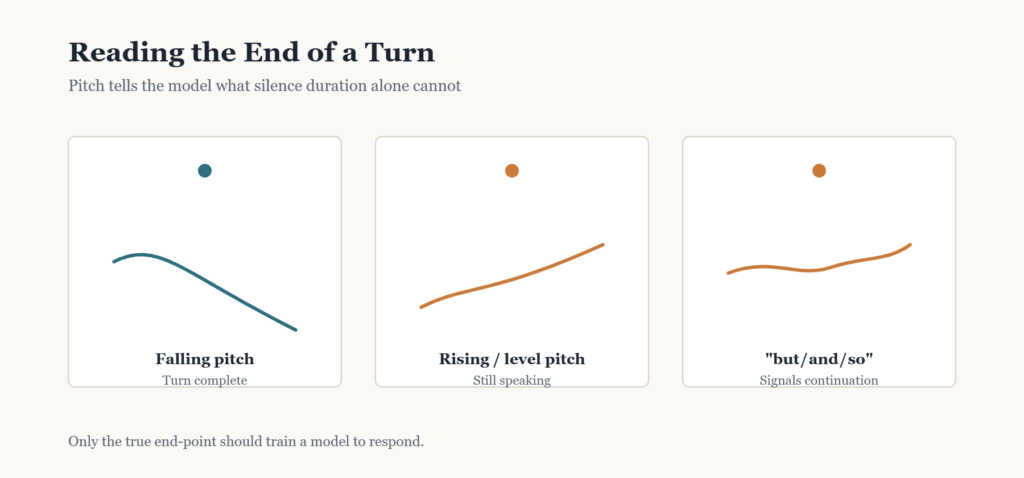
End-point labeling marks the true end of a semantic or intentional turn. It is not the same as the last audible word. Annotators must distinguish between:
- A completed utterance with falling intonation.
- A mid-thought pause with rising or level intonation.
- A hesitation before additional information.
- A conjunction like “but,” “and,” or “so” that signals continuation.
LiveKit’s EoT-Bench provides a useful example of this approach. Its dataset contains real human-agent conversations in 14 languages and marks pauses of at least 100 milliseconds. The final pause in a turn is labeled as the true end, while earlier pauses are treated as mid-turn hesitations that the agent should continue listening through.
Overlap and Interruption
Overlap also needs more structure than a simple “both speakers are talking” label. Human conversations contain brief overlaps that are not necessarily interruptions. A listener may say “yeah,” “right,” or “okay” while the other person continues. These backchannels serve a different function from an attempt to take the floor.
Research by Levinson and Torreira found that overlaps are common but generally brief, with many involving backchannels, simultaneous starts, or disfluencies rather than competitive interruptions.
For voice AI, this distinction is important. If every overlap is treated as a barge-in, the agent may stop speaking when the user was only acknowledging what it said. Annotation should therefore identify whether the overlap is a backchannel, genuine interruption, or non-competitive simultaneous speech.
Context and Speaker Variation
Turn timing also varies across speakers, languages, and interactional settings. A 2025 review of turn-timing research found that factors such as pragmatic context and the structure of the preceding utterance can affect when a response is perceived as appropriately timed.
A fixed pause duration cannot reliably define the end of every turn. Training data therefore needs to capture the context around each pause, including aligned audio and transcripts, speaker identity, precise timestamps, and labels that distinguish completed turns from mid-turn pauses and overlaps. These details give models the temporal context they need to learn when a speaker has actually finished and when the conversation should remain open for another utterance.
This variation also has implications for annotation. Guidelines should account for differences in accents, speaking styles, languages, and conversational contexts so that annotators do not apply a single timing pattern as the definition of a completed turn. Consistent contextual labeling helps ensure that the resulting dataset reflects how turn-taking varies across speakers and interactions.
The goal is not simply to mark where speech stops. It is to capture what the pause, overlap, or interruption means within the conversation and apply that interpretation consistently across the dataset.
How iMerit Ango Hub Helps Build Turn-Level Audio Data for Voice AI
iMerit Ango Hub can support this process by bringing speech labeling, transcription, speaker identification, and time-based annotation into a single workflow. Rather than treating a recording as one continuous stream, teams can apply the same turn-level schema described above directly to enterprise audio. That means marking speaker-turn boundaries, overlaps, interruptions, barge-in outcomes, and within-turn pauses, with consistent guidelines and quality checks holding that labeling steady across large datasets.
The quality of these labels becomes particularly important when the audio is difficult to interpret. Accents, background noise, domain-specific terminology, unclear speech, and simultaneous speakers can make automated labels unreliable. Model-assisted annotation can handle routine cases, while human reviewers can examine ambiguous segments and correct the labels. Consistent guidelines and quality checks help maintain the same annotation standards across larger datasets.
For voice AI teams, this workflow can create structured, time-aligned ground truth that captures not only what speakers say, but how they take turns. Precise boundaries, overlap and interruption labels, and within-turn pause annotations give models information about when a speaker has actually finished, when a pause is part of an ongoing thought, and when overlapping speech represents a genuine attempt to take the conversational floor.
iMerit has applied a similar approach to conversational data in a digital scribe engagement for a major software vendor. The team transcribed and annotated 350 clinical conversations, using Ango Hub to build structured training datasets. After the data was incorporated into the model, quality checks showed a 37% improvement in speaker identification, reaching 98% interpretive accuracy. Physicians using the digital scribe also gained back an average of four hours of clinic time per week, an 11% improvement in patient-facing time.
iMerit’s expert-led workflows and enterprise security practices, including SOC 2, ISO 27001, GDPR, HIPAA, and TISAX, also support programs involving sensitive voice and conversational data. For voice AI, the objective is not simply to produce cleaner transcripts. It is to create time-aligned ground truth that represents how speakers interact. That gives models information about when to keep listening, when to respond, and when to yield the floor.
Conclusion
Sub-second latency is essential to making voice AI responsive, but speed alone does not make a conversation feel natural. An agent also needs to understand when a speaker has finished, when a pause is part of an ongoing thought, and whether overlapping speech represents an interruption or a simple backchannel.
That understanding depends on better turn-taking data. Precise, time-aligned annotations of end-points, overlaps, and interruptions give voice AI systems the conversational context needed to respond at the right moment; not simply the fastest possible one.
For teams building more natural voice agents, the next step is not just reducing milliseconds. It is building better data around when and how people actually take turns speaking.
Key Takeaways
- Low latency alone does not create natural voice AI. Agents must also know when a user has finished speaking before responding.
- Voice AI turn-taking data captures conversational timing. Endpoints, pauses, overlaps, interruptions, and barge-ins provide structure that transcripts alone cannot.
- Pauses need context. A short silence can indicate hesitation, a self-correction, or a completed turn. Treating every pause as an endpoint can cause premature responses.
- Human-reviewed voice AI annotation remains important. Ambiguous overlaps, interruptions, accents, and noisy audio require contextual judgment and consistent quality controls.
- Voice AI annotation teams should optimize for timing and accuracy together. The goal is not simply to make agents respond faster, but to help them respond at the right conversational moment.
If you are working on a voice agent and struggling with premature responses or unreliable interruption handling, Talk to iMerit about building the turn-taking data your models are missing.