Industrial robots can fail in production when rare combinations of object pose, lighting, sensor state, and workcell conditions are missing from training data. Robot triage validates these failures, ranks them by risk and learning value, groups them into failure families, and routes them to the right human reviewers.
A robot can pass thousands of testing cycles during development yet fail in production when unexpected conditions combine, such as minor pose shifts, vision glare, vacuum pressure drops during a grasp, or force deviations. Individually, none of these conditions has to be unusual, but together they can cause failure.
For example, this paper on robotic assembly, screwing, and manipulation notes that out-of-distribution states can cause unpredictable behavior or task failure and uses force and torque temporal data to detect unexpected physical interaction states.
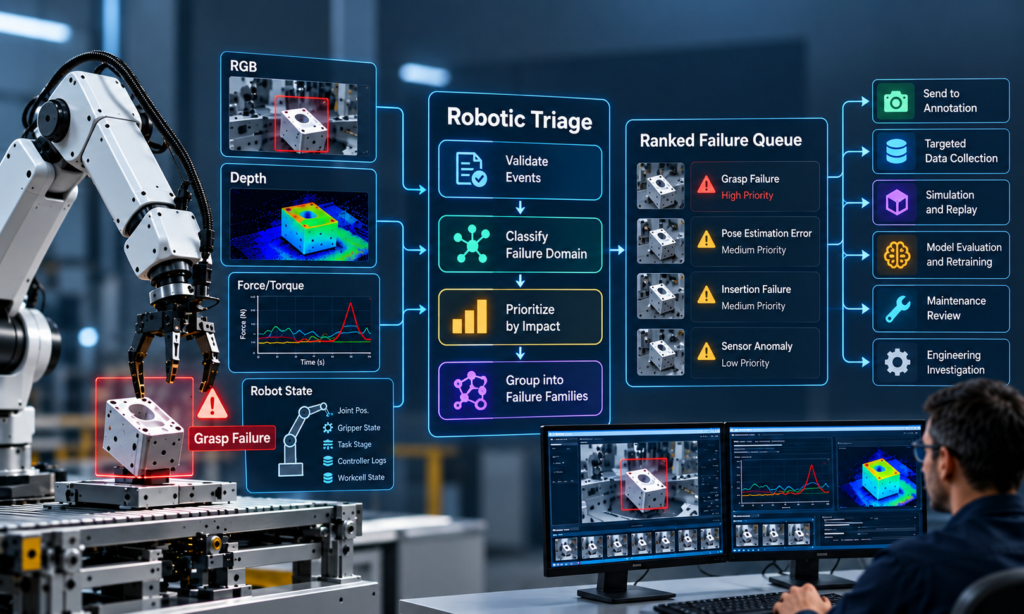
So, any deployed autonomous system beyond autonomous vehicles faces these rare events (long-tail edge cases) that were not sufficiently represented during development and validation. Autonomous vehicle teams use triage to manage this long tail by ranking rare driving events by risk and investigation value, grouping related events into scenario families, and routing them to the reviewers best equipped to determine what happens next.
Industrial robotics can apply the same triage logic to production failures across perception, manipulation, sensing, motion control, tooling, and the surrounding workcell. A robot triage framework validates potential failures, determines their significance, groups similar occurrences, prioritizes them, and routes them to the appropriate human reviewers.
This blog explains how robotics teams can build a robotic triage pipeline that turns production failures into ranked, actionable evidence and uses tiered human review to feed high-value cases back into model development.
Why Industrial Robot Deployments Create a Long-Tail Failure Problem
Production environments expand the combinations of physical, perceptual, and system states a robot must handle. The resulting failures are often difficult to isolate because the observable outcome may be several steps downstream from the condition that caused it.
- Perception failures can originate from distribution shift. Changes in illumination, background, material reflectivity, occlusion, camera viewpoint, or object pose can degrade detection, segmentation, depth estimation, or 6D pose estimation. These changes may occur without producing an obvious sensor fault.
- Manipulation failures are often visible in contact signals before task failure. A suction cup may achieve initial contact but lose vacuum during acceleration. An insertion trajectory may remain geometrically valid while force and torque measurements show binding or misalignment.
- Sensor anomalies can resemble model failures. Calibration drift, intermittent depth dropout, encoder disagreement, noisy force measurements, or timestamp misalignment can change model inputs without producing an explicit hardware fault.
- Workcell state changes the meaning of robot behavior. Conveyor timing, fixture position, PLC state, tooling condition, object availability, and operator interaction can determine whether an otherwise valid motion succeeds. Reviewing robot telemetry without this surrounding state can produce the wrong root-cause hypothesis.
- Long-tail failures are frequently combinatorial. “Grasp failure” is only an outcome label. The actual failure family might be specific package material + rotated object pose + partial depth dropout + low vacuum margin.
- Successful cycles overwhelm the failure signal. Reviewing logs chronologically or sampling uniformly allocates most review capacity to behavior the system already handles well.
- Robot anomaly detection alone does not provide a remediation decision. A threshold violation, reconstruction error, controller alert, or model-uncertainty score can surface a candidate event. It does not establish whether that event represents a perception gap, manipulation weakness, sensor problem, process variation, hardware issue, or isolated noise.
The robotics data challenge is therefore to identify production events that reveal repeatable capability gaps and the evidence needed to address them.
How a Robot Triage Program Identifies and Prioritizes Production Failures
Like autonomous vehicle triage, a production robotic triage pipeline reduces a large stream of robot alerts, task failures, and anomalous sensor events into evidence-complete cases. Each qualified case receives a failure type, priority, and downstream disposition.
Capture the Complete Failure Window
The robot triage pipeline captures a synchronized event window from the pre-failure state to task outcome. Depending on the robot and task, the event record can include:
- RGB or RGB-D frames
- object detections, masks, or pose estimates
- model confidence and model version
- joint position, velocity, and torque
- force and torque measurements
- gripper position, pressure, or vacuum state
- commanded and executed trajectories
- final task outcome
The event record retains timestamps and calibration state so reviewers can distinguish genuine model or sensor disagreement from data misalignment. This temporal context also helps identify failure precursors that appear before the task-level failure is registered.
Validate the Event and Assign a Failure Domain
Before prioritization, candidate events need an eligibility check. Exclude or separately tag duplicate triggers, incomplete event windows, corrupted sensor streams, scheduled maintenance states, expected safety stops, planned operator interventions, and monitoring false positives.
Qualified events can then receive a preliminary failure-domain label based on the available evidence. Typical domains include perception, sensing, manipulation, motion and control, hardware, process, and workcell integration. Cases spanning multiple subsystems or lacking sufficient evidence for an initial classification remain cross-system or unresolved and move to deeper review.
Maintaining an unresolved class prevents new failure signatures from being forced into the nearest existing category, where their recurrence would be spread across unrelated classes and harder to detect.
Prioritize by Risk, Coverage, and Learning Value
The triage pipeline prioritizes each qualified event by combining operational consequence with evidence of insufficient coverage for the observed condition. Relevant signals include:
- Safety severity: Potential impact on operators, equipment, or surrounding systems.
- Production impact: Downtime, rejected parts, cycle interruption, or throughput loss.
- Recurrence: whether similar events are appearing across cycles, robots, stations, or sites.
- Novelty: Degree of similarity to, or deviation from, previously validated failure families.
- Model evidence: Prediction errors, confidence levels, uncertainty, or disagreement between models or sensor-derived estimates.
- Coverage deficit: Representation of the relevant conditions in training, validation, and regression datasets.
- Root-cause ambiguity: Whether the evidence points to one subsystem or several.
- Expected learning value: Whether resolving the case could improve a repeatable model or system weakness.
Consolidate Events Into Failure Families
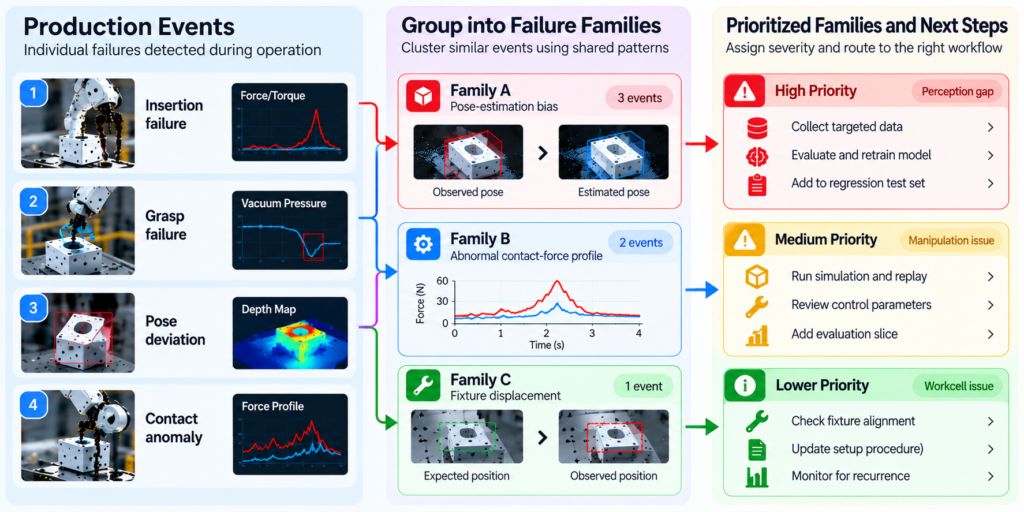
Prioritization at the individual-event level still creates redundant investigation when multiple alerts share a root cause. So, cluster qualified events using evidence such as task phase, object class and pose, perception outputs, trajectory deviation, gripper state, robot configuration, workcell conditions, and observed outcome. Each resulting failure family can carry:
- representative event windows,
- occurrence count and deployment distribution,
- severity and priority,
- training and regression coverage,
- suspected subsystem,
- and recommended downstream disposition.
The final triage output is a ranked failure queue with attached evidence, ready for annotation, data collection, replay, model evaluation, maintenance review, or root-cause investigation.
How Triaged Robot Failures Move Into Human Review and Model Improvement
Once failures are prioritized, the robot triage result determines the review path. Perception or coverage gaps can move to annotation, targeted data collection, model evaluation, or retraining, and reproducible manipulation failures can move to simulation or replay. Previously observed failures can become regression tests. Mechanical, calibration, or process-related cases move to maintenance review, while ambiguous cross-system failures require engineering root-cause investigation. Each path requires different expertise, from annotation and robotics specialists to ML, controls, and systems engineers.
A confirmed coverage gap may lead to new training samples or a targeted collection specification, while a reproducible failure can become an evaluation slice, simulation case, or regression test. The multimodal context captured during robotic triage stays associated with these outputs so reviewers and engineers can trace them to the triggering production conditions.
After remediation, the same failure family provides the basis for verification. Teams can test whether the failure remains reproducible under its known operating conditions, track its recurrence in production, and run associated regression cases against subsequent releases. If the failure persists or appears under new conditions, the new evidence goes back to the triage workflow for further investigation.
How iMerit’s Tiered Triage Framework Supports Industrial Robotics
Scaling industrial robotics requires a structured way to validate, prioritize, and escalate production failures. iMerit provides a three-tier triage framework that turns anomalous robot events into qualified cases for data, ML, and engineering teams.
Tier 1: Operational Triage
Validate event completeness and task context, remove duplicates and clear false positives, identify known operational interruptions, and apply preliminary failure tags.
- Deliverable: A filtered queue of qualified robot events with the required context for technical review.
Tier 2: Technical Triage
iMerit Scholars review synchronized multimodal data to assess severity, novelty, recurrence, and likely failure domain and group related events into failure families.
- Deliverable: Validated failure assessments with supporting evidence and routing recommendations for annotation, targeted collection, replay, evaluation, or specialist investigation.
Tier 3: Engineering Triage
Escalate high-severity, recurrent, ambiguous, or cross-system failures for root-cause analysis across model outputs, sensor signals, robot state, control behavior, and operating context.
- Deliverable: Root-cause evidence and a remediation path to improve model performance, such as new training data, model changes, sensor recalibration, control or tooling changes, or regression coverage.
Conclusion
Moving industrial robots into variable production environments increases visibility into rare failures. Detecting those events is only the first step. As with autonomous vehicle triage, teams still need to determine which failures are valid, recurring, and important enough to investigate. A production robot triage program preserves evidence, validates and classifies events, clusters them into failure families, prioritizes them by risk and learning value, and routes them to human reviewers. This transforms raw alerts into actionable training data, evaluation slices, replay cases, regression tests, and engineering fixes that reduce the likelihood of recurring failures.
Explore iMerit’s tiered triage or book a call with our experts to build a robotics triage workflow that identifies, prioritizes, and routes high-value production failures.