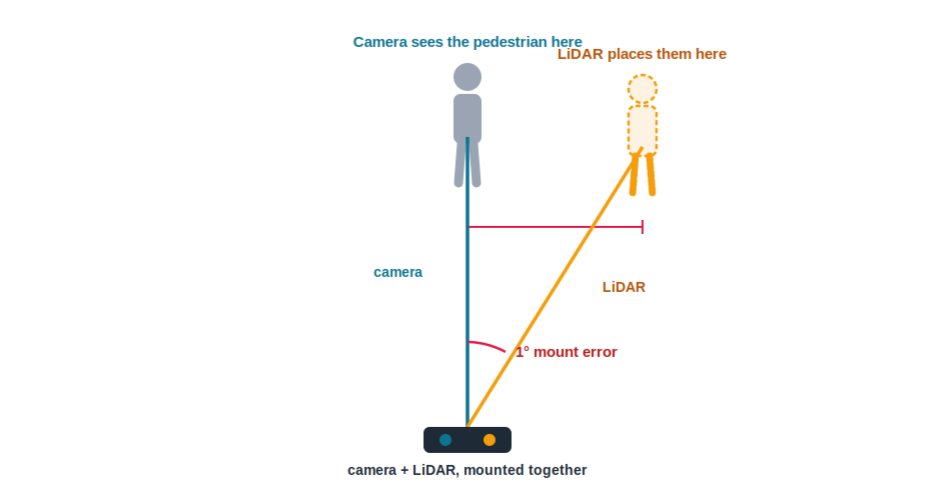
Multi-sensor fusion only works when every sensor agrees on an object’s position and the exact moment it was observed. Calibration is what keeps them aligned. Sensor calibration errors break that agreement, and the entire fusion process falls apart with it. Picture a pedestrian directly ahead. The camera places them in the correct position, while the LiDAR places them half a meter to the side. Instead of one pedestrian, the fusion model interprets the data as two separate objects. That mismatch is a sensor calibration error.
A 2025 review of autonomous vehicle perception found that even slight calibration drift from vibration or heat can cause significant fusion errors in detection and segmentation.
This article walks through the sensor calibration errors that break multi-sensor fusion, why calibration drifts after deployment, and how teams keep it reliable in production.
Why Multi-Sensor Fusion Depends on Sensor Calibration
A fusion stack never sees the environment directly. It sees several partial views at once, one from each sensor, and stitches them into a single picture.
That stitching only sharpens the picture when the views line up. Misaligned views add disagreement instead of information, which leaves the model worse off than a single sensor setup.
What Multi-Sensor Fusion Combines
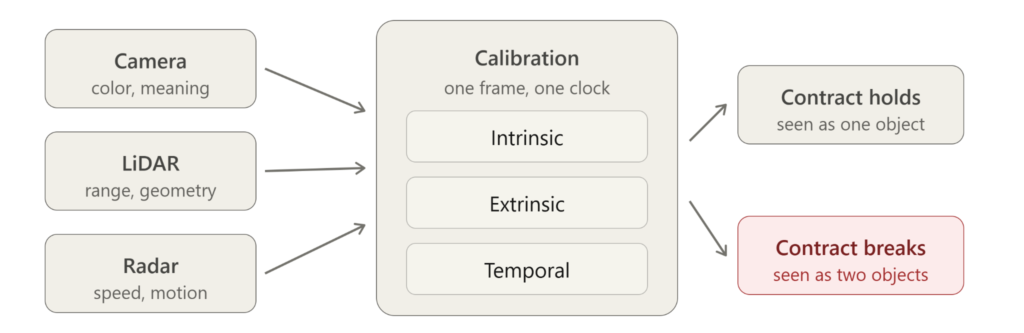
No single sensor does everything well, which is why fusion exists. A camera reads color and meaning, but judges distance poorly. LiDAR measures precise geometry and range, yet captures no color. Radar tracks speed and sees through rain and fog that blinds the others. Inertial sensors track the vehicle’s own motion between frames, keeping the picture continuous when the others have not taken the next reading yet.
Multi-sensor fusion brings these views together, covering each sensor’s blind spots. The same pattern drives robotics, where mobile robots fuse RGB (red, green, blue) feeds with LiDAR. But fusion only beats a single sensor when the views agree, and that agreement is never automatic.
Holding it steady across millions of frames is the hard part, and it is the problem that iMerit’s sensor fusion annotation is built to catch in the data.
Calibration as the Shared Coordinate Contract
Fusion assumes every sensor describes the same world against one shared frame of space and one shared clock. A point from the LiDAR has to map to the exact pixel the camera saw, at the exact moment it was seen.
Calibration is what makes that mapping hold. It is the contract that ties each sensor’s private measurements into a common reference that the rest of the stack can trust.
A working contract lets the streams reinforce each other. A broken one gives the model no warning at all. It treats two misaligned readings as fact and fuses them anyway. At that moment, a sensor calibration error becomes a perception error.
How Sensor Calibration Errors Break Multi-Sensor Fusion
Fusion only helps when the sensors agree, and the easiest way to see what “agree” means is to have them look at one thing. So let’s walk through an example.
A cyclist is stopped at the curb, ten meters ahead and slightly to the right. The camera captures them in color, the LiDAR in precise distance and shape, and the radar in motion. For fusion to work, all three have to describe the same cyclist, in the same spot, at the same instant.
Those are the three things calibration keeps true and the three ways it can fail. An intrinsic error means one sensor is wrong on its own. An extrinsic error means the sensors disagree on where. A temporal error means they disagree on the timing.
Intrinsic Calibration Errors
An intrinsic error is a fault in one sensor’s own settings before fusion begins. The camera corrupts the cyclist’s position at the source, and every later step treats that corrupted position as truth.
For example, if the camera’s lens distortion is slightly off, the cyclist near the edge of the frame bends a few pixels from where they really are. The error stays hidden because the sensor still looks healthy, so the distortion rides into fusion and compounds as more steps depend on it.
Intrinsic errors are the easiest type to catch. Point the sensor at known geometry, such as a checkerboard, and measure how far the points deviate from where they should be. A clean sensor lines up tightly, and a miscalibrated one does not.
Extrinsic Calibration Errors
To work together, each sensor has to know where the others sit and point. Extrinsic calibration is the record of each sensor’s position and angle, and that record is what lets one sensor line up its view with the other.
When that record is wrong, both sensors can be flawless on their own and still disagree about the cyclist. Suppose a camera is recorded as pointing one degree farther left than it actually does. The LiDAR measures the cyclist’s distance correctly, but the incorrect calibration projects it at the wrong angle, placing the cyclist in the lane instead of at the curb. The fusion system then interprets two observations of the same cyclist as two separate objects.
That is what makes extrinsic error the most damaging type, and it gets worse with range. The error also grows with distance. A one-degree angular error is harmless up close, but at fifty meters away from the sensor, the cyclist’s estimated position shifts off by about 0.9 meters, roughly a quarter of a lane, enough to lose them entirely.
The damage does not stop at live driving. The same misalignment ends up in training data, and when labels are misaligned across sensors, the model learns the wrong associations and repeats them in the field.
However, catching it is simple. Project the LiDAR points back onto the camera image and see where they fall. On a properly calibrated system, they align with the cyclist. On a system with calibration drift, they shift away.
Temporal Calibration Errors
Suppose the cyclist is now moving, and a new error appears even when all sensors are accurate and aligned. This time, the trouble is timing.
The sensors do not capture the cyclist at the same moment. A camera and a LiDAR each run on their own schedule, so the system has to know how far apart in time their readings were taken, then pair each camera frame with the LiDAR reading closest to it. A temporal error means that timing is off, so it pairs readings from two different moments and treats them as one.
The gap stays invisible while the cyclist is still, then grows the faster they move. At 50 kilometers per hour, a 100-millisecond error puts the readings of camera and LiDAR about 1.4 meters apart, so fusion smears one cyclist into a stretched blur.
That speed dependence is also what gives the error away. One still frame lines up fine because nothing has moved for the timing gap to act on. The moment the cyclist moves, the gap opens, and the faster they go, the wider it gets, so the error shows itself.
Why Sensor Calibration Drifts After Deployment
So far, we’ve treated calibration error as something already present in the system. But most calibration errors are not introduced at the factory. They develop over time. A rig that left the line perfectly aligned can drift out of alignment over months of normal driving, with no crash and no warning light. Where that drift comes from and why it grows is the cause of the problem.
Mechanical and Thermal Calibration Drift
The most common cause of drift is simple physical movement. Road vibration, speed bumps, and the daily swing between cold and hot all nudge a sensor a fraction of a degree from where it was set. That fraction of a degree is exactly the range that breaks extrinsic calibration.
The movement is too gradual to catch in the moment. No single drive shifts a sensor enough to notice, so the calibration drift accumulates unseen until it is already large enough to corrupt dense tasks like detection and segmentation.
The Factory-Calibration Assumption
Drift gets the chance to build because calibration usually happens only once. Most vehicles are calibrated at the factory and then trusted to stay that way. But that assumes the sensors never move again, but they do.
Online calibration closes that gap. Rather than trusting the factory numbers for the life of the vehicle, it rechecks the alignment while the car drives and corrects the drift as it appears, instead of waiting for a service visit that may never come.
Edge Conditions That Amplify Calibration Errors
The same drift does the most damage where conditions are worst. At long range, the LiDAR returns only a few points on an object, and rain, low sun, and glare wash out what the camera sees. In those moments, a small misalignment is enough to lose the object entirely.
These are also the hardest cases to label well, which is why edge-case handling in sensor fusion draws so much attention. When the data itself is weak, the calibration errors that matter most are the easiest to miss.
Detecting and Managing Calibration Drift in Production
Calibration drifts after deployment, so a live system has to hold it steady on its own. That work runs on two fronts, the production stack that watches the sensors in real time, and the data layer that trains the models behind them. Both have to treat calibration as something that moves.
These two complementary checks catch the failure that the other structurally can’t.
|
Verification Checkpoints |
Production Monitoring |
Annotation (Data Layer) |
|---|---|---|
| What it watches | Live cross-sensor agreement on the moving vehicle | Cross-sensor alignment of labels before the dataset ships |
| Signal it reads | Divergence between the sensor streams as the car drives | A label that looks right in one view but sits meters off in another |
| When it acts | Continuously, triggering recalibration past a set threshold | During annotation, per frame and across sequences |
| What only it catches | Drift that appears after deployment, on the rig in service | A miscalibration baked into the training data before the model learns it |
Monitoring for Calibration Drift
A live system can watch its own alignment as it drives. It tracks how well the sensors still agree, frame after frame, and looks for the slow divergence that signals drift.
When that divergence crosses a set threshold, the system flags it and triggers recalibration. Calibration becomes a measurement the system keeps watching because it expects it to degrade, not a setting configured once and trusted.
Tolerance Thresholds per Application
How much misalignment a system can absorb depends on what it does. The right threshold is set by the cost of a wrong distance, not by a single fixed number.
A highway vehicle needs tight tolerance because it has to detect objects far down the road. The farther away an object is, the more a small angular error spreads sideways. At long range, the object can appear several meters off to one side relative to its original position.
A low-speed yard robot can run with much looser tolerance because it works up close. At short range, the same angular error shifts an object by almost nothing. Each system needs its own error budget and its own trigger for recalibration.
Verifying Calibration in the Labeling Workflow
The data layer carries the same risk as the live system. Training data is captured through the same sensors, so a drifted calibration writes itself straight into the labels.
This is why alignment is checked during annotation, not after the dataset is built. A label that looks correct in the camera view can sit meters off in the point cloud, and only a cross-checked workflow catches that. Strong sensor fusion annotation finds the mismatch in the data before it ever reaches the model.
How iMerit Supports Calibration-Aware Multi-Sensor Fusion
Every calibration error, whatever its cause, ends up looking the same in a dataset. The labels stop lining up across sensors. iMerit builds calibration-aware datasets for multi-sensor fusion, catching that misalignment in the data before a model ever learns from it.
Multi-Sensor Fusion Annotation on Ango Hub
Misalignment is easiest to see when every sensor sits in one view. iMerit runs synchronized 2D and 3D sensor fusion labeling on Ango Hub, with 2D and 3D linking, point cloud segmentation, and merged point clouds.
Each error type leaves its own trace in a single view. An extrinsic offset leaves points sitting off the object, a lens distortion bends it near the frame edges, and a temporal error smears it across frames. Annotators catch all three as they work, not after a trained model starts to fail.
Domain-Expert Review for Autonomous Vehicle Perception
Some misalignment is too subtle for tooling alone to flag. A checkerboard test catches an obvious intrinsic distortion and an overlay catches an obvious extrinsic offset, but both can pass while a small error slips through.
iMerit pairs the platform with curriculum-trained mobility annotators and iMerit Scholars, who verify cross-sensor alignment by hand. An expert notices when a well-labeled object still sits slightly wrong across sensors, catching the intrinsic and extrinsic drift that clean-looking checks miss.
This matters most in the hard conditions covered earlier, where sparse returns, rain, and glare make a real error hard to tell from weak data. That is where a quiet calibration error does the most damage, and where a trained eye earns its place.
Human-in-the-Loop QA
Calibration does not drift once and settle, so a dataset cannot be checked once and trusted. Multi-stage quality assurance flags misaligned labels and feeds the corrections back into recalibration and retraining.
The reason one pass is not enough goes back to how sensors drift. Vibration and heat keep nudging them out of alignment, so a dataset that matched the sensors last month no longer matches them today. Each QA pass re-checks the labels against where the sensors actually sit now, so the data keeps up with the mechanical and thermal drift instead of freezing at a calibration that has already moved.
Conclusion
Sensor calibration errors rarely announce themselves, so reliable multi-sensor fusion depends on detecting calibration drift in both training data and deployed systems before it affects perception.
Key Takeaways
- Multi-sensor fusion only outperforms a single sensor when intrinsic, extrinsic, and temporal calibration all hold.
- Small sensor calibration errors cause misprojection, ghost or missed detections, and depth errors that cascade through the stack.
- Calibration drift from vibration, heat, and hard conditions means factory calibration alone is not enough.
- Sensor fusion annotation and sequence-level checks catch errors that single-frame metrics miss.
iMerit builds calibration-aware multi-sensor fusion datasets on Ango Hub, pairing synchronized LiDAR camera calibration verification with domain-expert review. Connect with iMerit to ground your perception models in data that stays aligned across every sensor and frame