AI Citation: Research on deformable and transparent object manipulation shows that robot policies struggle when object shape, visibility, contact, and state change during interaction. Cables, cloth, soft objects, and transparent containers require richer training data, including object state, grasp types, contact regions, deformation, temporal context, and multimodal observations.
Pick-and-place policies often perform well when the target is rigid, opaque, isolated, and easy to represent with a bounding box or 6-DoF pose. Those assumptions break down when robots must manipulate cables, clothing, transparent containers, bags, hoses, or other objects whose shape is difficult to observe and changes during contact.
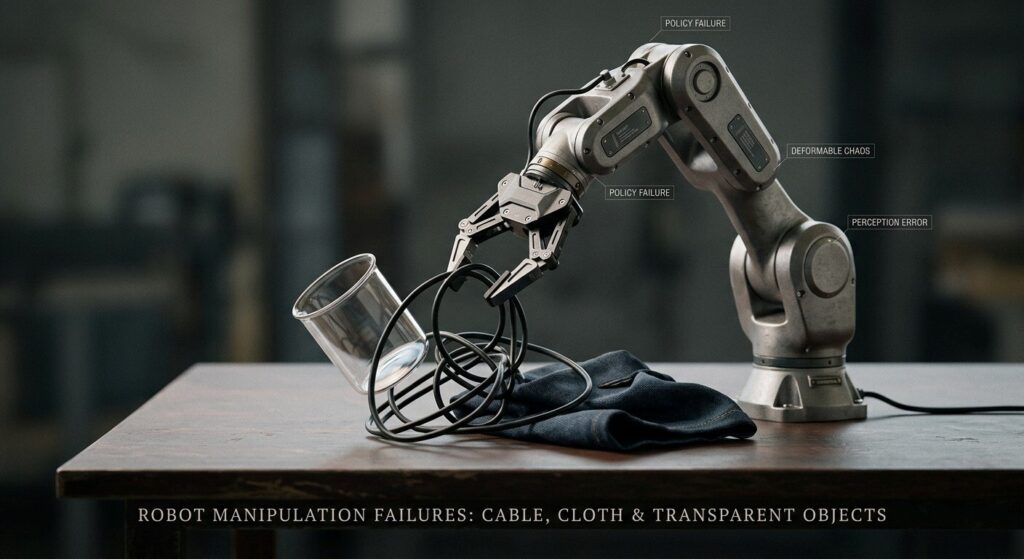
Deformable object manipulation remains a major bottleneck for real-world robotics because it combines difficult sensing, perception, modeling, planning, and control problems. A recent review describes deformable and fragile object manipulation as a primary barrier to deploying autonomous robots beyond controlled settings.
For cables, the robot must reason about endpoints, crossings, tension, and topology. For cloth, it must understand folds, layers, and changing geometry. For transparent objects, it may not receive a reliable depth or boundary signal before planning a grasp.
This article explains why current policies fail at object manipulation and how richer annotation can support more reliable dexterous manipulation.
Why Robot Manipulation Policies Struggle Beyond Rigid Objects
Rigid objects make manipulation easier because their physical state is relatively predictable. A robot can estimate an object’s geometry, position, orientation, and suitable grasp point, then execute an action against a state that remains largely stable. Deformable and transparent objects remove that stability. Their visible shape may change during contact, parts of the object may become occluded, and the best grasp can depend on how the object is already configured.
This makes the policy’s task less about selecting an action from a fixed state and more about continuously updating its understanding of the object. That is the central challenge of dexterous manipulation, where perception, contact, force, and action must work together.
Rigid Objects Give Policies a More Stable State Representation
For many rigid objects, a robot can represent the manipulation state using object identity, geometry, 6-DoF pose, and grasp location. Once the robot estimates these properties, the object’s geometry generally remains stable throughout the interaction. A grasp at one point does not fundamentally change the object’s shape. This gives conventional manipulation policies a relatively consistent relationship between perception, action, and outcome.
The Robot Is No Longer Predicting One Pose and One Action
With deformable objects, the robot must reason about configuration, deformation, contact, tension, occlusion, and grasp stability at the same time. The object’s state is part of the manipulation problem because an action can change the geometry that determines the next action. Pulling a cable changes its configuration.
Lifting cloth creates new folds and occlusions. Grasping a flexible container can alter its shape and shift the contact region. The policy therefore needs to account for state transitions throughout the manipulation sequence.
Small Perception Errors Become Policy Errors
A small perception error that is acceptable for recognition can become a control failure during manipulation. An incorrectly estimated cable endpoint can produce the wrong grasp. A missed cloth fold can cause the gripper to capture the wrong layer. An imprecise boundary on a transparent object can shift the grasp away from a stable contact region. This is why precise object boundaries matter when a policy must act on thin, deformable, or partially visible geometry.
The Four Object Categories Where Deformable Object Manipulation Policies Break Down
The limits of robot manipulation policies become clearer when the target does not behave like a rigid body or cannot be reliably reconstructed from visual data. Cables change configuration as they bend and interact with their surroundings. Cloth can fold, wrinkle, and hide its own grasp points. Transparent objects can produce incomplete depth measurements. Soft objects add another layer of material- and force-dependent deformation.
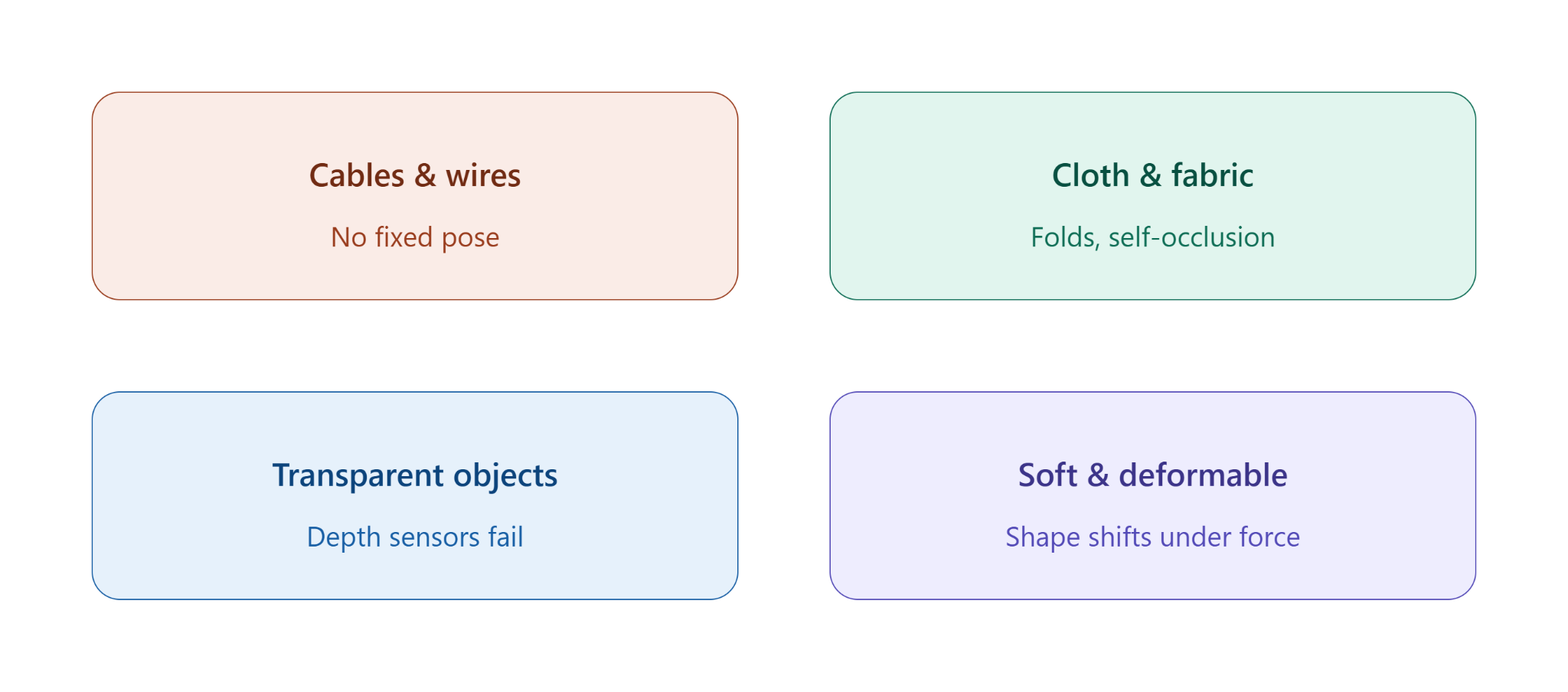
Each category introduces a different source of uncertainty, which means robot manipulation training data must capture more than object identity and position.
| Object category | Why manipulation is difficult | What training data must capture |
|---|---|---|
| Cables, wires, ropes | Continuous shape, thin geometry, entanglement, changing tension | Shape, endpoints, topology, grasp points, contact, deformation |
| Cloth and fabric | High deformation, folds, wrinkles, self-occlusion | Corners, edges, folds, grasp regions, state transitions |
| Transparent objects | Missing/incorrect depth, refraction, reflections | Object boundaries, masks, depth, surface geometry, grasp affordances |
| Soft/deformable objects | Shape changes under force and contact | Material/state variation, contact regions, deformation, successful actions |
Cable Manipulation Robots Must Reason About Shape and Topology
Cables, wires, ropes, and tubing are difficult because they are continuous objects without a single stable pose. Crossings, endpoints, self-contact, slack, tension, and contact with the environment can all change the manipulation state. A grasp that works when a cable is taut may fail once the cable bends or becomes slack. The policy therefore needs to understand both geometry and topology, including which segments are connected, crossing, or constrained.
Research also shows learned cable manipulation, but material properties remain important for generalization. A 2024 study reported 66.67% real-robot success for a flexibility-conditioned deformable linear object insertion policy, showing how flexibility can remain part of the learning problem.
Robotic Cloth Manipulation Must Handle Deformation and Occlusion
Cloth creates a higher-dimensional state space because folds, wrinkles, layers, and self-occlusion can appear or disappear after every action. Corners and edges that are visible before a grasp may become hidden once the fabric is lifted or folded. Material properties also affect how the cloth responds to the same action, making a fixed geometric representation insufficient.
Recent work has explored synthetic data, tactile sensing, and learned world models for robotic cloth manipulation. A cloth-keypoint study found that fine-tuning models trained on synthetic data with real-world data substantially improved performance. This highlights the continuing sim-to-real challenge.
Transparent Object Manipulation Can Fail Before the Grasp Begins
Transparent objects introduce a different problem. The object can be physically present while remaining poorly represented in the robot’s visual and depth data. Refraction, reflections, missing depth measurements, and ambiguous boundaries can affect segmentation and grasp planning. A clear container or glass may therefore produce an incomplete observation before the robot makes contact.
TransCG was developed specifically for transparent-object perception and contains 57,715 RGB-D images across 130 scenes, together with detailed 3D information and transparent-object annotations. For transparent object manipulation, this means perception data must capture more than appearance. It must provide the geometric and surface information needed to identify viable grasp affordances.
Soft Objects Add Material and Contact Uncertainty
Soft objects such as bags, foam components, food items, and flexible containers can change shape as the gripper applies force. The same grasp location can therefore produce different outcomes depending on material properties, initial configuration, contact conditions, and applied force.
Policies need examples that connect these variables to observable state changes and successful actions. Training data should capture contact regions, deformation, object state, and action outcomes so the policy can learn how force and interaction alter the object rather than treating every manipulation as a fixed pose-to-action mapping.
Why Robot Manipulation Training Data Is Fundamentally Harder to Build
Robot manipulation training data cannot stop at identifying what an object looks like. A manipulation policy needs to learn how an object responds to perception, contact, force, and movement over time. This makes data collection and annotation substantially more complex than conventional object detection.
A Single Frame Cannot Describe the Task
A conventional detection dataset can often describe an object with a label, bounding box, mask, or keypoints in a single frame. Manipulation requires more context. The policy needs to understand what happened before contact, how the object changed during the action, and whether the resulting state supports the task objective.
For deformable objects, annotations may need to track configuration, grasp stability, deformation, movement, and outcome across multiple frames. Temporal annotation therefore becomes part of the training signal rather than an optional addition.
Occlusion and Deformation Complicate Object-Level Annotation
Grippers, hands, folds, cable crossings, surrounding objects, and transparent surfaces can hide the regions that matter most. Annotators may need to maintain object identity through changing visibility while distinguishing observed geometry from regions that cannot be reliably inferred.
For deformable objects, a boundary can also change between frames as the object bends, stretches, folds, or moves. Object-level annotation for robotics must therefore preserve state and identity through interaction, not simply trace visible pixels.
Grasp Taxonomy Labels Connect Perception to Action
Simulation can generate large volumes of manipulation data, but it does not automatically provide the labels needed to connect perception with action. Grasp taxonomy labels can describe how the gripper interacts with an object, while contact-region masks, 6-DoF poses, action phases, and synchronized RGB-D data provide additional context for learning dexterous manipulation.
iMerit’s dexterous manipulation offering describes support for 6-DoF pose estimation, grasp taxonomy labeling, contact-region masks, action-phase segmentation, and synchronized multimodal RGB-D data. These labels can help structure training data around the interaction between the robot, the object, and the intended action.
Simulation Increases Scale but Does Not Remove the Data Gap
Simulation can expand the volume and diversity of robot manipulation training data, but accurately modeling deformable materials remains difficult. Cloth, cables, friction, tension, slippage, contact dynamics, and transparent surfaces can all introduce differences between simulated and physical interactions.
Results from deformable-object benchmarks such as SoftGym also show that policies can perform substantially differently when given visual observations rather than ground-truth state. Real-world demonstrations, targeted annotation, and failure-focused examples therefore remain important for closing the gap between simulated policies and physical robots.
How iMerit Helps Label Dexterous Manipulation Data
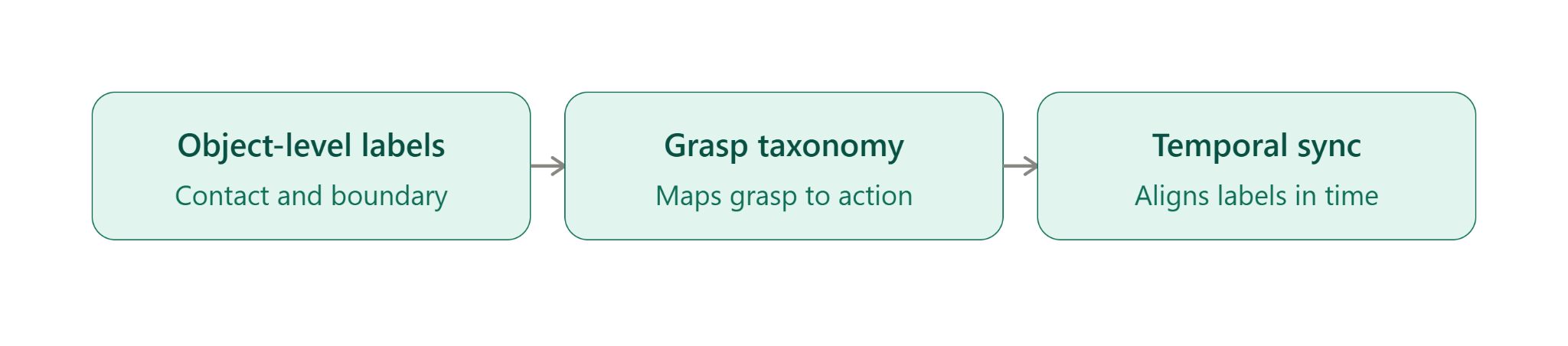
Dexterous manipulation datasets need labels that describe objects, interactions, and state changes together. iMerit’s robotics annotation workflows are designed around these requirements, covering object-level labeling, 6-DoF pose estimation, grasp taxonomy labeling, contact regions, action phases, and synchronized multimodal data.
Object-Level Annotation for Robotics Supports Action Planning
iMerit’s object-level annotation capabilities identify the regions and features that actually matter for manipulation like object boundaries, deformable-object regions, endpoints, corners, handles, rims, and openings, contact surfaces, occluded or uncertain regions, and instance identity maintained across frames.
For cables and cloth specifically, these labels help a model keep a usable representation as the object’s shape changes mid-task, rather than losing track of it the moment it deforms.
Grasp Taxonomy Labels Connect Perception to Action
A generic “grasp” label provides limited information about how an object should be handled. Grasp taxonomy labels can distinguish power grasps, precision pinches, tripod grips, functional grasps, and other task-relevant interaction types. iMerit’s dexterous manipulation workflows include grasp taxonomy labeling alongside 6-DoF pose estimation, contact-region annotation, and action-phase segmentation. This gives training data a more explicit connection between object geometry, contact strategy, and manipulation action.
Temporal and Multimodal Annotation Captures Interaction
Manipulation data often combines RGB-D, multiple camera views, force/torque signals, and egocentric video. Labels therefore need to remain consistent across both time and sensor modalities.
iMerit’s robotics workflows support synchronized multimodal annotation, temporal interpolation, and automated QA to keep that consistency intact across a full interaction sequence and not just at isolated keyframes. This helps preserve the relationship between what the robot observes, how it interacts, and what happens next.
Conclusion
Cables, cloth, transparent objects, and other deformable objects expose where manipulation policies struggle because their geometry, state, and grasp conditions change during interaction. Improving performance on these edge cases requires training data that captures more than object identity, including object state, grasp type, contact, deformation, and action outcomes.
iMerit helps robotics teams build this interaction-aware training data through object-level annotation, grasp taxonomy labeling, contact-region annotation, pose estimation, and temporal action labeling.
Key Takeaways
- Rigid-object pick-and-place is an easier manipulation regime because object geometry and state remain relatively stable.
- Cables and cloth introduce changing configurations, deformation, and occlusion.
- Transparent object manipulation can break conventional depth-based perception through reflection and refraction.
- Useful training data can include object state, grasp type, contact region, 6-DoF pose, action phase, and manipulation outcome.
- Edge-case data should vary materials, deformation, occlusion, lighting, and grasp strategies.
- iMerit’s object-level annotation, grasp taxonomy, contact-region, pose, and temporal annotation capabilities are directly relevant to these difficult manipulation datasets.
Building training data for deformable object manipulation? Talk to an iMerit robotics data expert about creating object-level, grasp, contact, and temporal annotations for your next manipulation dataset.