Autonomous vehicle systems face coverage gaps when rare combinations of road conditions, actor behavior, sensor states, and environmental factors are underrepresented in training data. Scenario mining helps identify these long-tail events, validate failure patterns, and build repeatable coverage for training, evaluation, and regression workflows.
Mature autonomous vehicle (AV) programs generate enormous volumes of routine driving data, but the events most likely to expose model weaknesses appear only a tiny fraction of the time. For example, Waymo’s WOD-E2E dataset contains 4,021 long-tail driving segments (~12 hours) from scenario types that occur less than 0.03% of the time in daily driving.

This scarcity creates a coverage challenge for perception and data teams. Standard sampling and volume-based prioritization tend to preserve common driving conditions. As a result, training and evaluation datasets miss rare combinations of actor behavior, blocked views, road geometry, weather, and system state.
Rarity describes how often a scenario occurs within the vehicle’s operational design domain (ODD). Low exposure means fewer examples are available to characterize a failure mode and establish regression coverage when a weakness emerges.
The highest-priority cases are those that are both poorly represented and linked to safety risks, model weaknesses, novelty, or unresolved coverage gaps.
This raises the operational question which is how should an AV data program detect, validate, and prioritize rare scenarios that standard sampling logic regularly overlooks?
In this article, we explore why conventional triage fails to catch autonomous vehicle edge cases, how to prioritize rare scenarios by risk and coverage value, and how to convert individual incidents into repeatable training and regression coverage.
Why Standard Triage Misses Autonomous Vehicle Edge Cases
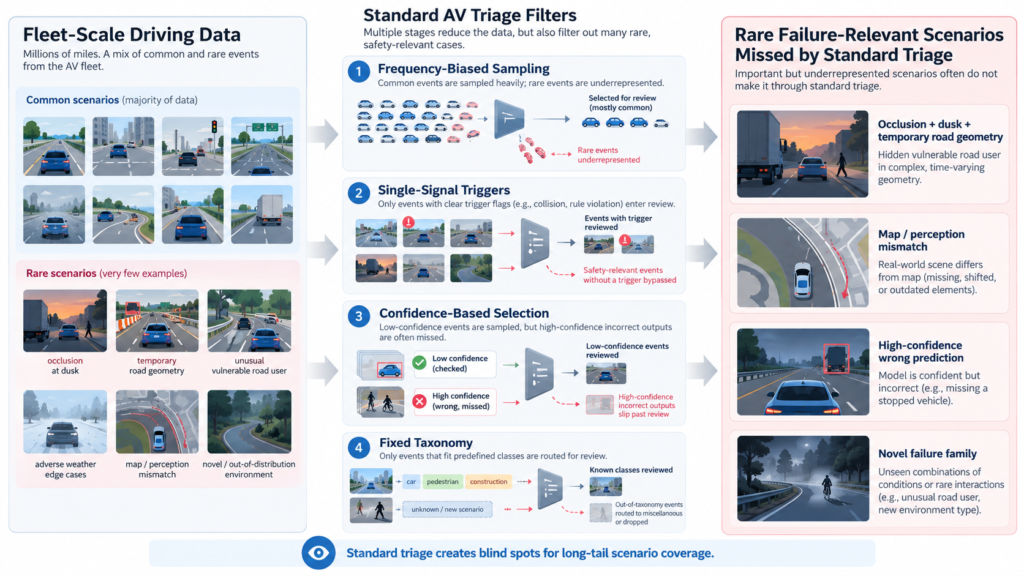
Most triage systems use observable signals such as interventions, disengagements, anomalous trajectories, model uncertainty, sensor faults, or rule-based event triggers. But these signals create systematic blind spots for long-tail scenario coverage and edge case detection.
Frequency-Biased Sampling
Uniform or volume-based sampling mirrors normal driving distributions, so high-frequency scenarios dominate the dataset. If a scenario occurs once in tens of thousands of relevant encounters, collecting additional nominal driving data expands the candidate pool without proportionally increasing that scenario’s representation after sampling. The result is low recall for long-tail scenario families at the data-selection stage, even when the fleet has encountered them.
Single-Signal Triggers
Trigger-based triage sorts fleet data using predefined signals such as intervention flags or sensor-health metrics. Safety-relevant events that do not meet a trigger threshold may never enter the review queue.
This issue worsens with combinatorial rarity (factors occur together). For example, a partly hidden pedestrian may appear from an unusual angle at dusk near temporary road changes. Each factor may be common on its own, but the combination is rare. Single-signal triggers can catch known failure signatures while poorly covering rare feature combinations.
Confidence is Not a Reliable Failure Detector
Uncertainty-based sampling retrieves low-margin predictions, but confidence does not imply correctness. A model can produce high-confidence false positives, misclassifications, incorrect track associations, or poorly calibrated trajectory predictions when a rare input resembles patterns well represented during training.
Because these outputs remain above the confidence threshold used for uncertainty-based selection, detecting them requires orthogonal signals including:
- Prediction-versus-outcome residuals;
- Cross-model or cross-sensor disagreement;
- Track discontinuities;
- Trajectory feasibility violations;
- Map-to-perception inconsistencies;
- Downstream planner corrections; and
- Recurrent error signatures across model versions.
Existing Taxonomies Can Hide Novel Failure Families
Predefined taxonomies can also suppress discovery. If every incoming clip must map to a predefined scenario class, events that do not fit may be assigned to a broad miscellaneous class, treated as noise, or excluded. Over time, recurring unmatched events remain undetected as distinct failure families because the taxonomy lacks representation for their defining feature combinations.
How to Build a Rare-Scenario Prioritization Framework
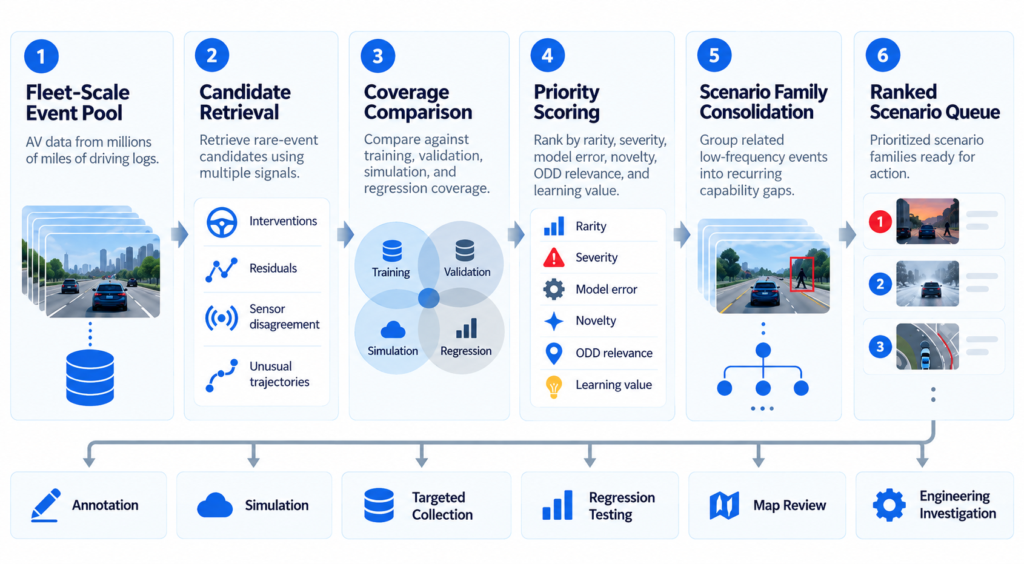
A rare-scenario mining program first needs to reduce fleet-scale logs into candidate events. Candidate retrieval can combine intervention and disengagement logs with model residuals, cross-sensor disagreement, unusual actor trajectories, localization or map inconsistencies, and sensor degradation to increase long-tail recall.
Identify Coverage Gaps
Represent retrieved events using attributes such as actor trajectories, ego behavior, road topology, traffic controls, occlusion, environmental conditions, sensor state, ODD attributes, model outputs, and system version. Compare these descriptors with scenarios already included in training, validation, simulation, and regression datasets.
Separate Rarity From Criticality
Rank retrieved candidates using multiple signals, including:
- Occurrence rate: frequency within the relevant ODD.
- Safety severity: consequence of an incorrect response.
- Model error and uncertainty: observed failure, residual, instability, or disagreement.
- Novelty: distance from existing scenario coverage.
- ODD relevance: applicability to current or planned deployment.
- Recurrence: repetition across vehicles, routes, or model versions.
- Expected learning value: whether additional data or investigation can close the identified capability gap.
Safety-critical conditions can also use hard escalation rules so that a severe event is not suppressed simply because recurrence is low.
Mine Failure Precursors
Analyze the temporal window preceding an explicit failure for signals such as increasing occlusion, track instability, localization residuals, map-perception disagreement, shrinking time-to-collision, or repeated planner corrections. These precursors can surface capability gaps even when the final maneuver does not produce a disengagement or collision.
Consolidate Scenario Families
Group rare events by the conditions and type of failure that caused them. Events from different locations may belong to the same group (family) if they share a perception failure. Visually similar scenes may require separate families when one stems from localization and the other from prediction. This prevents recurring weaknesses from remaining fragmented across otherwise unrelated fleet logs.
Route the Scenario by Failure Type
Route validated scenarios by required intervention: annotation, simulation, targeted collection, regression testing, map review, or engineering investigation.
Pony.ai’s PonyWorld 2.0 is a current example of this directed loop. It self-diagnoses to identify scenarios that require additional learning, generates targeted data-collection tasks, and feeds the resulting samples back into training.
The operational deliverable is a ranked scenario queue with failure evidence, coverage status, required data, escalation level, and downstream owner.
How to Turn One Rare Event Into Repeatable Model Coverage
Define a validated edge case by its invariant conditions, like the actor interaction, occlusion structure, or other conditions responsible for the failure. Then identify parameters that can vary without changing that scenario definition. For an occlusion-related interaction, these might include actor speed, emergence time, and available stopping distance. Sweeping those parameters establishes a scenario envelope around the original event and reveals where model behavior transitions from acceptable to failure.
Use that envelope to define explicit coverage requirements across relevant parameter ranges and boundary conditions, including the original fleet event and collected or generated variants. Version validates cases and promotes them into persistent regression sets so subsequent model releases can be tested against the same scenario family.
Close coverage only when the scenario family has sufficient representation, the original failure and relevant boundary conditions are reproducible, and the updated system passes the corresponding regression criteria across releases. If new events fall outside the established envelope, expand or split the scenario definition to prevent scenario drift. The resulting metric is the number of validated scenario families with sufficient coverage and closure, not the number of individual edge cases discovered.
How iMerit Helps Surface and Prioritize Long-Tail AV Scenarios
Fleet-scale edge-case programs require validating, grouping, escalating, and routing events without sending every anomaly to an engineering team. iMerit provides the human-in-the-loop triage layer that converts prioritized autonomous vehicle data into qualified scenarios for downstream model-development workflows.
- Validated scenario queues: Autonomous Vehicle Triage Services provide event classification, multi-sensor review, false-positive filtering, scenario tagging, root-cause analysis, and workflow routing. The deliverable is a structured set of qualified events.
- Escalation matched to failure complexity: Tiered Triage Services move cases from high-volume operational validation to multi-sensor technical investigation and, when required, full-stack engineering root-cause analysis across autonomy modules.
- Expert validation of ambiguous long-tail events: iMerit’s directed-triage workflow uses AV-trained specialists to validate whether a suspected weakness is reproducible, determine novelty and severity, and establish the evidence needed for the appropriate downstream workflow.
- Production workflow for selected scenarios: Ango Hub provides configurable annotation, review, routing, benchmarking, and QA workflows for moving qualified events into model-development pipelines.
Key Takeaways
- Prioritize by risk and coverage value: Prioritize autonomous vehicle edge cases using severity, model error, novelty, ODD relevance, recurrence, coverage deficit, and expected learning value.
- Measure coverage at the scenario-family level: Track whether validated families are sufficiently represented across training, validation, simulation, and regression assets.
- Use temporal evidence for edge case detection: Pre-failure behavior can expose capability gaps even when no intervention or disengagement occurs.
- Connect triage to remediation: Each qualified scenario should leave the review queue with a defined downstream owner and action.
- Measure closure against the failure mode: Verify that the identified failure envelope is covered and remains resolved across subsequent releases.
Struggling to surface the rare scenarios buried in fleet data? Talk to iMerit’s autonomous systems experts about building an edge-case triage and scenario-mining workflow that prioritizes the events your models need most.