Frontier labs are moving beyond saturated public benchmarks by building proprietary evaluation systems with fresh production-sourced tasks, expert-reviewed capability probes, contamination controls, multidimensional grading, and continuously refreshed held-out datasets. These evaluation pipelines preserve discriminative value as models improve, enabling teams to identify meaningful capability gaps and regressions across real-world workflows.
Ask five different frontier labs how their latest model performs on HumanEval. You’ll get five nearly identical answers, all clustered within a point or two of each other. At that density, the test isn’t measuring which model writes better code. It’s measuring rounding error.
That compression is the real signal. When an eval lead can’t separate this quarter’s release candidate from last quarter’s on the tests everyone still cites, the problem isn’t the model. It’s that the test was built for a different job.
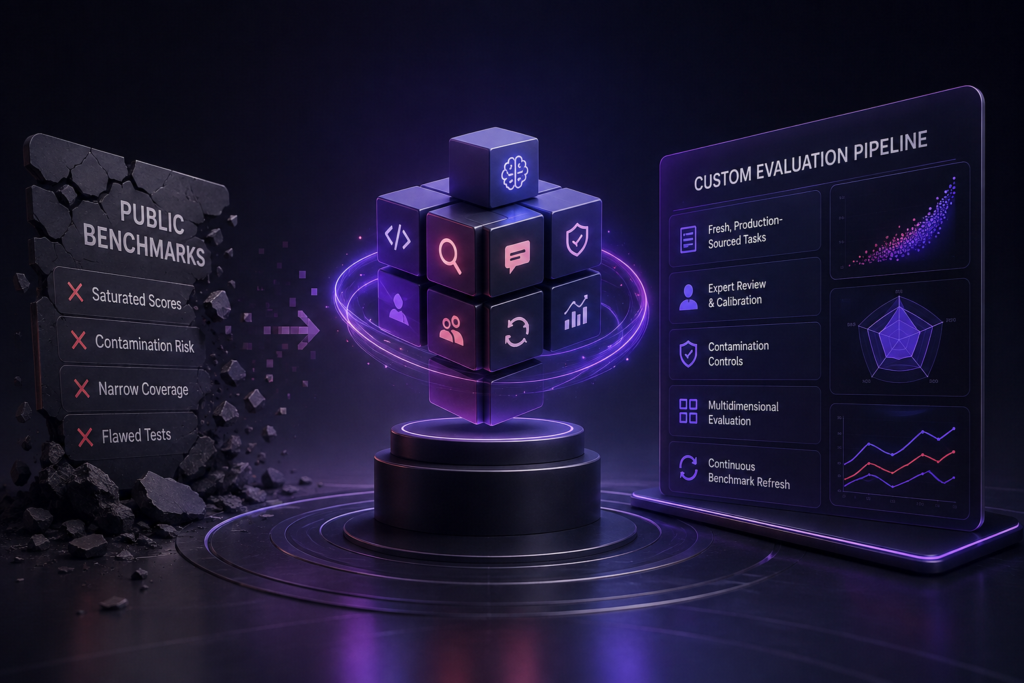
A 2026 study of 60 LLM benchmarks found nearly half had saturated the same way. So frontier labs stop trusting the leaderboard and start building their own evaluation pipeline.
This article breaks down why public benchmarks lose their edge, and how frontier labs build evaluation infrastructure to replace them.
Why Public Evaluation Benchmarks Lose Discriminative Value
Public benchmarks lose discriminative value through several distinct mechanisms, and each creates a different problem for evaluation teams. A saturated score makes it harder to rank release candidates or detect meaningful regressions. Contamination can make apparent gains look larger than they are. Narrow task coverage can hide failures that matter in production, while flawed prompts or tests can turn evaluation noise into false model failures.
The operational consequence is significant. When an eval no longer produces a reliable signal, teams cannot confidently use it for release gates, model selection, routing decisions, or regression monitoring. The response is not simply to find a higher-scoring benchmark, but to build evaluation infrastructure that controls for these failure modes.
1. Ceiling Effects and Benchmark Saturation
A benchmark loses discriminative value when models approach its scoring ceiling and their results cluster tightly near the maximum.
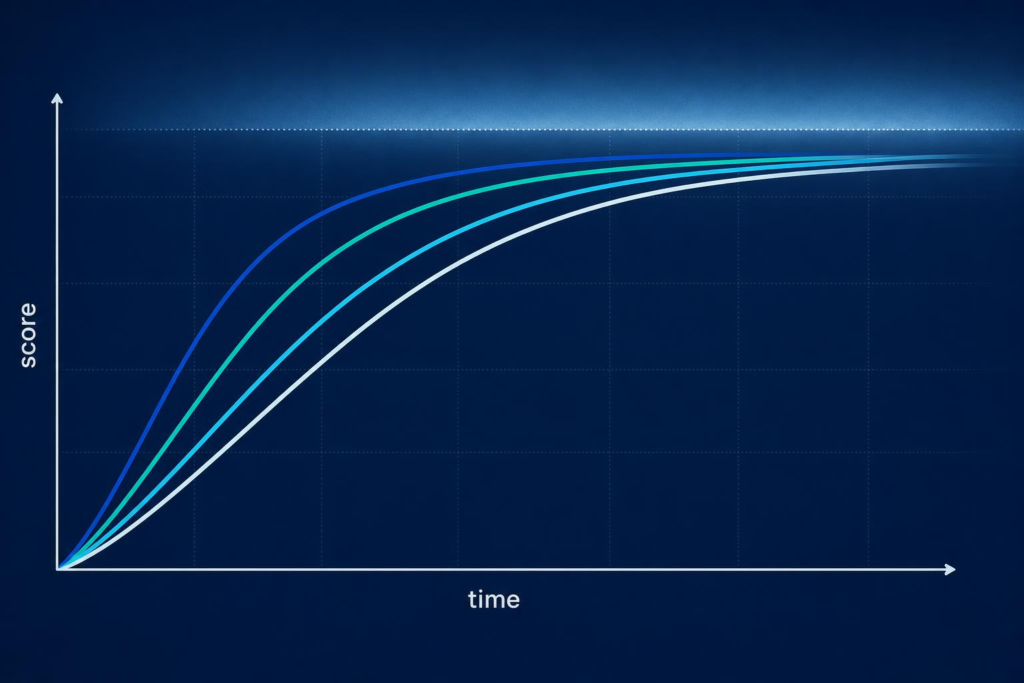
At that point, a small score difference may reflect sampling, prompting, evaluator, or harness variance rather than a meaningful capability gap.
For teams, this makes the benchmark unreliable for ranking closely matched models or deciding whether a new release represents a real improvement. The test still measures something but it provides less useful separation between models.
2. Benchmark Contamination From Training-Data Exposure
Public benchmarks are also becoming harder to interpret when their prompts, solutions, repositories, or discussions are present in model training data. This creates a risk that models can reproduce information encountered during training rather than solve an unfamiliar problem.
OpenAI’s 2026 analysis of SWE-bench Verified found that frontier models could reproduce specific release-note details and even verbatim details from human-written gold patches. Red teaming also found this behavior across frontier models from three providers. For evaluation teams, benchmark contamination weakens their ability to measure generalization and makes scores across model generations harder to compare.
3. Narrow Measurement: Why HumanEval Alone Misses Agentic Capability
HumanEval remains useful for measuring a specific capability. For example, functional correctness on short, self-contained programming problems. Its 164 tasks provide a controlled way to test whether generated code satisfies predefined unit tests. The limitation is scope and not benchmark quality. Agentic software engineering can require repository navigation, planning, tool use, debugging, context management, and iterative execution.
An eval team relying only on function-level coding scores could therefore miss capabilities that determine performance in production. Broader evaluation infrastructure should layer automated metrics with domain-specific tasks and expert judgment to measure the behaviors that matter in the target workflow.
4. Benchmark Artifacts and Flawed Test Design
A benchmark can also lose signal because the evaluation itself is poorly constructed. Problems can come from ambiguous prompts, tests that enforce unstated implementation details, insufficient test coverage, or requirements that extend beyond the task description. OpenAI’s 2026 audit of SWE-bench Verified found material test-design or problem-description issues in 59.4% of 138 audited tasks, including tests that were too narrow or too broad.
This distinction is important for evaluation teams because a failed test should reflect a model’s actual limitation, not a problem with the test itself. Poorly designed tests can distort model comparisons and lead teams to make decisions based on inaccurate results.
What Frontier Labs Build When Custom Public Benchmarks Stop Differentiating Models
Once a public benchmark stops separating model performance, the replacement cannot simply be a larger or more difficult test set. Frontier labs need a model evaluation system that continuously produces fresh tasks, verifies that those tasks measure the intended capability, protects them from contamination, and removes items when they stop providing useful signals.
The objective is not maximum difficulty. It is a sustained discriminative value, which is the ability of an evaluation to distinguish meaningful differences between models.
The first priority is to bring evaluation closer to the real-world work where models still encounter meaningful failure modes.
1. Production-Sourced Evaluation Data From Real-World Model Work
One way to move beyond recycled benchmark questions is to build production-sourced evaluation data from the work models are increasingly expected to perform. For coding systems, this can include repository-level bugs, pull requests, debugging sessions, regression fixes, dependency changes, and multi-step tasks that require an agent to inspect a codebase, plan changes, execute tools, and verify the result. Similar approaches apply outside software engineering like production failures, difficult user interactions, escalation cases, and newly emerging workflows can expose capability gaps that static datasets never anticipated.
SWE-rebench V2 shows what this infrastructure can look like at scale. Its 2026 pipeline automatically harvests executable software-engineering tasks from real repositories and reports more than 32,000 tasks across 20 programming languages and 3,600+ repositories, with reproducible execution environments. It also attaches metadata that flags potential confounders such as underspecified descriptions and overly restrictive tests.
However, production-derived does not automatically mean evaluation-ready. A real task can contain ambiguous requirements, incomplete tests, irrelevant implementation details, or multiple valid solutions. Evaluation teams still need to validate task quality, define what constitutes success, and establish reliable grading before a production failure becomes an evaluation item.
2. Domain Expert Evaluation for LLMs: Building Targeted Capability Probes
Fresh data provides realism, but it does not guarantee coverage of the capabilities an evaluation team needs to measure. Domain experts can deliberately construct tasks around known weaknesses, difficult edge cases, ambiguous requirements, safety-sensitive decisions, and failure modes that are too rare or expensive to capture through passive data collection.

OpenAI’s GDPval shows this approach at scale. It covers 44 occupations and 1,320 specialized tasks based on real knowledge-work deliverables. Professionals with an average of 14 years of experience created the tasks, which went through an average of five expert review rounds. This helps evaluation teams test practical skills rather than simply measuring what is easiest to collect.
Expert-authored probes are particularly important when correctness depends on context, judgment, or domain conventions that automated metrics cannot fully capture. They can also be regenerated as model capabilities change. This helps teams to target newly exposed weaknesses instead of repeatedly measuring capabilities models have already mastered.
iMerit Scholars provide access to specialists who can create, review, and evaluate model outputs across domains. The network supports workflows including prompt and response creation, model evaluation, correction, reasoning, and domain-specific model tuning.
3. Building Contamination Resistance Into Evaluation Data
Keeping an evaluation private is useful, but it is only one layer of contamination control. A robust system also needs provenance tracking, private holdout sets, controlled exposure, contamination checks, task rotation, and a process for retiring compromised items.
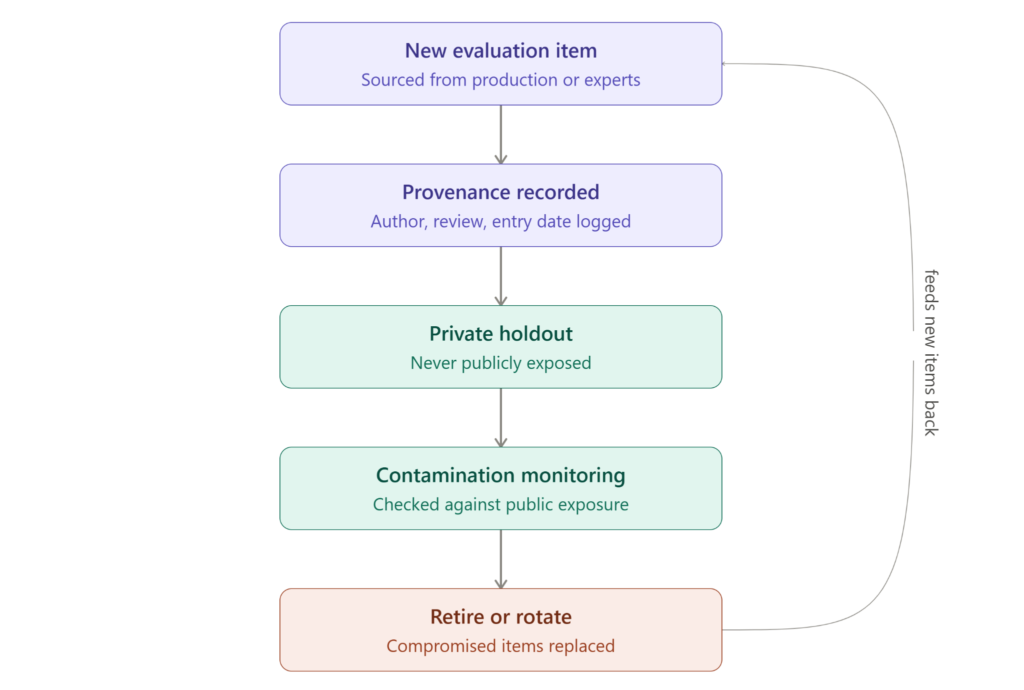
This matters because publishing a task and its solution creates an opportunity for both to enter future training corpora. OpenAI’s audit of SWE-bench Verified found evidence of contamination and recommended greater care around benchmark publication, training-data filtering, and contamination detection. It also noted that privately authored evaluations such as GDPval reduce exposure risk.
For frontier teams, the objective is not to claim that contamination-resistant benchmarks are impossible to compromise, but to maintain enough provenance and exposure controls to identify, isolate, and retire compromised items.
Task provenance should show where an item originated, who authored and reviewed it, when it entered the holdout set, and whether it has subsequently appeared in public or training-accessible material. When exposure is suspected, the item can be isolated, investigated, and retired without invalidating the entire evaluation program.
4. Multidimensional Evaluation: Moving Beyond Pass/Fail
Making tasks harder does not solve evaluation saturation if the grading system reduces complex model behavior to a single binary outcome. Production systems often need to satisfy several requirements simultaneously.
For coding agents, an evaluation can measure functional correctness, regression safety, security, computational efficiency, code quality, and tool-use behavior. For broader AI systems, useful dimensions may include outcome quality, instruction adherence, workflow execution, reasoning quality, cost, latency, and human preference.
The COMPASS evaluation provides empirical support for this distinction. It evaluates generated code across correctness, efficiency, and quality, using real competitive-programming problems and a human baseline derived from more than 393,000 submissions. Its evaluation found that models with strong correctness performance did not necessarily produce efficient or maintainable code.
The strongest evaluation pipelines therefore combine automated graders with explicit rubrics and expert review. Automated checks provide scale and repeatability, rubrics define what quality means, and domain experts handle cases where correctness depends on judgment or context. OpenAI’s GDPval uses this layered model. The expert graders compare deliverables using occupation-specific rubrics, while an automated grader provides a scalable approximation of expert judgment.
5. Held-Out Datasets and Continuous Benchmark Refresh
The final step is turning evaluation into a living system rather than maintaining a static benchmark. Labs can retire saturated tasks, add newly observed failure cases, introduce harder capability slices, rotate held-out datasets, and maintain versioned datasets so results remain comparable without exposing the entire evaluation corpus.
The key metric is not difficulty alone. An evaluation item has value when it can meaningfully separate models on a capability that matters. A task that 99% of frontier models pass may still be useful for regression testing, but it has little value for ranking current models. Conversely, a difficult task that produces inconsistent grading or reflects an unrealistic workflow is not necessarily informative.
Continuous refresh therefore closes the loop between deployment and evaluation. Production failures can become new test cases; expert reviews can expose capability gaps; contamination monitoring can trigger item retirement; and score distributions can identify when a task has lost discriminative value. The result is not another benchmark leaderboard but an evaluation pipeline that evolves with the models it measures.
What Frontier Eval Pipeline Infrastructure Looks Like in Practice
A frontier eval pipeline infrastructure is not a single dataset or scoring script. It is a set of connected layers that control how tasks are sourced, validated, executed, analyzed, and refreshed. Each layer addresses a different failure mode that can weaken evaluation signals over time.
| Layer | What the lab builds | Why it matters |
|---|---|---|
| Task source | Production, research, red-team, expert-created tasks | Realistic capability distribution |
| Task bank | Private, versioned, continuously refreshed | Limits contamination |
| Expert layer | Domain-qualified task authors and reviewers | Validates difficulty and correctness |
| Evaluation harness | Code execution, tools, environments, rubrics | Tests actual behavior |
| Holdout layer | Never-exposed tasks | Measures generalization |
| Failure taxonomy | Structured failure labels | Explains why models fail |
| Refresh loop | New tasks + retired tasks | Prevents benchmark decay |
| Reporting | Capability slices, not one score | Preserves discriminative signal |
The key is the connection between these layers. Evaluation results should feed failure analysis, which informs the next round of task creation and refinement. This turns evaluation from a static measurement exercise into a continuous capability-monitoring system.
How iMerit Builds Proprietary Evaluation Sets for Frontier Labs
Building a proprietary evaluation system requires more than generating a large pool of test items. Frontier labs need tasks that target specific capability gaps, expert review that validates whether those tasks measure what they intend to measure, and an operating model that can continuously identify and add new failure cases.
iMerit addresses these execution requirements through its Scholars network, which includes more than 25,000 domain experts across 60+ countries. (iMerit Scholars)
iMerit can support frontier evaluation programs across five areas:
- Proprietary task creation: Domain experts develop evaluation prompts and scenarios tailored to specific capabilities, workflows, and domains rather than relying on recycled public tasks.
- Expert review and adjudication: Specialists assess task validity, model outputs, reference answers, and evaluation criteria, including ambiguous or difficult cases.
- Failure-mode coverage: Expert-led analysis helps identify edge cases and recurring model failures that can be converted into targeted evaluation tasks.
- Contamination resistance: Controlled task creation and proprietary evaluation data reduce reliance on publicly exposed benchmark material and support the use of private evaluation sets.
- Continuous refresh: New tasks and failure cases can be incorporated as model capabilities change, helping maintain the evaluation set’s discriminative value over time.
iMerit’s Ango Deep Reasoning Lab adds a workflow for collaboration between AI models and subject-matter experts on complex reasoning tasks, supporting expert-driven evaluation and refinement
This combination gives frontier teams an execution layer for developing and maintaining specialized evaluation data, while supporting the expert calibration and continuous iteration required to preserve its usefulness as models improve.
Conclusion
The hard part was never proving a frontier model can code. It’s proving the test can still tell the difference.
Public evaluation benchmarks compress the moment models start optimizing against them: ceiling effects flatten real gaps, contamination rewards memory over reasoning, narrow tasks miss agentic work, and flawed test design masks both. A leaderboard doesn’t fail loudly here; it just stops meaning anything.
The answer is not to abandon public benchmarks, but to complement them with continuous evaluation infrastructure that evolves as models improve. That means sourcing new failure modes, validating them with experts, protecting held-out evaluation sets, and retiring tasks when they no longer separate models effectively.
Key Takeaways
- Discriminative value, not raw difficulty, is what makes an evaluation task worth keeping.
- Contamination resistance requires provenance tracking and rotation, not just secrecy.
- Grading has to move past pass/fail to catch what correctness alone misses.
- A static benchmark decays; an evaluation pipeline doesn’t.
iMerit builds the expert-intensive parts of that infrastructure; sourcing, validating, and protecting evaluation sets at scale. Talk to an expert to build proprietary, continuously refreshed evaluation datasets for your models.