Coding benchmark contamination occurs when AI models encounter evaluation tasks or solutions during training, making performance scores less reliable. Building trustworthy coding evaluations requires private, expert-verified datasets, robust test validation, reproducible execution environments, and continuous quality checks to measure real-world coding capabilities accurately.
A coding agent can top an evaluation benchmark leaderboard and still struggle with real software projects. The problem may not be the model alone. The benchmark itself may no longer be giving a reliable signal.
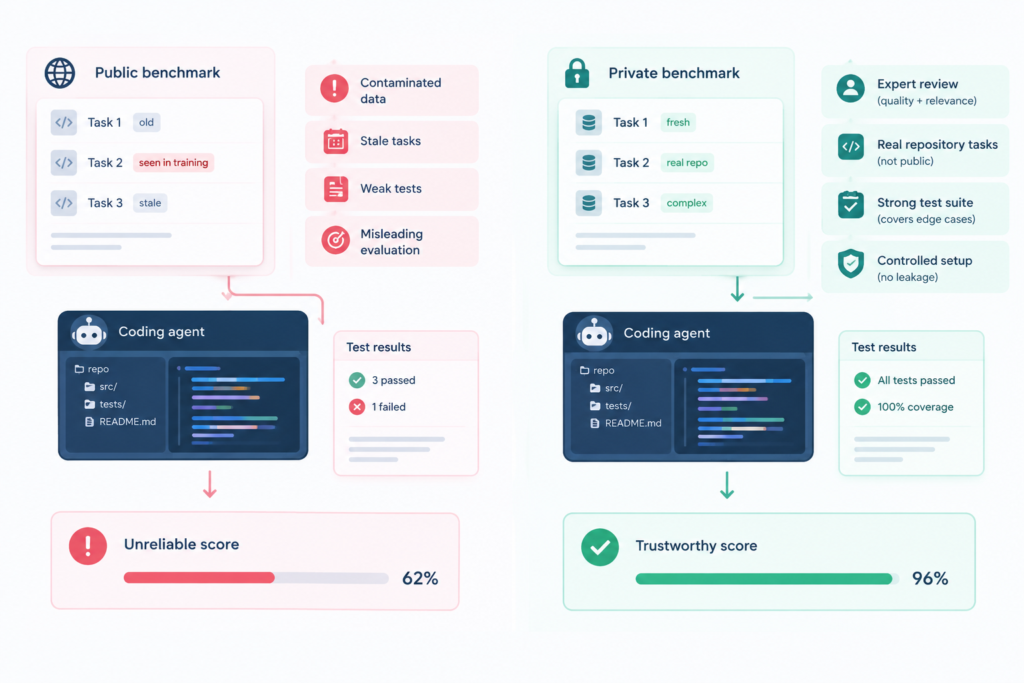
Coding benchmark contamination is one cause, which means the model powering the agent has already encountered the benchmark tasks or solutions during training. The other is flawed evaluation design, such as broken tasks, tests that reject valid fixes or pass incomplete ones, and execution environments that skew results.
SWE-Bench Verified is a recent example. In February 2026, OpenAI stopped reporting SWE-Bench Verified results. It found out that frontier models had seen tasks and solutions in training and that many tests rejected correct fixes. It recommended SWE-bench Pro, then retracted that recommendation in July after estimating that roughly 30% of Pro’s tasks were broken. For teams evaluating coding agents, the question is no longer which benchmark to replace, but what to build instead.
This article examines why coding benchmarks lose their signal, how contamination and evaluation issues affect results, and how to improve coding benchmark reliability.
How Coding Benchmark Contamination Affects Benchmark Reliability
A coding benchmark should show how well an agent can solve software tasks without relying on prior exposure to the specific task, repository, issue, or solution. Coding benchmark contamination can weaken that signal when agents encounter tasks, repositories, or solutions before evaluation.
Public benchmarks can lose reliability the longer they remain in use. Since their tasks and solutions are fixed and publicly available, they can eventually become part of training data, giving newer models exposure to problems they later encounter during evaluation. Teams can also optimize models against widely used benchmarks and their leaderboards, making it harder to separate genuine coding improvements from benchmark-specific gains.
Hence, the scores can reflect familiarity with benchmark material rather than independent problem-solving ability. This exposure can happen in several ways:
- An issue report or comment can have more than a description of the problem. It can also include the reason for the bug or information that helps find the fix. A SWE-Bench+ analysis showed that 32.67 percent of patches examined had solution leakage, where the solution was clearly given in the issue report or comments.
- An agent may identify the affected file from an issue description without first understanding the repository structure. The SWE-Bench Illusion study reported up to 76% accuracy for buggy file identification on SWE Bench tasks compared with up to 53% on tasks from repositories outside SWE Bench. The researchers linked this gap to possible contamination or memorization.
- An agent may have encountered project documentation, release notes, earlier code changes, or other public information during training. OpenAI also reported evidence that models could reproduce original human-written fixes and verbatim details from some SWE-bench Verified problem statements.
Not all prior knowledge counts as contamination. Applying general programming knowledge or recognizing a common bug pattern is expected behavior. Benchmark contamination is when prior knowledge of a task or repository helps in solving the task.
Contamination also differs from a flawed evaluation. In a contaminated benchmark, the agent may have access to task information from the model it uses or from its surrounding tools. In a flawed evaluation, the problem is how the benchmark judges the agent’s work. A test may reject a correct fix, miss an incomplete one, or produce different results because the execution environment is inconsistent. A task can therefore be completely new to the agent and still produce an unreliable score due to flawed evaluation.
Why Coding Benchmarks Can Fail Even Without Contamination
An unreliable outcome may occur even if the tasks within the benchmark are completely new to the coding agent. This may happen because of how the code was executed, the patch test, or how the benchmark determined the task was completed.
1. Execution and Environment
A coding agent creates a patch, which is used to apply the change in the repository. This time, however, evaluation will run all necessary tests to verify that the change works as intended. In other words, the outcome will also depend on the testing environment. Dependencies, package versions, operating systems, configuration, and test infrastructure can all affect the outcome.
If the environment cannot reliably reproduce the conditions needed to run the repository, it becomes harder to tell whether a failure came from the agent or the evaluation setup.
2. Repository-Level Impact
A patch can affect code beyond the reported issue. It may fix the target bug but break existing functionality elsewhere. This is why repository-level evaluation needs to check both the intended fix and existing behavior.
3. Test Quality
Passing tests does not always mean that the task was solved correctly. A test can be too strict and reject a valid implementation. It can also be too weak and allow an incomplete fix to pass.
OpenAI’s 2026 audit of SWE-Bench Pro identified overly strict tests, underspecified tasks, low-coverage tests, and prompts that conflicted with the tests. The audit estimated that about 30% of the tasks were broken.
Earlier analysis found similar issues in SWE-Bench. SWE-Bench+ reported that 31.08% of the patches it examined as passed were suspicious because the tests did not adequately verify correctness.
4. Benchmark Coverage
Even if the tasks are technically appropriate, they may give a limited view of the coding capabilities if the benchmark itself is limited in the variety of languages, frameworks, repositories, environments, or tasks used. Research comparing repository-level coding benchmarks found that SWE-bench uses a more limited set of repositories than newer benchmarks, which can affect how well its results generalize to other software engineering environments.
A reliable coding model evaluation needs more than a test suite that produces a pass or fail. It needs realistic tasks, stable execution environments, tests that reflect the actual requirements, and enough coverage to represent the type of software work being evaluated.
How the Industry is Responding to Coding Evaluation Problems
No single benchmark addresses every coding agent evaluation problem. Recent approaches are instead changing how coding tasks are collected, exposed, verified, and evaluated.
| Benchmark/Development | Problem it Addresses | What Changed |
|---|---|---|
| SWE-Bench Pro | Public exposure and limited task diversity | Draws on 41 repositories split into public, held-out, and commercial sets, with human-verified tasks. |
| LiveCodeBench | Contamination from older public problems | Continuously collects newly released programming problems and records their release dates, enabling evaluation on problems released after a model's training cutoff. |
| SWE-bench-Live | Stale, fixed repository-level task sets | Adds new GitHub issues through an automated curation pipeline, with a Docker image for each task to support reproducible execution. Later releases expanded to multiple languages and Windows. |
| SWE-Bench Pro Verified | Reward hacking and task-quality problems in SWE-Bench Pro | Adds anti-hacking safeguards to block solution leakage, and refines tasks with misleading descriptions or overly narrow tests. Some models score substantially lower than on the original. |
These approaches move coding evaluation beyond fixed, publicly available task sets. They use fresher tasks, held-out or private data, broader coverage, and stronger verification.
But freshness alone is not enough. New tasks can still have weak tests or unclear requirements. They need to be expert-vetted and privately held to reduce contamination risk, as well as have clear requirements and reliable execution environments to support accurate evaluation.
What It Takes to Improve Coding Benchmark Reliability
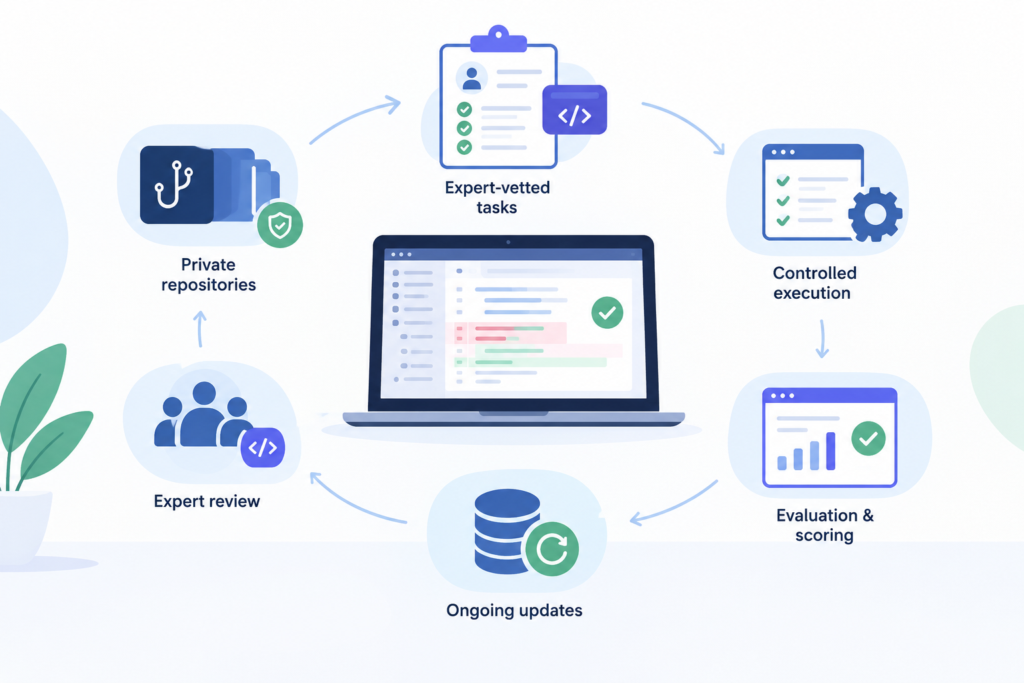
AI coding benchmark evaluation needs control at every stage. From making and checking tasks to running and scoring them, control is essential. Keeping each stage in check helps teams spot problems before they change the results.
Engineering Expertise and Execution Infrastructure
Quality coding assessments require individuals with software engineering knowledge and familiarity with each task’s codebase. These professionals can help develop practical tasks and determine whether patches address the intended issue. Reproducible execution is also important, as the results can be influenced by dependencies, software versions, and test runners.
Task, Patch, and Test Validation
A reliable task should clearly describe the intended behavior without forcing a specific implementation. Tests should then distinguish valid solutions from incomplete or incorrect patches. This process also needs review beyond simply running tests. OpenAI’s audit used automated checks alongside reviews from experienced software engineers. Each flagged task received further investigation before researchers classified its problems.
This approach shows why human review remains useful even when automated evaluation can run at scale.
Coverage and Dataset Management
Benchmark reliability also depends on what the dataset represents. Teams should consider different repositories, languages, frameworks, application types, and software engineering tasks. SWE-Bench Pro research describes tasks from 41 software engineering repositories and 123 programming languages. Its dataset also includes public and private components that cover different software settings.
Teams also need to manage evaluation data over time. This means tracking task provenance and monitoring whether benchmark material becomes publicly available.
A durable evaluation program should include:
- Coverage management across repositories, languages, frameworks, and task types.
- Provenance tracking to understand where evaluation data comes from.
- Exposure monitoring to identify benchmark data leakage risks.
- Task refresh and retirement when tasks become outdated or compromised.
- Continuous quality checks for prompts, tests, environments, and task design.
Reliable coding evaluation starts with how you build the benchmark. Privately held tasks created and reviewed by experts give teams greater control over task quality, expected outcomes, and how agent performance is judged.
How iMerit Supports Reliable Coding Evaluation
iMerit brings together software engineering knowledge with AI agent evaluation workflows. This enables teams to develop coding evaluations that mimic actual software development tasks. Some of the tasks done by iMerit include debugging, feature development, refactoring, and other repository-level tasks.
iMerit supports the evaluation pipeline through:
- Engineering-led task development: Technical experts develop and review tasks based on realistic software engineering scenarios. They focus on real development work rather than isolated code generation prompts.
- Code and patch validation: Reviewers assess whether tasks are clearly defined and whether patches solve the underlying issue. They also account for valid alternative implementations.
- Execution focused QA: iMerit uses multi-stage quality control for coding datasets, with processes designed to check syntax, logic accuracy, and alignment with developer intent.
- Targeted failure coverage: Evaluations target incomplete fixes, dependency problems, and patches that pass narrow tests without fully resolving the issue.
- Continuous evaluation refresh: New tasks can be developed and validated as existing tasks become exposed, outdated, or less effective at distinguishing current model capabilities.
The Scholars network from iMerit helps access experts with both technical skills and domain expertise, while structured review processes ensure proper evaluation. These capabilities help organizations create custom AI evaluation datasets that go beyond mere benchmarks and improve coding agent efficiency.
Conclusion
Coding benchmarks can lose signal even when their leaderboard numbers keep moving. Contamination is one problem. However, task quality, test design, execution environments, and repository-level complexity create additional ways for coding evaluations to misrepresent capability.
Key takeaways
- Coding benchmark contamination can inflate results when models encounter benchmark tasks, repositories, or solutions before evaluation.
- Repository-level evaluation requires execution and testing in a controlled environment.
- Weak tests can produce misleading results even when benchmark tasks remain fresh.
- Engineering expertise helps teams validate tasks, patches, and expected behavior.
- Provenance tracking helps identify exposure and benchmark data leakage.
- Custom AI evaluation datasets can reflect an organization’s actual repositories and coding workflows.
Talk to an iMerit expert to build and maintain custom coding-agent evaluations that produce more reliable signals of real-world performance.