As scientific AI moves closer to the lab bench, autonomous labs are becoming a major frontier for biopharma, chemistry, materials science, and life sciences teams.
Today’s systems are not just automating routine lab work. They are combining reasoning models, robotics, scientific instruments, and closed-loop experimentation to generate hypotheses, plan experiments, execute protocols, analyze outputs, and recommend next steps.
But autonomous labs depend on more than automation. They need high-quality data and expert feedback loops that help models learn from every experiment.

That makes the right data annotation partner critical. Teams building scientific AI need support for complex lab outputs, experiment planning feedback, process supervision, metadata quality, provenance, and model evaluation.
This guide compares leading data annotation platforms and services that may support scientific AI and autonomous lab workflows. It also highlights where iMerit is uniquely positioned for teams that need expert-reviewed scientific data annotation workflow and model-ready feedback loops.
This overview was developed by iMerit using publicly available information to help scientific AI and autonomous lab teams evaluate potential data annotation partners.
1. iMerit + Ango Hub
iMerit delivers expert human-in-the-loop annotation, curation, evaluation, and feedback workflows for scientific AI, biopharma foundation models, and autonomous lab systems.
Through Ango Hub tooling and its managed expert workforce, iMerit supports complex scientific data workflows across experiment planning, analytical data interpretation, process supervision, model evaluation, and specialty model dataset creation.
Strengths
- Domain-trained experts with chemistry, biology, analytical, and materials science backgrounds
- Support for complex lab outputs such as liquid chromatography, LC-MS, HPLC, NMR, assay results, instrument logs, reaction outcomes, purity profiles, yield estimates, and metadata
- Expert feedback workflows for experiment planning, protocol review, experimental design, next-best-experiment selection, and scientific reasoning quality
- Process-supervision support for evaluating how models plan, interpret, reason, and recommend next steps
- Specialty model dataset creation with calibrated annotations, expert rubrics, benchmarks, and model-monitoring datasets
- Metadata and provenance workflows that preserve links between raw data, expert decisions, and model-ready datasets
- Secure delivery through Ango Hub with model-assisted review, task routing, reviewer consensus, QC controls, and traceable project workflows
- Secure, compliance-aligned workflows for sensitive healthcare and biopharma data, including HIPAA, GDPR, ISO 27001, and SOC 2-aligned security and governance requirements
- Scalable QA through consensus review, adjudication, gold-standard tasks, targeted rework, and scientific quality control
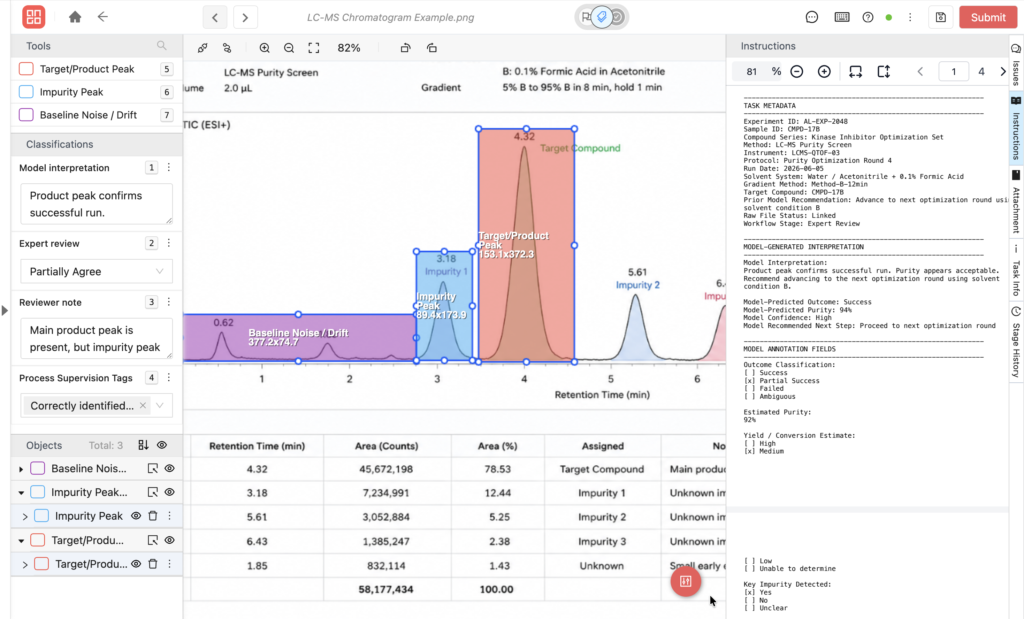
This makes iMerit a strong fit for autonomous lab teams that need more than generic annotation. By combining scientific expertise, secure platform tooling, compliance-aligned operations, and scalable QA, iMerit helps turn complex experimental outputs into structured learning signals for reasoning models, robotic labs, and closed-loop discovery.
2. Scale AI
Scale AI offers a broad data engine for model training, evaluation, human feedback, and RLHF workflows. It is known for large-scale AI data operations and supports enterprise AI teams across multiple domains.
Strengths
- Large-scale data operations for frontier and enterprise AI teams
- RLHF, human feedback, and model evaluation workflows
- Support for multimodal data and model development pipelines
- Automation and infrastructure orientation
Considerations
- Public positioning is broad across enterprise, government, and frontier AI rather than specifically focused on autonomous lab workflows
- Scientific data interpretation may require specialized workflow design and domain expert configuration
- Customer teams may need to define their own lab-specific rubrics, provenance requirements, and scientific reasoning evaluation criteria
3. Labelbox
Labelbox provides a data-centric AI platform with healthcare and life sciences positioning. Its platform supports data management, annotation, model evaluation, and governance workflows for AI development.
Strengths
- Healthcare and life sciences platform positioning
- Support for medical imagery, documents, videos, and other healthcare data types
- Enterprise-grade data governance and AI data management
- Annotation and model evaluation workflows
Considerations
- Public materials emphasize healthcare and life sciences broadly, with less visible focus on autonomous lab-specific workflows
- Scientific reasoning, process supervision, and experiment planning review may require custom workflow design
- Domain expert staffing and scientific annotation rubrics may need to be supplied or configured by the customer
4. SuperAnnotate
SuperAnnotate provides a data annotation and evaluation platform for multimodal and agentic AI workflows. Its public positioning emphasizes human data pipelines, model evaluation, and support for domain-specific AI systems.
Strengths
- Multimodal annotation support across text, image, video, audio, and other formats
- Platform tooling for human data and model evaluation workflows
- Support for agentic, multimodal, and frontier AI use cases
- Configurable workflows and collaborative annotation features
- Subject matter expert marketplace positioning through SME-focused offerings
Considerations
- Public materials are broad and platform-led rather than specifically centered on autonomous labs
- Scientific data interpretation workflows may require additional configuration and expert sourcing
- Lab-specific provenance, calibration, and experimental design review may need to be built into custom workflows
5. Dataloop
Dataloop offers an AI data platform with annotation, automation, model-in-the-loop workflows, and RLHF tooling. Its platform can support data operations across multiple AI development use cases.
Strengths
- Model-in-the-loop annotation workflows
- RLHF Studio and feedback workflow tooling
- Automation, APIs, and SDK support
- Configurable quality rules and project management
Considerations
- Public positioning is broader AI data operations rather than scientific AI or autonomous labs specifically
- Scientific domain expertise and lab-specific review workflows may need to be added by the customer
- More technical onboarding may be required for teams building specialized experimental data pipelines
6. Centaur AI
Centaur AI focuses on expert data annotation for medical AI and life sciences. Its model is built around expert reviewers and scalable annotation workflows for healthcare and life sciences applications.
Strengths
- Life sciences and medical AI specialization
- Expert annotation network for healthcare and life sciences data
- Support for drug discovery, clinical development, multi-omics, clinical notes, and medical AI use cases
- Scalable expert annotation model
Considerations
- Public positioning emphasizes medical AI and life sciences annotation more than autonomous lab process supervision
- Less visible focus on experiment planning feedback, closed-loop optimization, and reasoning-model workflow evaluation
- Autonomous lab teams may need to validate fit for analytical instrument outputs and lab-specific provenance needs
7. Sama
Sama provides managed annotation services across computer vision, NLP, and multimodal AI. Its public positioning emphasizes human-verified data, quality processes, and scalable delivery for production AI systems.
Strengths
- Managed annotation services with human-verified data
- Experience with computer vision, NLP, and multimodal AI
- Scalable delivery model
- Quality-focused data operations
Considerations
- Public positioning is broad across AI data services rather than focused on autonomous lab or scientific reasoning workflows
- Scientific lab data interpretation may require dedicated domain expert sourcing and custom rubric design
- Less visible specialization in closed-loop experimentation, process supervision, and analytical data provenance
Feature Comparison Table
| Capability | iMerit | Scale AI | Labelbox | SuperAnnotate | Dataloop | Centaur AI | Sama |
|---|---|---|---|---|---|---|---|
| Scientific domain experts | ✅ | Partial | Partial | Partial | Partial | ✅ | Partial |
| Complex lab output interpretation | ✅ | Partial | Partial | Partial | Partial | Partial | Partial |
| LC-MS, HPLC, NMR, and assay workflows | ✅ | Partial | Partial | Partial | Partial | Partial | Partial |
| Experiment planning feedback | ✅ | Partial | Partial | Partial | Partial | Partial | Partial |
| Process supervision for reasoning models | ✅ | ✅ | Partial | Partial | ✅ | Partial | Partial |
| RLHF / human feedback workflows | ✅ | ✅ | Partial | Partial | ✅ | Partial | Partial |
| Specialty model dataset creation | ✅ | ✅ | Partial | ✅ | ✅ | ✅ | Partial |
| Metadata and provenance workflows | ✅ | Partial | ✅ | Partial | Partial | Partial | Partial |
| Managed expert workforce | ✅ | ✅ | Partial | Partial | Partial | ✅ | ✅ |
Why iMerit Stands Out for Scientific AI & Autonomous Labs
Autonomous labs are not just another annotation use case. They require a combination of scientific expertise, structured workflows, model feedback design, and quality systems.
iMerit is built for teams that need to move from raw experimental outputs to model-ready data that can support reasoning, planning, evaluation, and closed-loop optimization.
iMerit offers:
- Expert scientific reviewers with chemistry, biology, analytical, and materials science backgrounds
- Structured interpretation of complex lab outputs including chromatography, LC-MS, HPLC, NMR, assays, reaction outcomes, instrument logs, yield estimates, purity profiles, and metadata
- Reasoning-model feedback workflows for experiment planning, protocol review, experimental design, next-best-experiment selection, and scientific reasoning quality
- Process-supervision signals that evaluate how models plan, interpret, reason, and recommend next steps, not just what they output
- Specialty model datasets with calibrated annotations, expert rubrics, benchmarks, and model-monitoring data
- Provenance-aware workflows that connect raw artifacts, expert decisions, derived labels, and final model-ready datasets
- Secure delivery through Ango Hub with model-assisted review, task routing, reviewer consensus, QC controls, and traceable project workflows
- Compliance-aligned data operations for sensitive healthcare and biopharma environments, including HIPAA, GDPR, ISO 27001, and SOC 2-aligned security and governance requirements
- Scalable QA systems including consensus review, adjudication, gold-standard tasks, targeted rework, and scientific quality control
For autonomous lab teams, this creates a more reliable path from experimental data to learning signals that improve AI systems over time.
Build Scientific AI With Expert-Reviewed Data
If you are building reasoning models, robotic labs, specialty scientific AI, or closed-loop discovery systems, the right data partner can help you move faster while maintaining quality, traceability, and scientific rigor.
iMerit helps autonomous lab teams structure, interpret, evaluate, and monitor the data behind AI-driven experimentation.
Schedule a Demo or Talk to Our Experts Or explore our Scientific AI & Autonomous Labs Solutions.