Autonomous labs are moving scientific AI closer to the physical process of discovery.
Across biopharma, chemistry, materials science, and life sciences, teams are building systems that can generate hypotheses, plan experiments, execute protocols, analyze results, and recommend what to do next. This is a major shift from traditional lab automation. Automated labs run predefined workflows faster. Autonomous labs go further by connecting reasoning models, robotics, instruments, and closed-loop experimentation into systems that can learn from every cycle.
The promise is clear: faster experimentation, better reproducibility, fewer manual bottlenecks, and more useful scientific data. But there is a challenge at the center of this shift: autonomous systems are only as good as the feedback they learn from.
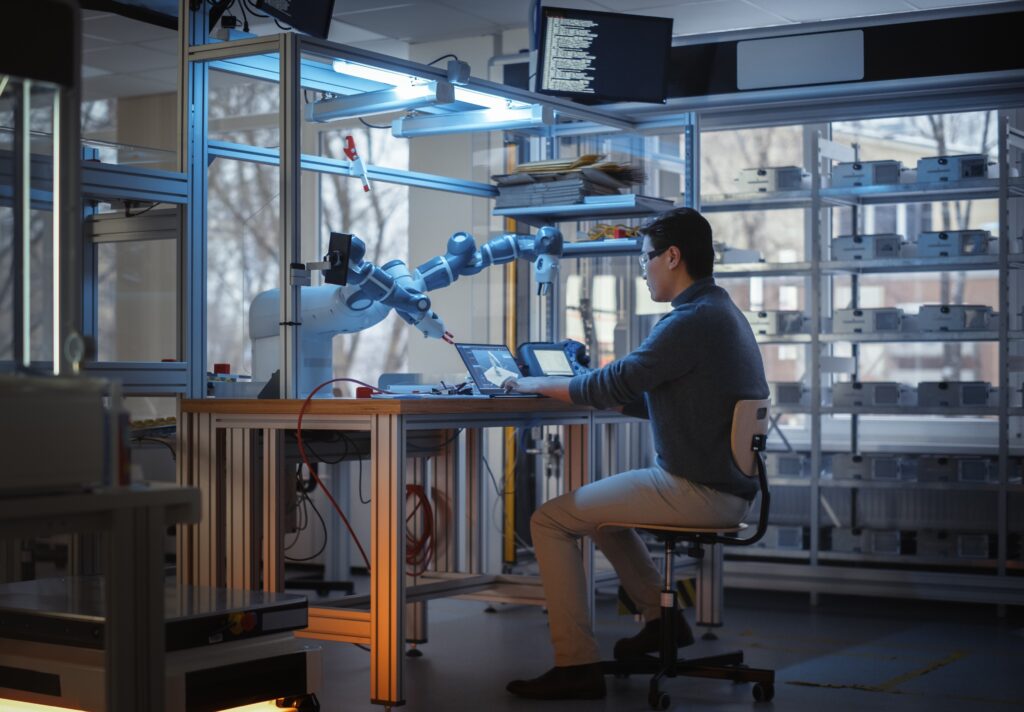
Raw experimental data is rarely ready for AI. Instrument outputs can be noisy, fragmented, incomplete, or difficult to interpret. A chromatography trace may point to purity, impurities, a failed separation, or an ambiguous result. An assay output may need to be understood in the context of controls, sample conditions, instrument behavior, and protocol variation.
For an autonomous system, that context matters. If a model only learns that an experiment “worked” or “failed,” it may miss the deeper signal. It needs to understand why the outcome occurred, whether the experimental design was sound, whether the data was interpreted correctly, and what should be tried next.
The Feedback Layer Is the New Bottleneck
Autonomous labs can generate more data than traditional workflows. But more data does not automatically create better models.
The real bottleneck is turning experimental outputs into structured feedback that models can learn from. That means connecting raw outputs to experimental context, capturing uncertainty, preserving metadata, and translating expert judgment into model-ready signals.
This becomes especially important in closed-loop workflows. If an AI agent receives incomplete or misleading feedback, it may continue recommending experiments based on flawed assumptions. Small errors in interpretation can compound over multiple cycles. As AI moves closer to the lab bench, data quality, provenance, and expert oversight become essential.
Reasoning Models Need Process Supervision
Reasoning models are becoming more important in scientific AI because they can support multi-step decisions: choosing experiments, adjusting variables, designing protocols, interpreting prior results, and recommending next steps.
But a model can produce a plan that sounds plausible while still being incomplete, inefficient, poorly controlled, or scientifically weak. It may miss key constraints, choose the wrong variable to optimize, or overinterpret prior results. That creates a need for process supervision.
Instead of evaluating only the final output, teams need to evaluate how the model reasoned. Was the plan feasible? Were the controls appropriate? Did the model interpret the data correctly? Did it identify the right failure mode? Did it choose a logical next experiment?
This is where expert feedback, RLHF, and RLTF-style workflows become valuable for scientific AI.
How the Field Is Responding
Scientific AI teams are investing in better data infrastructure and feedback workflows.
Standards aware pipelines are creating more connected laboratory workflows with AI systems. Human in the loop review is also expanding beyond labeling to support planning, interpretation, oversight, and continuous improvement.
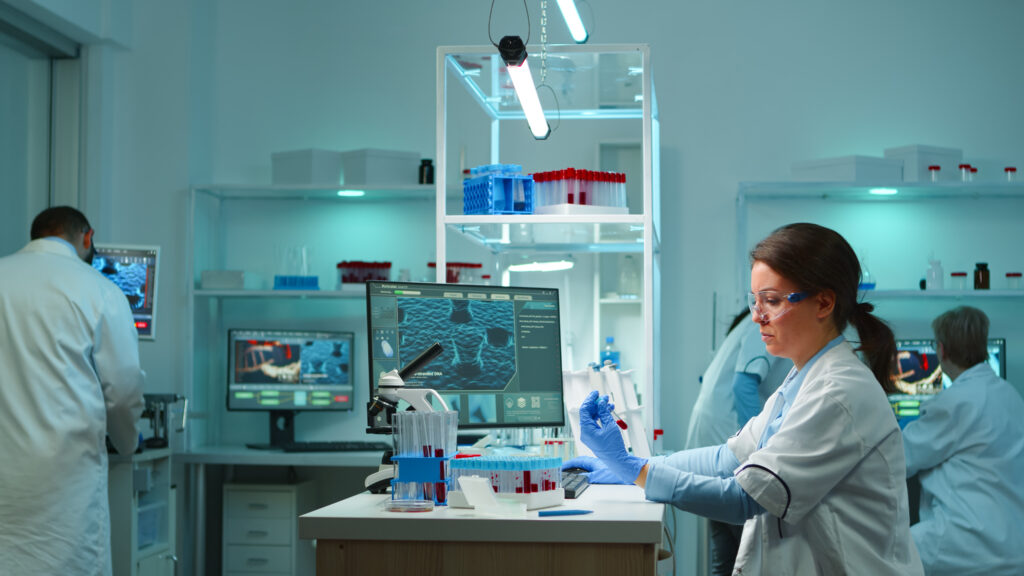
Many teams are also building specialty models trained on proprietary datasets, specific instruments, experimental workflows, or domain-specific tasks. These models can be more useful than general-purpose systems when they are trained and evaluated on high-quality, expert-reviewed data. The common thread is clear: autonomous labs need structured data, expert interpretation, and reliable feedback loops.
Where iMerit Comes In
iMerit helps scientific AI and autonomous lab teams build the expert data layer behind closed-loop discovery.
iMerit supports teams by helping them:
- Interpret complex lab outputs such as liquid chromatography, LC-MS, HPLC, NMR, assay results, instrument logs, reaction outcomes, purity profiles, yield estimates, and metadata.
- Improve reasoning-model workflows with expert feedback for experiment planning, protocol review, experimental design, next-best-experiment selection, and scientific reasoning quality.
- Create process-supervision signals that evaluate how models plan, interpret, reason, and recommend next steps.
- Build specialty model datasets with calibrated annotations, expert rubrics, benchmarks, and model-monitoring datasets.
- Strengthen provenance and quality by preserving links between raw data, expert decisions, and model-ready datasets while using consensus review, adjudication, and scientific QA.
- Support secure, compliance-aligned data operations with workflows designed for sensitive healthcare and biopharma data environments, including HIPAA, GDPR, ISO 27001, and SOC 2-aligned security and governance
- Operationalize expert review through Ango Hub with secure annotation workflows, model-assisted review, task routing, reviewer consensus, QC controls, and traceable project delivery.
The result is a more reliable path from raw experimental outputs to structured learning signals for training, evaluation, closed-loop optimization, and continuous model improvement.
Building the Data Layer for the Lab of Tomorrow
Autonomous labs have the potential to accelerate discovery, but their success depends on the quality of the feedback they learn from.
The next generation of scientific AI will need more than raw experimental outputs. It will need what iMerit provides: structured data, expert interpretation, calibrated feedback, process supervision, reproducible workflows, and ongoing model evaluation.
By turning complex lab outputs into reliable learning signals, iMerit helps autonomous lab teams build AI systems that can reason, plan, interpret, and improve with confidence.
Building an autonomous lab or scientific AI system?
Talk to iMerit about expert-reviewed data workflows for reasoning models, robotic labs, and closed-loop discovery.
Schedule a Demo or Talk to Our Experts Or Explore Our Scientific AI & Autonomous Labs Solutions