A driver’s eyes drift closed for half a second. An infant sits undetected in a rear-facing car seat. A passenger reaches for a fallen object while the vehicle navigates highway traffic. These fleeting moments inside the cabin can determine whether an autonomous system responds appropriately or fails catastrophically. For AI model developers working on Level 3 autonomy, perception systems monitoring vehicle interiors must perform flawlessly across thousands of behavioral variations, lighting conditions, and occupant configurations. The foundation of this performance lies in data annotation for autonomous vehicles, where precision labeling transforms raw sensor feeds into training signals that teach models to recognize drowsiness, distraction, and danger.
What Are In-Cabin Monitoring Systems?
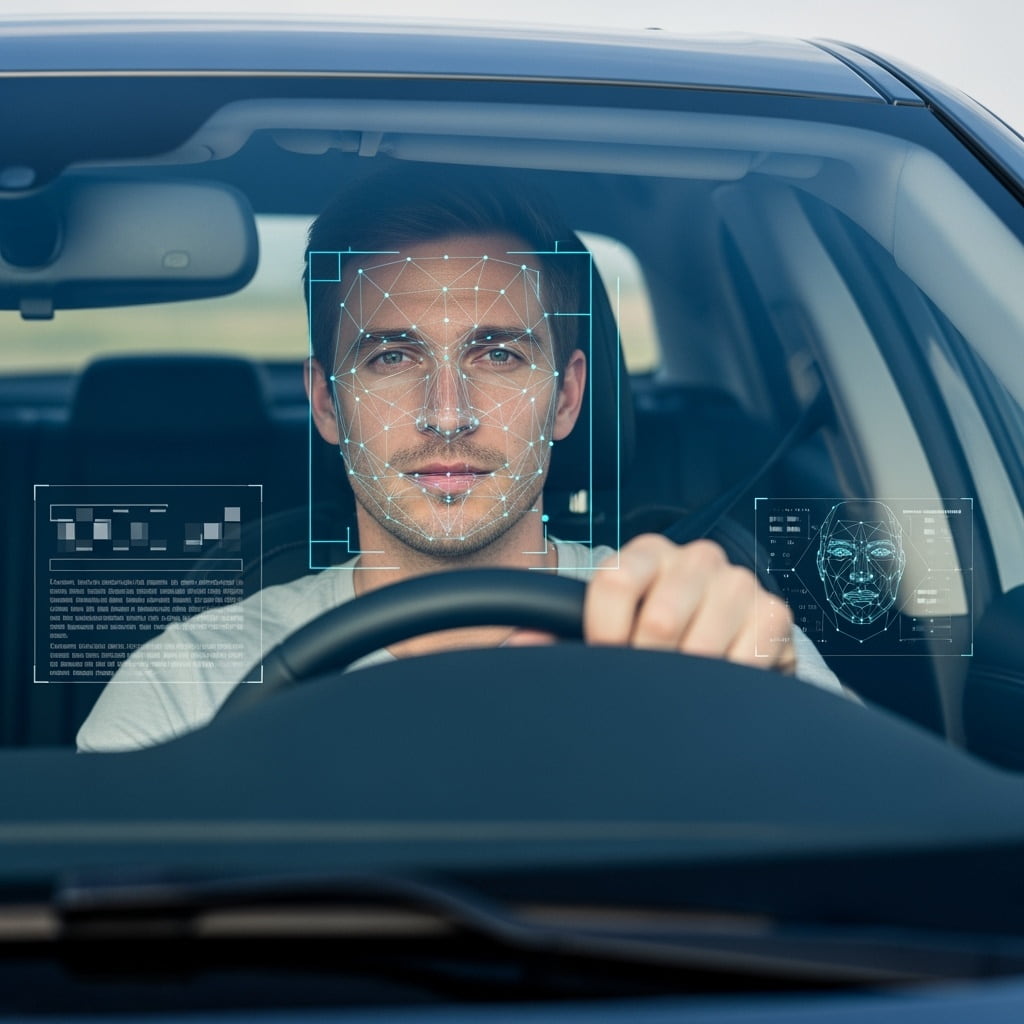
In-cabin monitoring encompasses two complementary technology categories. Driver Monitoring Systems (DMS) concentrate on the person operating the vehicle, continuously assessing attention levels, alertness states, and physical positioning. Occupant Monitoring Systems (OMS) broaden this scope to all passengers, tracking seat occupancy, body posture, and safety compliance throughout the cabin.
These systems pursue four interconnected objectives: Safety, compliance, comfort, and personalization. Safety is a priority, with DMS technology detecting drowsiness, cognitive distraction, and impairment before incidents occur. Regulatory compliance has become pressing as governments implement DMS mandates. Comfort optimization adjusts climate and seating based on preferences. Personalization enables vehicles to recognize individual users and adapt accordingly.
Key Technologies and Use Cases Inside the Cabin
Specialized Sensor Arrays
In-cabin monitoring relies on purpose-built sensor configurations optimized for cabin environments. Near-infrared (NIR) cameras provide consistent imaging regardless of ambient lighting conditions, enabling reliable monitoring during nighttime driving, through tunnels, or during harsh sunlight transitions that would blind conventional cameras. RGB cameras capture rich texture and color information essential for detailed facial expression analysis and object recognition. Time-of-flight (ToF) sensors and structured light systems add precise depth perception for accurate three-dimensional occupant positioning, posture assessment, and gesture tracking. Many production systems employ multi-sensor fusion approaches that combine these inputs to overcome individual sensor limitations and achieve robust performance across diverse conditions.
Computer Vision and Deep Learning Models
Modern DMS and OMS systems deploy convolutional neural networks (CNNs) and transformer architectures trained specifically for in-cabin perception tasks. Facial landmark detection models identify dozens of key points across eyes, eyebrows, nose, mouth, and jaw to enable precise tracking of micro-expressions and gaze direction. Object detection architectures like YOLO and similar real-time frameworks enable the identification of hands, mobile phones, food items, cigarettes, and other objects relevant to driver distraction assessment. Pose estimation networks, such as those built on MediaPipe or OpenPose, analyze full-body positioning and movement patterns across all cabin occupants, supporting applications from seatbelt detection to medical emergency recognition.
AI Algorithms for State Detection
Beyond raw perception, in-cabin systems employ sophisticated classification and regression algorithms that interpret sensor data to assess driver and occupant states continuously. Drowsiness detection algorithms monitor PERCLOS (percentage of eyelid closure) metrics, blink frequency and duration, yawn detection, and head nodding patterns to identify fatigue before it becomes dangerous. Attention models track head pose angles and gaze vectors in real time to determine whether drivers maintain appropriate focus on the roadway ahead. Emotion recognition algorithms analyze facial action units defined by the Facial Action Coding System (FACS) to identify stress, frustration, anger, or contentment that may affect driving behavior and decision-making.
Why High-Quality Annotation Is Critical for In-Cabin AI
Training effective perception models demands annotation across multiple dimensions. Each one ties directly to safety outcomes.
Occupant identification requires precise bounding boxes and segmentation masks so models can accurately count and locate every person in the cabin. Facial landmark annotation involves point-by-point labeling of dozens of features, from eyelids to mouth corners. Errors here lead directly to flawed drowsiness or attention detection. Gaze labels must capture eye position and viewing direction with enough precision to distinguish between a driver checking mirrors and one glancing at a phone. Gesture annotation documents hand positions and movement patterns, helping models determine whether a driver maintains proper control of the vehicle.
Temporal labeling adds another layer of complexity. Unlike static annotations, this type captures behavior sequences and state transitions across video frames. It enables detection of gradual fatigue onset or sudden medical events that a single frame would miss. For automakers pursuing Level 3 approval, the stakes are high. They have to demonstrate reliable DMS performance across demographic variations, lighting extremes, and occlusion scenarios. When annotation is incomplete or inconsistent, teams can face costly retraining cycles that delay market entry and compliance deadlines.
Workflow Best Practices for In-Cabin Monitoring Projects
Comprehensive Annotation Guidelines
Effective projects begin with detailed guidelines defining every label class and edge case procedure. Solution architects and domain experts should collaborate to establish criteria covering scenarios models will encounter in production.
Pre-Labeling with Automated Models
Pre-trained models can auto-annotate common driver behaviors including head pose, eye gaze, facial expressions, and hand movements. This automation accelerates throughput while establishing consistent baseline labels for human review.
Multi-Stage Quality Assurance
Robust quality control requires structured review workflows where multiple annotators can be assigned to the same asset. iMerit’s Ango Hub platform enables reviewers to accept, reject, or fix labels while benchmarking tasks measure annotator performance against established standards. Sample labels can be marked as training examples, helping annotation teams calibrate on edge cases and ideal outputs. AI-assisted quality control implements random sample checks and validation to ensure correctness and consistency across large datasets.
Pipeline Integration and Human Oversight
Annotation workflows must integrate seamlessly with existing data infrastructure. Ango Hub aligns with client pipelines through API connections, webhooks, and configurable task routing, while analytics dashboards provide visibility into project progress and annotator performance metrics. The platform combines automation for routine labeling with active human oversight for complex behaviors and rare events. Real-time troubleshooting allows annotators to flag questions directly to project managers, ensuring edge cases receive immediate expert attention rather than propagating errors through the dataset.
Explore iMerit’s In-Cabin Monitoring Data Annotation Solutions
Building perception systems for driver and occupant monitoring requires annotation capabilities purpose-built for the complexity of cabin environments. iMerit’s in-cabin monitoring data annotation solutions address the full spectrum of DMS and OMS requirements, from driver attention tracking to full-cabin occupant awareness. Expert annotators provide precise landmark, pose, and behavioral labels, which train models to detect unsafe conditions in real-time.
Our Ango Hub platform powers these services with flexible workflows, API integration, and pre-trained models that accelerate annotation through automatic facial point detection. Human reviewers ensure accuracy on complex frames, while custom taxonomy support allows teams to define classifications that match their specific requirements.
For AI developers building Level 3 autonomous systems, iMerit offers secure, compliant annotation infrastructure that transforms raw cabin sensor data into validated training datasets. Contact our team of experts today to accelerate your in-cabin monitoring project.