AI training data becomes production-ready through a controlled pipeline that standardizes raw sources, applies quality filters, removes duplicates and contamination, scores relevance, routes uncertain cases to experts, and validates the final dataset against defined pretraining or fine-tuning requirements.
Frontier models depend on data from web crawls, GitHub repositories, academic corpora, public datasets, licensed sources, documents, and audio; at enormous scale. A single Common Crawl snapshot alone contains 2.7 billion web pages, comprising 386 TiB of raw content.

But data accessibility isn’t the same as data readiness. An off-the-shelf (OTS), licensed, or downloadable dataset can still fail training-readiness requirements: extraction errors, ambiguous provenance, redundant content, or misalignment with the model’s objective.
Raw sources must undergo transformation, validation, and curation to become reliable AI training data. This layer decides which records are kept, transformed, escalated for review, or rejected.
This article explores how OTS data becomes production-ready and how readiness criteria differ for pretraining versus fine-tuning.
Why Off-the-Shelf Data Is Not Production-Ready AI Training Data
Off-the-shelf data cuts collection time, but readiness depends on meeting the model’s criteria for quality, provenance, domain relevance, schema consistency, safety, and evaluation integrity. Failure modes vary by source type.
- Web crawls contain repeated navigation, cookie banners, boilerplate, thin pages, spam, duplicated text, and personally identifiable information (PII). A crawler may retrieve a page successfully, yet extract little useful semantic content.
- Code datasets can contain vendored dependencies, generated files, forks, duplicated code, credentials, low-quality snippets, and licensing constraints. File-level deduplication can still miss function- or repository-level overlap. Stack v2 collected more than 3 billion files and found roughly 40% of permissively licensed files were near-duplicates.
- Papers and documents pose extraction challenges: PDF layouts disrupt reading order, OCR corrupts mathematical notation, tables lose row-column relationships, formulas get omitted, and metadata is often incomplete or inaccurate.
- Audio requires voice-activity detection, segmentation, speaker diarization, overlap handling, timestamp alignment, terminology checks, and transcription validation before training.
These failure modes require different processing rules and thresholds. FineWeb2, for example, uses language-specific classifier thresholds and deduplicates within individual languages rather than one preprocessing configuration across its multilingual corpus.
How a Training Data Pipeline Converts Raw Sources Into Training Assets
Converting OTS data into a training asset requires a controlled sequence of transformations, each changing a record’s representation, eligibility, or training value, while preserving enough metadata to trace it back to its source and reproduce it under specification.
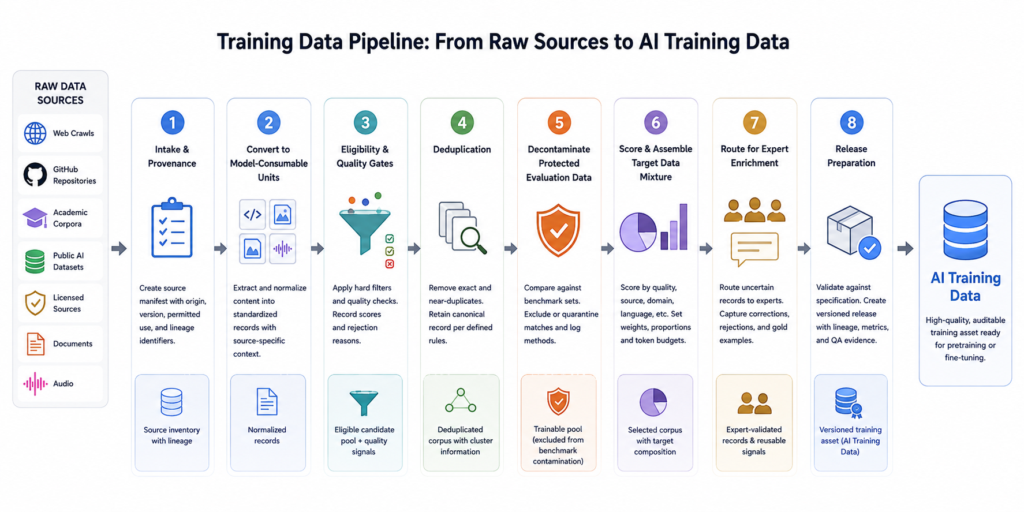
Intake and Provenance
The pipeline first creates a source manifest: origin, snapshot version, collection date, permitted use, language, domain, and raw object identifier. Stable IDs or content hashes maintain lineage as records are extracted, segmented, filtered, or enriched.
Output: a source inventory with origin, version, and lineage tracked per record.
Convert Raw Data Into Model-Consumable Units
Extraction converts each source into the unit downstream systems evaluate: HTML/WARC records become main-content text, code retains repository and file-path context, documents preserve headings, tables, formulas, and layout and audio is segmented into utterances with speaker, timestamp, language, and transcription metadata. The resulting schema standardizes content while retaining source-specific context for filtering and QA.
Output: normalized records with a consistent schema ready for quality evaluation.
Apply Eligibility and Quality Gates
Normalized records pass through deterministic and learned filters. Hard gates remove records that violate training requirements– decoding failures, unsupported formats, blocked sources, exposed credentials, PII, and disallowed content.
Quality filters evaluate language confidence, repetition, text density, domain relevance, and model-estimated utility, retaining triggered rule, score, and rejection reason for auditability.
Output: an eligible candidate pool with auditable rejection and quality signals.
Deduplication
Exact hashing removes identical records. Near-duplicate detection tokenizes content into n-grams, computes MinHash signatures, uses locality-sensitive hashing (LSH) to retrieve candidate clusters, retaining one representative per rule.
Granularity depends on source: document or paragraph for web, file or repository for code, transcript segment for audio. The similarity threshold, comparison unit, clustering method, and canonical-record rule all shape the training distribution.
Output: a deduplicated corpus with cluster membership and canonical-record decisions recorded.
Decontaminate Protected Evaluation Data
The post-deduplication corpus is checked against benchmark and evaluation exclusion sets as part of data curation, using exact hashes, n-gram overlap, and, where required, semantic or model-assisted matching for paraphrased, translated, or reformatted content. Matches are excluded or quarantined, with the benchmark and matching method logged for auditability.
Output: a trainable pool separated from known and suspected benchmark contamination.
Score and Assemble the Target Data Mixture
Quality filtering determines whether a record is usable; mixture construction determines how much influence its source or domain receives.
The pipeline scores eligible data by source, language, domain, quality tier, technical depth, and model relevance, translating signals into selection thresholds, sampling weights, mixture proportions, and token budgets that define the corpus’s composition.
Output: a selected corpus with measurable source, domain, language, and quality composition.
Route Records for Expert Enrichment
Records that can’t be confidently auto-accepted get routed on signals like model confidence, classifier disagreement, domain, risk, rarity, or training value. Domain experts resolve technical terminology, transcription errors, taxonomy ambiguity, domain validity, and conflicting labels. Corrections, rejection, adjudications, and gold examples become reusable outputs that improve later automated passes.
Output: expert-validated records and reusable quality signals.
Release Preparation
The final gate verifies the dataset against its training specification and assigns dataset/schema versions, split definitions, provenance references, composition statistics, and QA results. The release manifest records input volume, retention rate per gate, final source/domain composition, expert-review volume, and the pipeline configuration used to produce it. Only accepted records are exported to the pretraining or fine-tuning pipeline.
Output: a versioned, auditable training asset ready for pretraining or fine-tuning.
Where Automation Stops and Expert Data Operations Begin
Automation carries a record through extraction, language identification, duplicate detection, contamination checks, and quality scoring, with acceptance determined by defined rules or signals. The handoff to expert data operations occurs when those signals can’t determine readiness, typically at three points:
Semantic correctness:
A record passes structural and quality checks, but confirming technical accuracy still requires domain knowledge.Ambiguous acceptance decisions:
Scores fall near acceptance thresholds, or quality signals disagree. Expert adjudication determines whether it enters the training pool, requires correction, or is rejected.Behavior-dependent quality:
For fine-tuning data, an example can be syntactically valid while target response is incomplete, factually incorrect, inconsistent with the rubric, or contradictory to similar examples. So, acceptance requires evaluation against the intended model behavior.
As exceptions increase across datasets, domains, and training objectives, the challenge shifts from identifying where expert judgment is required to providing enough domain expertise and review capacity without slowing data throughput.
If OTS data is already flowing through your pipeline but expert review, routing, and QA are becoming bottlenecks, talk to iMerit about combining domain specialists with managed workflows to move high-value records through production efficiently.
What Production-Ready Means for Pretraining vs Fine-Tuning Data
The data readiness criteria change with the training stage: pretraining readiness is evaluated across the corpus’s composition, while fine-tuning readiness depends on the correctness and behavioral consistency of individual examples.
The table below compares stage-specific readiness requirements.
| Readiness criterion | Pretraining data | Fine-tuning data |
|---|---|---|
| Unit of control | Corpus-level distribution and composition | Individual prompt-response or task examples |
| Quality requirements | Defined quality distribution, domain/language coverage, provenance, deduplication, and decontamination | Domain-correct targets, consistent schemas and rubrics, and difficult-case coverage |
| Training signal | Controlled sampling weights, mixture proportions, and source/token allocation | Consistent supervision across semantically equivalent inputs |
| Validation | Track filter yield by source, language, and domain; validate selection and mixing recipes before full-scale compute | Validate examples against task requirements and isolate protected evaluation data from augmentation and trainable pools |
| Production-ready state | A reproducible corpus with controlled composition and documented data-selection and mixing rules | A task-aligned dataset with validated targets, consistent supervision, and protected evaluation boundaries |
Maintaining these controls gets harder when fine-tuning data spans multiple domains under tight deadlines. iMerit tackled this for a top cloud computing company, delivering 50,000+ domain-specific training units across 10 industries in three months. See the full case study.
How iMerit Turns Raw Sources Into Production-Ready AI Training Data
Executing a data pipeline from OTS to production-ready training data requires workflow control, source-specific tooling, domain expertise, and QA capacity. iMerit combines these through Ango Hub, managed data operations, and iMerit Scholars.
Data Preparation and Workflow Design:
Ango Hub supports configurable AI data workflows with role-based assignment, annotation and review stages, benchmarking, quality control, analytics, and model-assisted processes, letting teams encode acceptance and escalation rules into the workflow.Source-Specific Transformation:
Ango Hub’s text workflows support schema-aware annotation, pre-label imports, routing, review, and quality checks. Audio workflows support transcription, segmentation, timestamps, diarization, PII-related workflows, and multilingual review.Ground-Truth Data Creation:
iMerit combines structured annotation, expert review, and adjudication workflows to create reliable ground-truth data for training and evaluation.Domain-Expert Enrichment:
iMerit Scholars brings SMEs into the data pipeline to refine domain-specific prompts, responses, labels, reasoning traces, and technical content for quality training data. This integration supports model development for supervised fine-tuning as well as reasoning and alignment tasks.Benchmarking:
iMerit develops expert-reviewed benchmarks and structured evaluation datasets to measure model performance, identify failure modes, and support model comparison.Fine-Tuning and QA:
iMerit’s Corpus Augmentation supports enrichment, domain adaptation, and dataset improvement, while Prompt & Response Generation supports fine-tuning data production. Reviewer validation, correction workflows, and QA enforce acceptance criteria before release.
Key Takeaways
AI training data readiness is a training-specific acceptance state. The same OTS corpus can suit one objective and not another, depending on provenance, quality distribution, domain coverage, contamination risk, and required supervision. The goal for data teams: set measurable acceptance criteria and maintain them from raw acquisition through versioned release.
Working with public, licensed, or off-the-shelf data that isn’t ready for pretraining or fine-tuning? Talk to iMerit’s AI data experts to turn raw sources into validated, production-ready training assets.