FID and CLIP measure frame-level quality and prompt alignment, but they miss temporal failures such as identity drift, flicker, and broken motion. Production-grade video generation evaluation combines automated screening, sequence-level review, rubric-based human evaluation with reviewer calibration, and failure taxonomies that show model teams what to fix.
AI generated video can look convincing in individual frames and still fail as a sequence. A person may retain the right appearance in the opening frame but gradually change identity. A hand can reach toward an object while contact breaks between frames. A camera move may begin smoothly and then introduce jitter, shifting geometry, or inconsistent perspective.
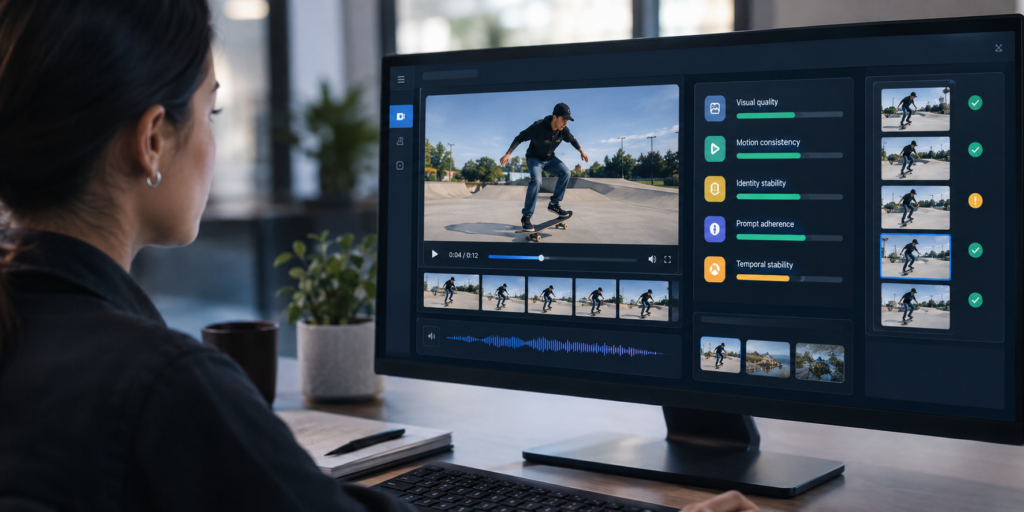
These failures expose a limitation in how video quality is often measured. Metrics such as FID and CLIP-based similarity can provide useful signals about visual quality and prompt alignment, but they do not fully capture temporal consistency, motion quality, or whether a scene remains coherent over time.
This article examines what video generation evaluation requires beyond FID and CLIP, including temporal metrics, motion analysis, human evaluation, and multimodal review.
Why FID and CLIP Are Not Enough for Video Generation
FID and CLIP provide useful signals for evaluating AI generated content, but they do not capture every aspect of video quality. Because generated video unfolds over time, production evaluation also needs to assess consistency, motion, and continuity across the complete sequence.
What FID and CLIP Actually Measure
For video generation evaluation, these metrics are best treated as partial signals:
- Fréchet Inception Distance (FID) compares the distributions of generated and real samples using features extracted by an image classifier. When applied to video by evaluating individual frames, it primarily reflects frame-level visual similarity and quality, rather than whether motion remains coherent across the sequence. FID can also be sensitive to sample size and may not consistently reflect human judgments. However, research has identified limitations in FID itself, including sensitivity to sample size and cases where its score does not align with human judgments.
- Contrastive Language-Image Pretraining (CLIP)–based metrics provide a different signal. CLIP learns aligned image and text representations, making its embeddings useful for assessing whether generated visual content corresponds to a textual prompt. This can help measure prompt adherence at scale. But a high text-video similarity score does not establish that the generated content remains coherent throughout the sequence.
- Both can support automated regression testing and model comparisons, giving teams scalable measurements across large evaluation sets.
Their limitation becomes clearer when the unit of evaluation changes from an image to a sequence.
The Temporal Blind Spot
Video Data can contain plausible individual frames while failing when those frames are viewed together. A person’s face may gradually change identity. Clothing can morph between frames. Objects can disappear or shift position. Hands may deform during movement, backgrounds may flicker, and camera motion can become unstable.
These failures concern relationships between frames, which static measurements of visual feature distributions or semantic similarity do not directly capture. FID measures the distribution of visual features across samples, while CLIP-based measures assess semantic alignment, so a strong score can indicate plausible visual content without showing whether it remains consistent throughout the sequence.
For production use, video quality evaluation needs to measure both what appears in the video and how it changes over time.
What Automated Video Benchmarks Still Miss
Production-grade video generation evaluation cannot be reduced to a single quality score. A useful benchmark needs to separate the different ways a generated sequence can succeed or fail, because temporal consistency itself has several dimensions.
Temporal Consistency is Multidimensional
A production evaluation should distinguish between different types of temporal and sequence-level failures:
| Dimension | What to Check |
|---|---|
| Subject consistency | Does the same person/object remain visually stable? |
| Motion consistency | Does movement progress naturally from frame to frame? |
| Temporal stability | Are there flickers, jumps, or transient artifacts? |
| Spatial consistency | Do objects maintain plausible positions and relationships? |
| Appearance consistency | Do texture, clothing, lighting, and geometry remain stable? |
| Prompt adherence | Does the generated sequence actually perform the requested action? |
This reflects a broader shift in video-generation evaluation research. Benchmarks such as EvalCrafter evaluate generated videos across multiple dimensions, including visual quality, content, motion, temporal consistency, and text-video alignment, rather than treating overall video quality as a single metric.
Later evaluation work like VBench-2.0 has expanded this approach further by examining factors such as human fidelity, controllability, physical plausibility, and commonsense. The implication for production teams is straightforward: a video can score well on one quality dimension while still failing in another that matters to the application.
Newer Benchmarks Show the Evaluation Surface is Expanding
The same trend applies when video generation becomes multimodal. VABench evaluates audio-video generation across 15 dimensions, including text-video and text-audio similarity, audio-video synchronization, and lip-speech consistency.
However, benchmark coverage does not eliminate the need for human evaluation. Automated tests can measure whether audio and video events are synchronized or whether generated content aligns with a reference or prompt, but they are less reliable for judging whether motion looks natural, an action makes contextual sense, or an output is appropriate for its intended use. Human reviewers can assess these sequence-level and contextual qualities using explicit rubrics, while calibration and agreement checks help make those judgments consistent at scale.
A Production-Grade Framework for Video Generation Evaluation
Production evaluation has to answer a practical question. Is the generated video usable for its intended purpose, and if not, why? That requires moving beyond a single quality score and examining the output at the level where failures actually occur.
A strong framework combines scalable measurement with closer inspection of the complete sequence. It then turns those findings into consistent, actionable feedback for model teams.
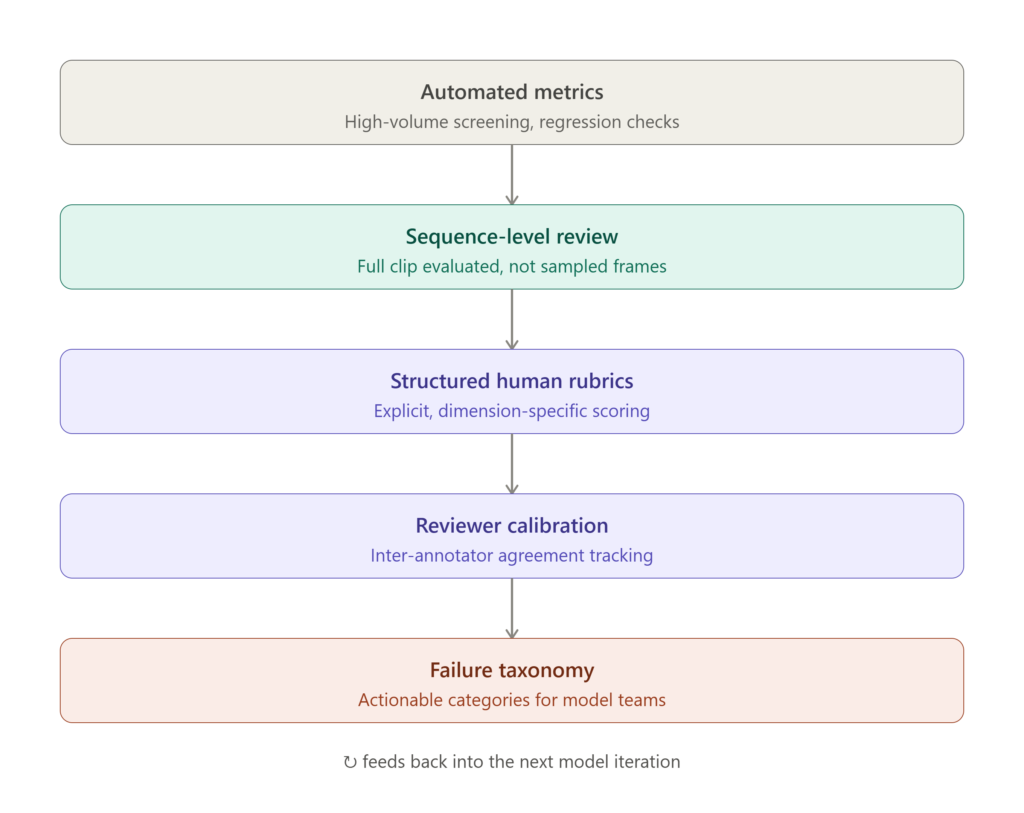
1. Automated Metrics for High-Volume Screening
Automated metrics are useful for screening large batches of generated clips and detecting regressions between model versions. At this stage, teams can use measures for semantic prompt alignment, visual quality, and distributional similarity to identify broad changes across models, checkpoints, or prompt sets.
FID and CLIP-based measures can remain part of this stack, but they should function as signals rather than standalone quality gates. A strong score can indicate that generated content is visually or semantically aligned with the reference data or prompt, but it does not establish that the sequence remains coherent over time.
The metric set should also reflect the application. An image-to-video system may require dedicated measures for source-subject preservation and composition, while an audiovisual generation system needs evaluation methods that examine synchronization between speech, lip movement, sound, and visual events. These specialized checks can then feed into the sequence-level and human evaluation stages that follow.
2. Sequence-Level Evaluation for Temporal and Motion Failures
After automated screening, evaluation should examine the complete video sequence rather than isolated frames. Expanded video generation benchmarks can provide automated signals for temporal consistency, motion, spatial relationships, and other sequence-level properties.
Human review is then used where these signals are difficult to measure reliably, particularly for natural motion, action completion, identity stability, and contextual coherence.
| Evaluation Dimension | Automated or Benchmark Method | Example Reviewer Question |
|---|---|---|
| Temporal consistency | Temporal consistency metrics and expanded video benchmarks | Does the video remain stable from beginning to end? |
| Subject identity | Identity similarity or reference-consistency metrics | Does the subject maintain the same identity and attributes? |
| Motion quality | Motion and temporal metrics, including motion-specific video measures | Does movement appear physically and visually natural? |
| Object permanence | Object tracking and temporal consistency analysis | Do objects persist unless the prompt calls for a change? |
| Spatial relationships | Object tracking and spatial consistency measures | Do objects maintain their expected relationships? |
This combined approach helps identify failures that aggregate metrics can dilute, such as a face changing midway through a clip, an object shifting position, or an action becoming inconsistent as motion progresses.
3. Structured Human Evaluation With Explicit Rubrics
Human evaluation should focus on dimensions that automated metrics cannot reliably capture. Instead of asking reviewers to assign one overall quality score, use explicit and dimension-specific rubrics. For example:
- Temporal consistency: 1 = severe instability, 3 = noticeable artifacts, 5 = stable throughout
- Prompt adherence: 1 = substantially incorrect, 3 = partially fulfilled, 5 = fully executed
- Motion naturalness: 1 = clearly unnatural, 3 = mixed, 5 = natural and coherent
Explicit criteria give reviewers a common interpretation of each score and make results easier to compare across model versions. Evaluation sets should also include both representative production prompts and difficult cases involving complex motion, multiple subjects, longer sequences, reference conditioning, and known failure modes.
4. Failure Taxonomy and Model Feedback
A failed generation should produce more than a low score. It should generate a diagnostic failure category that points model teams toward the underlying problem.
- Identity drift: investigate reference conditioning and subject preservation
- Temporal flicker: investigate temporal stability
- Motion artifact: investigate motion modeling and training data
- Prompt failure: investigate instruction following
- Physics failure: strengthen physical-consistency evaluation
The objective is to turn evaluation into an improvement loop. A production-grade system should show what failed, where it failed, how often it occurs, and whether the next model version reduces that failure. That makes evaluation useful for development decisions rather than limiting it to a leaderboard score.
Where iMerit Fits: Scaling Structured Human Evaluation for Video
Production-grade AI video evaluation needs careful human review. iMerit combines domain-trained human reviewers with structured workflows to evaluate video quality and risk throughout the model lifecycle, from early testing and pre-release validation to post-launch monitoring.
Structured Video Evaluation Through Ango Hub
iMerit combines expert human review with Ango Hub to support structured AI video evaluation at scale. The platform supports configurable workflows for video review, annotation, quality control, and evaluation that can adapt to different model behaviors and risk profiles. iMerit’s video-generation evaluation workflows cover areas such as motion consistency, scene transitions, lip-sync, identity stability, defect tagging, and safety risks.
The approach maps directly to the framework above:
- Configurable rubrics: Turn temporal consistency, motion quality, identity stability, prompt adherence, and risk criteria into explicit evaluation dimensions.
- Reviewer workflows: Route clips through review, validation, and quality-control stages rather than relying on a single judgment.
- Multimodal evaluation: Assess generated video alongside prompts, reference images, audio, and other inputs when required.
- Risk assessment: Identify legal, cultural, ethical, identity-drift, emotional-mismatch, and safety issues alongside technical defects.
- Actionable outputs: Convert judgments into structured labels, defect categories, and evaluation signals that model teams can use for iteration.
The iMerit Scholars network adds domain expertise to this process. Rather than relying only on general annotators, scholars bring domain experts into model evaluation and feedback workflows, including specialists in medicine, STEM, coding, and languages.
Our experience with large-scale video workflows also demonstrates why structured review and quality control matter at the sequence level. When working with Kitware, iMerit processed 189.5 hours of video across nearly 3,000 five-minute clips for an activity-recognition project. We established sequential production and quality-control workflows, incorporated client feedback into the annotation process, and reviewed testing and evaluation data to maintain consistency.
The resulting workflow achieved 97.5% clip quality, with only 2.5% of clips requiring rework. While the engagement focused on video annotation rather than generative video evaluation, it demonstrates the operational foundation required for high-volume video review: structured workflows, continuous feedback, and quality controls that assess video as a sequence rather than as isolated frames. Visit Scholars Page
Conclusion
Production-grade video evaluation requires more than a strong benchmark score. FID and CLIP remain useful signals, but they cannot fully capture temporal consistency, motion quality, identity stability, or whether a generated sequence actually fulfills its intended action.
Reliable evaluation combines automated screening with sequence-level review, structured human judgment, reviewer calibration, and actionable failure taxonomies. This approach helps model teams identify not only whether quality has changed, but also what went wrong and where to focus the next iteration.
Key takeaways
- FID and CLIP are useful signals, but neither is a complete video quality metric.
- Frame-level quality can hide temporal inconsistency and motion artifacts.
- Video generation evaluation should separate prompt adherence, identity, motion, temporal stability, spatial consistency, and physical plausibility.
- Structured human review is necessary for failures that depend on watching and interpreting the full sequence.
- Reviewer calibration and inter-annotator agreement are essential for making human evaluation reliable at scale.
- Production pipelines should combine automated screening with targeted human evaluation and actionable failure taxonomies.
- iMerit’s Ango Hub provides configurable workflows and human-in-the-loop infrastructure for scaling this type of multimodal evaluation.
If your evaluation pipeline is producing aggregate scores but still missing temporal defects, inconsistent identities, prompt failures, or difficult-to-diagnose model regressions, talk to iMerit about building a structured evaluation workflow that connects expert review with actionable model feedback.