The question I keep coming back to is not whether AI can help. It clearly can; but the real question is who gets access to it says Basu.
By Ishani Duttagupta.
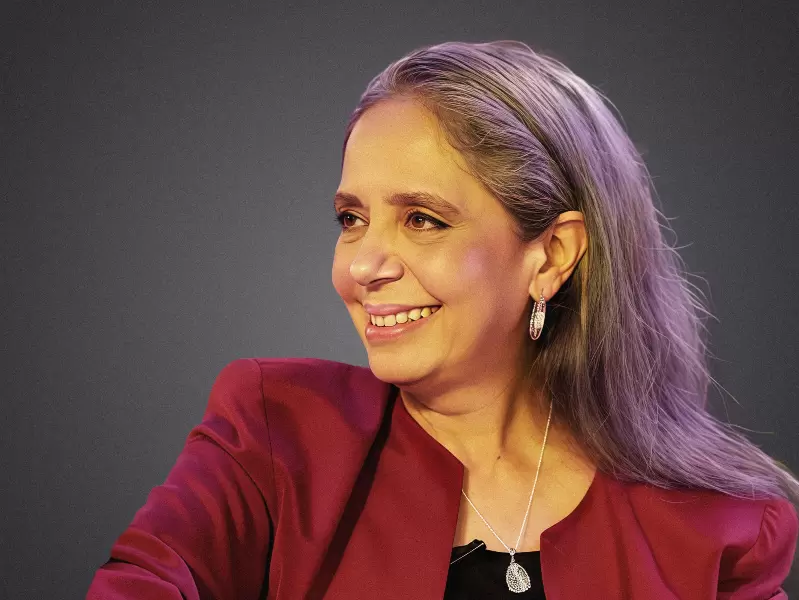
Radha Ramaswami Basu is a pioneering tech entrepreneur whose career spans enterprise software to AI. She established HP’s operations in India while managing the company's $1.2 billion software division. Later, she became the first Asian woman to take a company public on NASDAQ with SupportSoft and also earned a spot on the ‘Top 25 Women of the Web’ list in 2000.
Today, she is the founder and CEO of iMerit, a company that helps top AI labs and enterprises train, tune, and evaluate their models. Global data and AI company EXL recently agreed to acquire iMerit to strengthen its enterprise AI technology.
In an email interview, Basu discusses her journey and the future of AI. Below are edited excerpts from their conversation.
Ishani Duttagupta: You are one of the most recognised names of women in technology leadership in the US – what have been some of the toughest challenges that you have faced?
Early on, HP asked me to establish its first software operations in India, long before there was an Indian tech ecosystem or proof the model could work globally. I focused less on selling the idea of India and more on delivering work that spoke for itself. That operation eventually became a $1.2 billion global business and one of the earliest demonstrations that India could compete at the frontier of enterprise technology.
The 2002 Nasdaq listing of SupportSoft brought a different challenge. As the first woman of Indian origin to take a tech company public, I faced scrutiny that went beyond the business itself. Rather than engage with the noise, I concentrated on building a company with undeniable numbers and loyal customers. Product and performance mattered more than any club or clique.
At iMerit, the challenge has been creating a new category in AI while building an inclusive global workforce. I enjoy overturning assumptions — whether it’s showing up to a San Francisco conference in a saree and speaking about GenAI, autonomy, and healthcare AI, or competing aggressively in enterprise sales. People eventually recognize that I am focused on outcomes, not appearances.
COVID-19 was perhaps the greatest stress test of my career. I led a daily war room, we added 2,000 jobs while much of the industry was cutting back, and my long association with NASSCOM helped us stay connected with other leaders navigating the crisis. My response has always been to bring people along with me, and show results to customers and employees alike. This is my philosophy of ‘Two Feet Planted Firmly on the Ground’.
Please share some details on the role of AI in the area of philanthropy and your own contribution in this area?
The question I keep coming back to is not whether AI can help. It clearly can; but the real question is who gets access to it. What I find genuinely promising is how AI can address the talent shortage inside non-profits, which is a problem the sector rarely discusses publicly. Most foundations and nonprofits struggle for affordable talent in marketing, finance and operations, especially when paid out of the slender overheads they are allowed to keep from grants. AI solutions must help to bridge this gap.
At Anudip Foundation, which my husband Dipak and I founded in 2007, we have reached over 500,000 people across 22 states and 68 districts through 92 skill centers.
In the last decade we focused on inclusive tech education and digital skills to navigate an increasingly digital world.
Today, building an AI-ready populace is a priority. ANUDIP is now a strategic partner of Google and the Asian Development Bank for AI skilling in India, aimed at equipping resource-limited youth with the knowledge and tools to excel in an evolving AI-driven environment.
I am also on the board of the Jhumki Basu Foundation (JBF). JBF was founded in 2009 to honor Prof. Jhumki Basu’s vision of democratizing science education. We fund the STEM Ed Innovators program and support the S. Jhumki Basu STEM Education and Research Center at NYU. JBF trains educators who are trying to reach underserved youth with the same quality of science instruction that well-resourced schools take for granted. We equip teachers with professional development, coaching, and AI-integrated tools to elevate the educational experience and help students become change-makers in their communities.
So, the honest answer to your question is that AI’s role in philanthropy is still being written. The organizations that learn to deploy AI without losing the human touch at the center of good social work will be better placed to reach more people, use resources wisely, and tell their story in ways that actually reflect the depth of what they do.
As CEO of iMerit, you are an advocate for Sovereign AI – please share the context and some examples of how iMerit is working in this area.
For iMerit, I want to look at Sovereign AI in terms of local capability and accountability, not politics. We have experienced how domain specific and region-specific data can have a huge effect on the performance and governance of a model for local conditions. Language and cultural nuance are both significant, of course, but it goes deeper.
In healthcare, we come across certain diseases more frequently in some populations versus others. In agricultural AI, we see indigenous weeds or soil conditions which need special nuance in the data. We also see different environmental, soil and traffic conditions in data capture, whether sensors or cameras.
We should think bigger than Sovereign AI being only about sovereign control over the stack. It is a way to ensure that AI is built on data that actually reflects the people it serves. The local experts weigh in on locally sourced data and this makes the model much more relevant. The AI should aspire to represent the local needs and local wisdom. Trustworthy models come from data that knows where it is, is responsive to where it is, and is also accountable to where it is.
At iMerit, we have been involved with regional data tuning ranging from red teaming for inappropriate cultural questions, to linguistic nuance, to local crop and disease conditions. In all cases we provide inputs on how to structure the data taxonomy, and also what “correct” looks like, by working with local experts.
iMerit is one of the first movers in the space of software-delivered AI services and the need for expert-in-the-loop systems. Please share your perspective on this.
Year after year, we would hear that humans-in-the-loop were a commodity and would soon go away. Now, the picture has changed. Humans in the loop are seen as the experts who help to train, evaluate, tune, improve and oversee the AI. With the rise of Generative AI, this need has gone up a thousand-fold.
Most AI labs have annual budgets of a billion dollars for expert data. Experts are of two types: one are the people who have been working with image and text data over many years at iMerit. They now have a native ability to deal with multimodal data, combining image, video, tabular and text intelligence in ever-increasing contexts. They have gained an experiential expertise,
Second, are our Scholars – a global network of experts who bring together domain knowledge in medicine, STEM, coding and languages, advanced degrees, and unique problem setting/problem evaluation skills. We launched the iMerit Scholars program in 2025. Scholars is a global community of PhDs, MDs, linguists, and engineers who don’t “label” data, they coach, challenge, torment, and coach models the way great teachers test students.
Ango Hub, our software, brings these together with interfaces and workflows that allows us to orchestrate thousands of experts globally and maintain high quality and complexity in rich interfaces to do the work while managing global logistics.
Why are nuance and judgment the real differentiators in building AI-resilient enterprises?
Models have become tremendously capable. With this capability comes great power to handle complex tasks, but also greater ability to create nuanced errors and hallucinations. Each new version of a model brings more and more subtle failure cases.
We no longer have to convince anyone about the crucial role of data itself. Now the conversation is, how do you leverage that data to achieve the outcomes. Specifically, well defined and tagged data is table stakes now. This is why better judgment and governance around data is the differentiator. Heavy context and domain knowledge, and subjective judgement calls, are now the requirement from the data teams.
Take insurance pre-authorization for complex drug treatment. One missed process step, one inconsistent policy flag, one instance of model drift and you are not just making an error, you are affecting patient outcomes. Spotting where and why the model made an error becomes a very nuanced and expert job.
Anticipating where a model could fail becomes a creative design job. Tying in human oversight to a series of judgement calls in an agentic workflow, is no longer what you would historically have called data labelling. Our Ango platform has also evolved to reflect this need, specifically with very complex workflow design capabilities which can mix and match human and model judgement in multi-step flows, and capture large contextual information from the experts.
You have often spoken about the need to work with governments globally on AI. What are some of your takeaways from the AI summit in New Delhi on this?
The summit successfully convened global AI leaders united around a shared vision of responsible and inclusive AI. The consensus was that AI must be purpose-built for societal applications like healthcare, education, agriculture. AI should enable local companies to build solutions for local needs in the Global South.
Large Indian IT businesses can seize this chance because they have built strong trust with enterprises over decades. They can repay that trust by driving successful outcomes in AI, especially in highly regulated industries. India will be both an important consumer and provider of AI, just as it is in digital technology. Both have to progress together.
I was on a panel themed “Scaling Human Potential in the age of AI”. For AI in the enterprise, model performance is only the start of the equation. My focus was on the shift from generic human-in-the-loop workflows to complex expert-in-the-loop systems. Who evaluates it? Who governs it? Who is accountable when it fails? Those are the harder problems.
What stayed with me most was off the main stage after my panel. Young founders, engineers, and students were probing pointed questions about model governance and AI performance. That, to me, is the generation that is actually building what this summit was discussing.