Research published in 2026, including a May survey on dexterous hand intelligence and papers on sim-to-real transfer, shows dexterous manipulation training data remains the field’s core bottleneck. Real-world datasets like RealDex and egocentric video sources are closing the gap that pure simulation data cannot.
Dexterous manipulation research hit an inflection point in 2026. A wave of new surveys and papers converged on the same conclusion: hardware and algorithms have outpaced the data infrastructure needed to train them. For teams building annotation pipelines, including iMerit’s work supporting dexterous manipulation training data, this gap is the real story, since the models are largely ready while the data infrastructure behind them still isn’t.
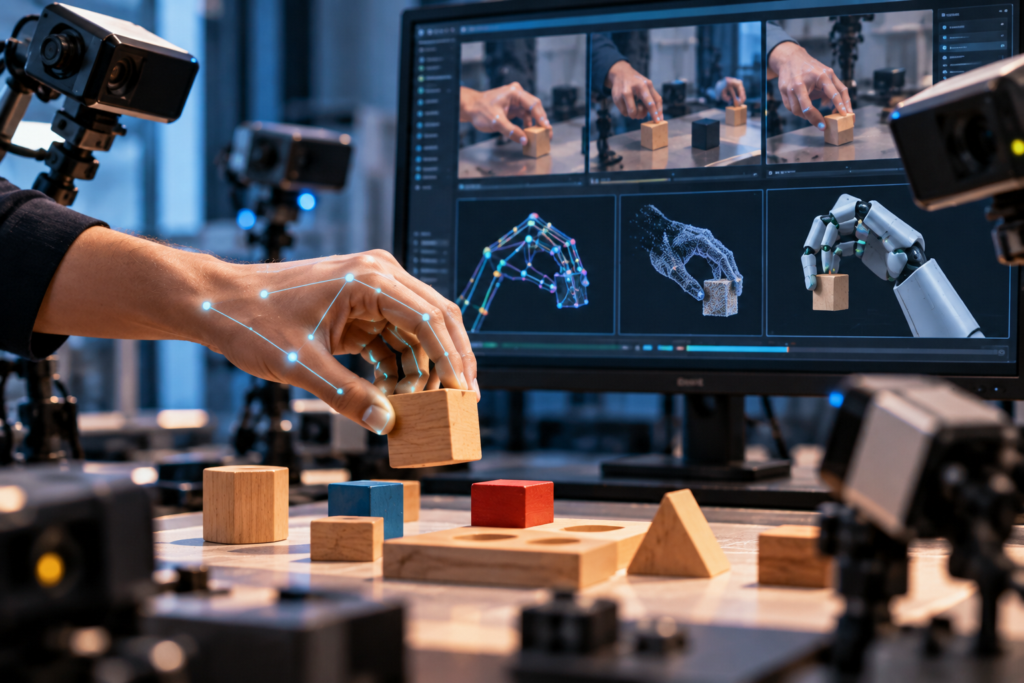
This matters because dexterous manipulation is not pick-and-place robotics. It covers contact-rich tasks, in-hand reorientation, bimanual coordination, and manipulation of articulated tools, the kind of fine motor control that has resisted automation the longest. iMerit’s Scholars network and Ango Hub annotation platform have both been stretched by projects in this space, because the labeling demands are unlike anything in simpler robotic pick-and-place work. Here are five papers from 2026 that show where the field’s data challenges actually sit.
Towards Robotic Dexterous Hand Intelligence: A Survey
This May 2026 survey found that existing studies are often built on different assumptions about hand embodiments, sensor setups, task definitions, training data, and evaluation protocols, which makes it hard to compare results across papers and obscures how the field is actually progressing. The survey reviews dexterous hand research across four angles: hardware, control and learning methods, datasets and evaluation practices, and open limitations, and its core argument is that there’s no agreed-upon way to measure whether one dexterous manipulation system is actually better than another. When training data pipelines feed into models evaluated on inconsistent benchmarks, quality control upstream becomes even more important, because there’s no reliable downstream check.
In-Hand Manipulation of Articulated Tools with Dexterous Robot Hands with Sim-to-Real Transfer
This paper tackles the sim-to-real gap directly, noting that reinforcement learning and sim-to-real transfer have advanced rigid-object manipulation, but policies remain brittle for articulated mechanisms because of contact-rich dynamics that need both stable grasping and simultaneous in-hand articulation. The authors point out that articulated objects and robot hands show under-modeled effects like friction, stiction, and backlash in the real world, which widens the sim-to-real gap, and that robot hands still fall short of idealized tactile sensing in coverage, sensitivity, and specificity. This is a data problem as much as a modeling one, since simulation that can’t capture real friction and backlash behavior leaves the transfer gap unsolved no matter how good the architecture gets.
Towards Human-like Grasping for Robotic Dexterous Hand
The RealDex dataset captures authentic dexterous hand grasping motions with human behavioral patterns, built using a teleoperation system that synchronizes human and robot hand poses in real time. The RealDex paper argues that datasets derived purely from simulation rely on artificial energy functions and detailed object geometry that isn’t practical for real-world use, and that the gap between synthetic and real data leaves trained algorithms with poor real-world applicability and limited generalization. It’s one of the clearest examples of real-world data built specifically to close the sim-to-real gap rather than work around it.
World Models for Learning Dexterous Hand-Object Interactions from Human Videos
The EgoDex dataset addresses a data scarcity problem specific to dexterous manipulation: unlike natural language or 2D computer vision, there’s no internet-scale corpus for this domain. The EgoDex paper introduces 829 hours of egocentric video recorded via Apple Vision Pro, paired with 3D hand and finger tracking data captured at recording time, covering 194 different tabletop manipulation tasks. That level of annotation density, precise skeletal pose data tied to natural video, is a preview of what training data for this domain increasingly requires. It’s not just “label the object.” It’s dense, multimodal, temporally consistent labeling across every frame.
Universal Robotic Dexterous Grasping with Physics Awareness
The DexGrasp Anything dataset argues that quality, diversity, and scale are crucial for advancing the field, particularly for diffusion-based generative methods, since training on a broader data distribution lets models learn richer and more adaptable grasping strategies. The DexGrasp Anything paper positions its own dataset as larger than prior efforts in its comparison table, which says less about that one paper and more about the trajectory: every few months, the bar for “enough data” moves higher, and scale without diversity just repeats the same blind spots at a larger size.
Papers and Their Data Implications
| Paper | Focus | Contribution | Data Implication |
|---|---|---|---|
| Towards Robotic Dexterous Hand Intelligence | Field-wide review | Surveys hardware, methods, datasets, and evaluation | No standardized benchmarks yet |
| Articulated Tools with Sim-to-Real Transfer | Sim-to-real | Flags friction, stiction, backlash as under-modeled | Simulation alone can't close the gap |
| RealDex | Real-world dataset | Teleoperated, human-like grasping data | Reduces reliance on synthetic data |
| World Models (EgoDex) | Egocentric video | 829 hrs of annotated video, skeletal + hand pose data | Raises bar on annotation density |
| DexGrasp Anything | Dataset scale | Large-scale grasping dataset for diffusion methods | Scale without diversity repeats blind spots |
What This Means for Dexterous Manipulation Training Data
Pulling these five papers together, a few implications stand out for anyone building or sourcing training data pipelines in this space:
- First, evaluation inconsistency across the field means labeling quality can’t lean on downstream benchmarks to catch errors. It has to be right at the source.
- Second, the sim-to-real gap points to real-world data, especially teleoperated and egocentric video, as the highest-value additions to a training set right now, not more synthetic augmentation.
- Third, annotation density is rising fast. Skeletal pose, per-hand keypoints, contact points, and confidence scoring are becoming baseline expectations rather than nice-to-haves. Domain experts who understand biomechanics and contact dynamics, the kind of specialists iMerit’s Scholars network brings in, combined with a platform like Ango Hub that can handle synchronized multi-sensor annotation at that density, matter more here than in simpler robotic labeling tasks.
- Fourth, scale alone isn’t the answer if diversity and grasp quality don’t scale with it, since a bigger dataset built the same way as a smaller one just repeats the same blind spots at a larger size.
Conclusion
The bigger picture holds regardless: 2026’s dexterous manipulation research is converging on a shared conclusion, that better hands and smarter policies still fail without dexterous manipulation training data that captures the real-world complexity these systems are meant to handle. The bottleneck has shifted from model design to data design, and that shift only rewards teams who treat annotation as seriously as the papers now do.
Note: Most of these are arXiv preprints, some still on v1 or v2, not yet through peer review. Treat the specific figures and comparisons as reported by the authors, not independently verified.