Carbon Robotics built a single plant foundation model that lets farmers reconfigure their laser weeder for a new crop in minutes, replacing a collection of crop-specific vision systems. The model was trained on nearly 1 million annotated images spanning 184-plus plant types, enabling sub-millimeter weed elimination at scale.
Laser weeding AI just crossed a threshold that used to be its biggest bottleneck. Carbon Robotics recently introduced a single “large plant model” that replaces its collection of crop-specific vision systems, letting farmers customize their laser weeder for a new crop or region in minutes instead of retraining a model from scratch. Behind that shift sits years of data annotation work from iMerit’s weeding robotics team, which trained the system to recognize the subtle differences between crops and weeds across hundreds of plant varieties.
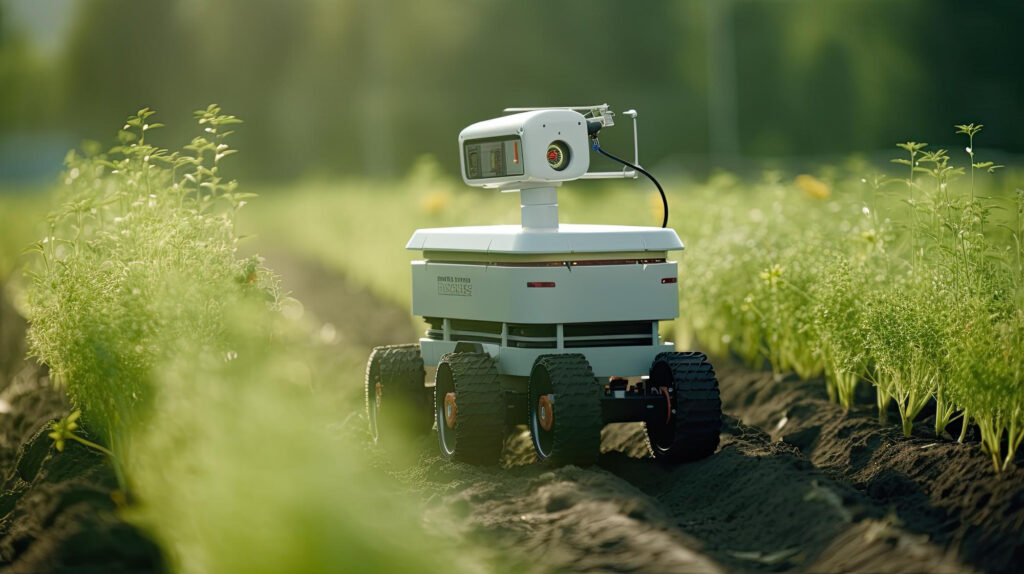
The result is a laser weeder that can be pointed at a carrot field in Arizona in the morning and reconfigured for lettuce or herbs on another farm by afternoon, with only minutes of setup in between. Using a simple iPad app, farmers review thumbnails from their own fields and tag a small number as crop or weed, and the model adjusts immediately without rolling new software or waiting on a retrain cycle. Getting there required solving a harder problem than it sounds: teaching a model to tell a desirable plant from an unwanted one when the same plant can be a crop in one field and a weed in another.
The Challenge Behind Laser Weeding AI
Carbon Robotics built its LaserWeeder to eliminate weeds with sub-millimeter precision, using computer vision to identify plants and lasers to remove the unwanted ones without harming the crop. That precision only works if the underlying model can reliably separate visually similar plants across different crops, geographies, and growth stages, since a young weed and a young crop often look nearly identical. Reliable crop and weed detection at that resolution isn’t just a modeling problem, it’s a data problem, since the model can only be as precise as the examples it was trained on.
Traditional vision models made this expensive to scale. Every new crop or weed type meant retraining, which slowed deployment and limited how many farms and plant varieties the system could support. The system also had to work in real time. A misclassification wasn’t a minor error since it could mean the laser missing a weed or damaging a crop, directly affecting yield.
As Zach New, Manager of Deep Learning at Carbon Robotics, put it: “To target weeds with sub-millimeter accuracy, the system must deeply understand plant structures across hundreds of crop and weed types at every stage of growth.”
Solving that meant Carbon Robotics needed more than a model. It needed a data annotation pipeline built for a problem this specific and this large, one that could keep pace with the field conditions the model would eventually have to handle on its own, the same challenge addressed in multi-stage crop annotation for precision spraying systems.
Building the Data Pipeline: From Polygons to Plant Foundation Models
Carbon Robotics didn’t start with an outsourced pipeline. In the company’s early years, the team labeled plant images themselves, often gathering in a hotel room after a day in the field to tag images by hand. It worked at a small scale, but it wasn’t sustainable.
“As you can imagine, it wasn’t scalable,” said Alex Sergeev, Chief Technology Officer at Carbon Robotics, in an interview with The Robot Report. “So, in 2020, we went on a quest to find a label partner, and that’s when we found iMerit.”
The annotation approach evolved alongside the model’s needs, moving from polygon-based labeling to keypoint and circular annotations that could mark the exact center point of a crop or weed, the precision the laser targeting system depends on. Teams were trained to recognize more than 184 plant variations, including subtle distinctions between crop species and weed types that would be easy for an inexperienced labeler to miss. Sergeev described the collaboration as building custom tooling specifically for this style of labeling, then handing it to iMerit so the workflow could keep improving on both sides: “We could also update it based on their feedback or feasibility, so it was very synergetic.”
iMerit's Role in the Partnership
What started as a five-person proof of concept in 2020 grew into a multi-year engagement supporting over 80 trained specialists. Multi-layer quality review systems kept accuracy consistent as the volume of labeled data grew, and iMerit worked directly with Carbon Robotics to improve the annotation tools themselves, introducing pre-labeling, magnification, and workflow simplification that made each annotation faster without sacrificing accuracy. That collaboration is detailed further in iMerit’s precision weeding case study, which covers the full arc from early labeling work to the scale needed for a plant foundation model.
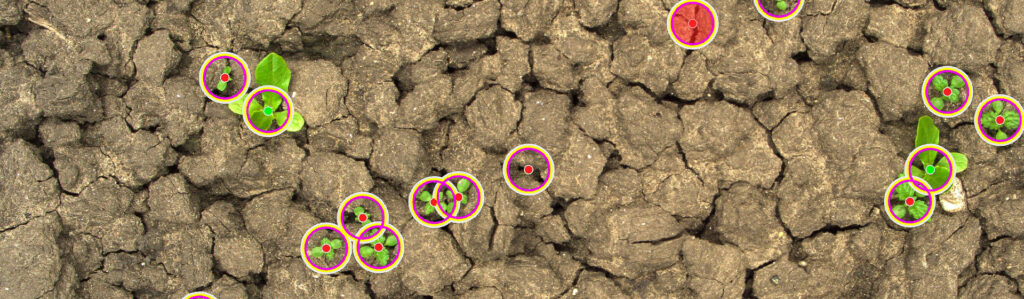
Inside Precision Agriculture Data Annotation at Scale
By the time the plant foundation model was ready, nearly 1 million images had been annotated, forming the training foundation for a system built to generalize across regions and crops instead of relying on one model per plant type. That scale is what separates a research prototype from a production system. Precision agriculture data annotation at this volume only works if quality holds steady across every batch, which is why the review layers built into the pipeline mattered as much as the labeling itself.
Getting to that volume required more than adding people. Through continuous refinement of the annotation workflow, the most complex scenes saw a 61% reduction in time to complete, a meaningful gain when the dataset runs into the hundreds of thousands of images. The engagement also expanded past labeling into real-time monitoring, sometimes called triage. Instead of only preparing training data, operators began reviewing live machine outputs in active field deployments, catching crop and weed detection errors before they compounded and feeding that feedback back into the system. That human-in-the-loop layer let Carbon Robotics keep refining performance in production, not just during training, which is ultimately what let the team move from a model that needed retraining for every new field to one that could adapt on the spot.
What's Next for Laser Weeding AI
The plant foundation model is only the first piece of what Carbon Robotics is building. The company recently released Carbon ATK, an autonomy kit that retrofits existing John Deere 6R, 8R, 8RX, and 8RT tractors (2019 and newer) without permanent modifications. The kit includes the cameras and sensors needed for perception and position tracking, enabling obstacle avoidance, path planning, and mission definition without a driver in the cab. Fusing that sensor data reliably in a field is a different problem than the perception systems built for roads, one that agricultural sensor fusion has to solve for dust, uneven terrain, and crop canopy that behave nothing like a paved road, the same perception and path-planning challenge iMerit supports through its autonomous mobile robot annotation work.
Paired with a smart implement like the LaserWeeder, a tractor outfitted with Carbon ATK can run a full weeding mission autonomously, and the same kit can support other tasks like tillage, spraying, and harvesting. None of it works without the same foundation: a model that understands plant structure well enough to make fast, accurate decisions in the field.
Laser weeding AI from Carbon Robotics can now eliminate up to 500,000 weeds per hour with sub-millimeter precision, powered by a plant foundation model trained on more than 1 million annotated images spanning 184-plus plant types, the product of a multi-year data annotation partnership with iMerit. As autonomy extends from the implement to the tractor itself, that same data foundation is what will keep making the next generation of farm automation possible.