Precision spraying machine learning has transformed how farms approach weed management, targeting herbicide application at the plant level, reducing chemical input, and protecting crop yield. But in production environments, many precision spraying models underperform, delivering inconsistent detection, elevated false positive rates, and poor generalization to edge cases that are routine in real field conditions.

The cause is rarely the model architecture. It’s the training data; specifically, the annotation quality behind it. Crop and weed detection annotation at the plant level demands a standard of precision that most general agriculture datasets were never built to meet. This gap, often invisible at the dataset level, surfaces at inference time: in the field, under pressure, at scale.
This post breaks down why plant-level weed-crop discrimination is genuinely hard, where general datasets fall short, and what annotation precision actually looks like for teams building production-grade precision spraying machine learning systems.
Why Plant-Level Discrimination Is Harder Than It Looks
For most precision agriculture AI teams, detecting the presence of weeds at the field zone level is largely a solved problem. Plant-level discrimination is a different challenge entirely; a model must correctly distinguish an individual weed from an individual crop, often at early growth stages and under conditions that make visual differentiation genuinely difficult.
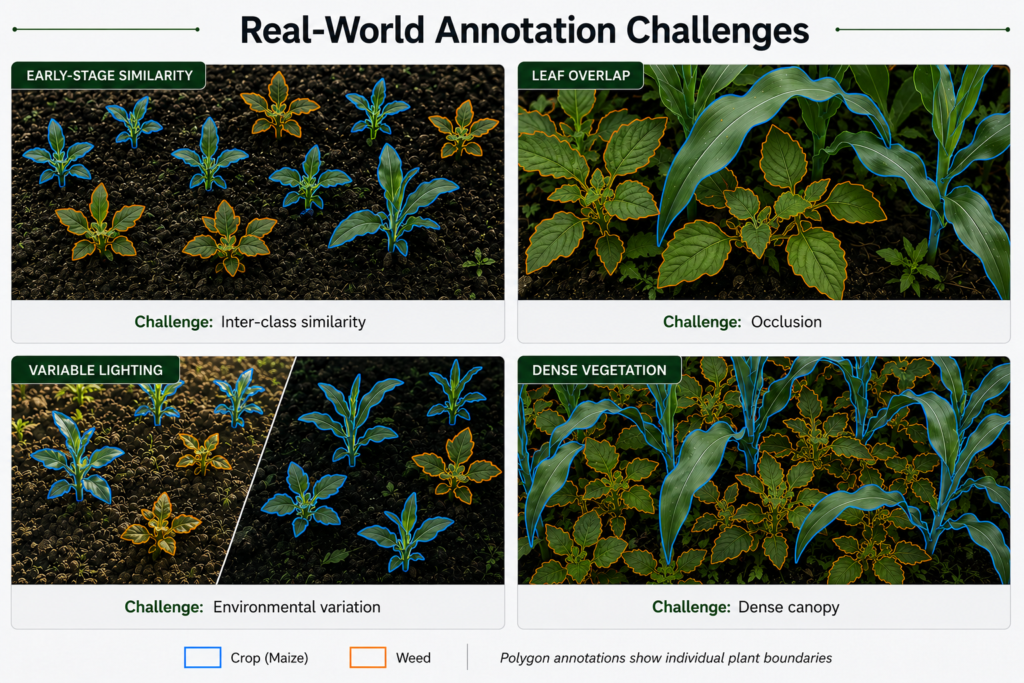
This is the distinction the industry calls green-on-green detection; identifying weeds growing among live crop plants; versus the comparatively simpler green-on-brown case of spotting weeds against bare soil. John Deere‘s See & Spray Select handles the latter; its Premium and Ultimate tiers, along with systems from Carbon Robotics and Greeneye, take on the harder green-on-green problem.
Three factors make this hard. First, inter-class similarity: many weed species closely resemble the crops they grow alongside, especially as seedlings. A young pigweed and a cotton seedling share leaf shape, color, and texture characteristics that challenge even experienced agronomists. Second, intra-class variation: the same weed species looks different across growth stages, soil types, lighting conditions, and geographies. A model trained on mature specimens in ideal lighting will not generalize to early-stage plants in overcast field conditions.
Third, occlusion and overlap: in dense crop rows, plants overlap, leaves occlude stems, and growth patterns are irregular. A precision spraying machine learning model operating on a ground-level robot or drone feed must handle all of this in real time. That makes annotation reflecting these conditions, not idealized lab conditions, the baseline requirement for reliable performance.
What General Agriculture Datasets Don't Provide at the Plant Level
General agriculture datasets were largely built for different purposes: crop type classification at field scale, yield prediction, disease detection at canopy level. They were not designed for plant-level weed detection training data requirements, and the gaps show up clearly when teams try to use them for precision spraying applications.
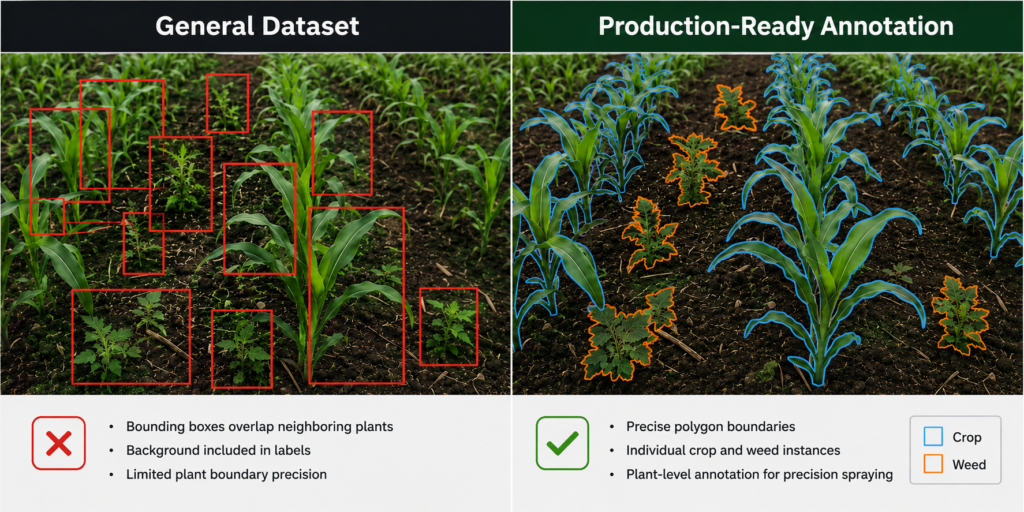
The first gap is annotation granularity. Most public datasets use bounding box annotations adequate for object detection tasks where presence and rough location are sufficient. Precision spraying models need polygon-level annotations that capture the actual morphology of each plant instance. A bounding box around a weed in a dense crop row includes portions of the neighboring crop plant. That overlap teaches the model the wrong boundaries.
The second gap is species-level labeling. Datasets that label “weed” as a single class are not useful for models that need to distinguish broadleaf from grass weeds, or specific invasive species from background vegetation. Different weed species require different herbicide formulations. A model that cannot discriminate at the species level cannot support variable-rate spraying. This isn’t a hypothetical requirement. Greeneye’s production system is trained to identify more than 250 weed species across different crops and field conditions, and Carbon Robotics’ LaserWeeder G2 runs real-time processing across 100+ crop models production-grade granularity a single “weed” class dataset cannot support.
The third gap is growth-stage coverage. A dataset dominated by mature plant imagery will produce models that fail on seedlings exactly at the stage where early intervention matters most for plant-level weed detection ROI. Class imbalance across growth stages is common in general datasets and rarely flagged.
The fourth gap is geographic and environmental diversity. A dataset collected in one region, one season, or one crop type does not transfer reliably to different soil conditions, lighting environments, or crop varieties. Agricultural image annotation for production models must reflect the diversity of deployment conditions, not just where data collection was convenient.
What Annotation Precision Actually Requires at the Plant Level
Building training data that closes these gaps requires deliberate annotation design, not just more data. For crop weed detection annotation at the plant level, four requirements stand out.
Polygon annotation over bounding boxes
Weeds are not rectangles. Their shapes are species-specific, growth-stage-dependent, and irregular. Polygon annotations that conform to the actual plant boundary give models richer geometric signals for discrimination. When applied by annotators who understand morphological differences between species, polygon annotation encodes biological knowledge that carries through to inference.This distinction matters at evaluation time too: polygon boundaries that tightly conform to plant morphology directly improve IoU (Intersection over Union) scores during model validation, since bounding-box annotations systematically inflate the overlap region between adjacent plant instances.Species-level and growth-stage labeling schemas
Annotation schemas must capture the classes the model actually needs to distinguish not a simplified crop vs. weed binary, but species-level labels across growth stages. This requires domain expertise at the schema design stage, not just the annotation stage.For example, a schema might label crops by species and growth stage (cotyledon, 2-leaf, 4-leaf, mature), with weeds labeled the same way, plus a separate tag for occlusion level (none, partial, heavy) on each instance. This lets the model learn discrimination signals conditioned on the growth stage rather than treating all instances of a class as visually uniform.
Domain-expert annotators for edge cases
Standard crowdsourced annotation pipelines are not adequate for plant-level weed detection training data. Early-stage plants, visually similar species, and occluded specimens require annotators with agronomy knowledge who can make judgment calls a general labeler cannot. This is where crop weed detection annotation quality most directly determines model performance.Field-representative data diversity
Agricultural image annotation for precision spraying must include images from varied conditions, different times of day, weather states, soil backgrounds, crop densities, and geographic regions. Systematic diversity prevents models from fitting to narrow conditions and failing in deployment. The scale this requires is substantial: Carbon Robotics’ Large Plant Model was trained on 150 million labeled plant images collected from more than 175 LaserWeeder units operating across 100+ crops in 15 countries, a benchmark for the geographic and environmental coverage plant-level detection models need to generalize.
How Annotation Workflow Design Affects Precision Spraying Machine Learning Accuracy
Even with the right schema and qualified annotators, workflow design determines whether quality holds at scale. For precision spraying machine learning pipelines, several factors directly affect downstream model accuracy.
Human-in-the-loop review layers are non-negotiable for edge cases. Automated pre-labeling can accelerate throughput on clear examples of well-lit, single-species, mature plants but ambiguous cases require expert review. A workflow that routes edge cases to domain-expert reviewers catches the errors that most damage model performance in production.
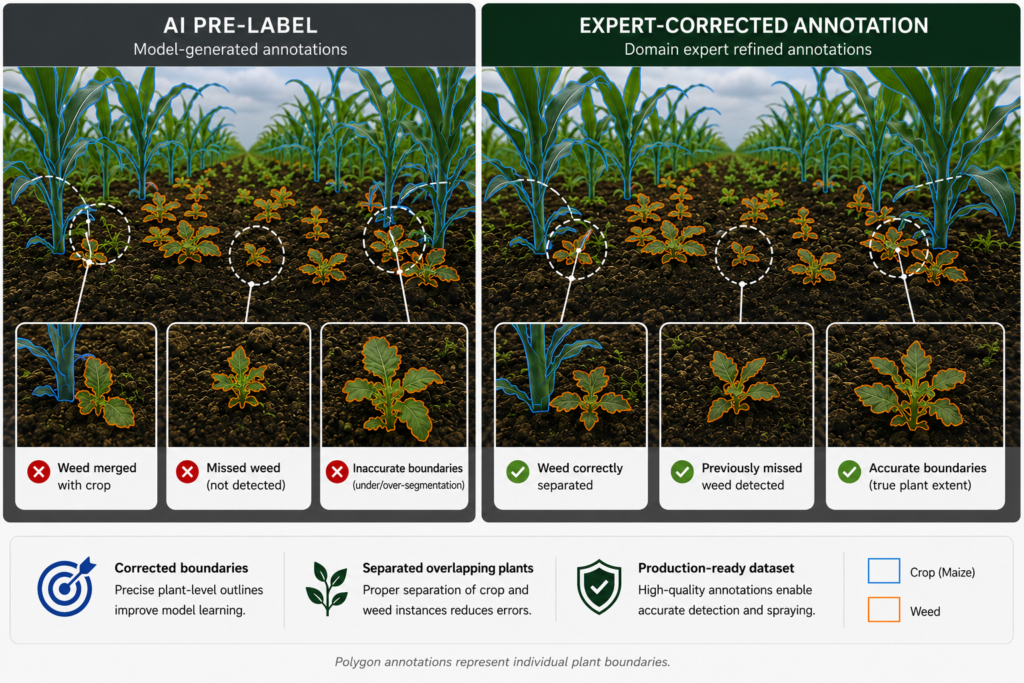
Consistency standards across annotators matter at scale. Small variations in how annotators draw polygon boundaries or assign growth-stage labels create noise that compounds across large datasets. Annotation consistency requires explicit labeling guidelines, inter-annotator agreement checks, and regular calibration across teams.
This is typically measured through inter-annotator agreement metrics; such as IoU overlap between annotators labeling the same image, or Cohen’s kappa for class-label agreement.
Synthetic data augmentation addresses class imbalance. Sparse weed instances relative to crop and background is a persistent problem in agricultural datasets. Synthetic augmentation, applied carefully to underrepresented classes, can address imbalance without proportionally expensive real-world data collection provided synthetically augmented data is held to the same annotation precision standards as real imagery.
Dataset-level QC goes beyond task-level review. Checking class distribution, geographic coverage, growth-stage balance, and annotation consistency across batches is what separates pipelines that produce reliable models from those that look good on test sets but fail in deployment.
What to Look for in an Annotation Partner for Precision Agriculture
For ML teams building precision spraying models, the annotation partner question is a capability question, not just a capacity one.
- Domain expertise in agronomy: Annotation teams who understand plant biology, weed species morphology, and growth stage characteristics will produce materially better weed classification training data than generalist labelers. Ask specifically how domain knowledge is embedded in the annotation workflow, not just who reviews final output.
- Flexible annotation tooling: Precision spraying applications require polygon annotation, semantic segmentation, and growth-stage classification, often within the same dataset. A platform that supports configurable workflows without custom engineering for each new schema reduces time-to-training-data significantly.
- Scalable HiTL infrastructure: The ability to route edge cases to expert reviewers, run inter-annotator agreement checks, and maintain quality across millions of images and multiple crop types is what separates annotation infrastructure from annotation tooling.
- Track record with agricultural AI at production scale: Look for evidence of handling the challenges of precision ag: overlapping vegetation, variable lighting, multiple crop types, and multi-stage datasets. Weed classification training data at production accuracy levels requires operational experience, not just technical capability. iMerit’s work with Sentera on corn tassel identification across diverse field conditions is an example of this production-scale annotation experience translating directly into model performance.
iMerit’s precision agriculture annotation capabilities powered by Ango Hub and domain-expert annotators support teams building weed detection, crop classification, and precision spraying machine learning systems at scale. Explore iMerit’s Crop and Weed Detection solution.