Amazon Mechanical Turk shuts down September 30, 2026, prompting AI teams to rethink how they source and validate human-generated data. Alternatives should prioritize contributor expertise, AI-use verification, quality control, and provenance. iMerit Ango Hub and iMerit Scholars combine qualified contributors with annotation, evaluation, and QA workflows.
For more than two decades, Amazon Mechanical Turk was the default answer to a simple question: how do you get human judgment at scale, quickly and cheaply? On September 30, 2026, that answer went away.
Amazon has not publicly attributed the closure to one specific cause. Its closure notice says the decision followed an assessment of its programs, tools, and services. Any explanation beyond that should therefore be treated as industry context rather than Amazon’s stated rationale.
Still, MTurk’s closure arrives during a fundamental change in the economics and meaning of human-generated data.
The Original MTurk Proposition
Mechanical Turk was built around tasks computers could not reliably perform. Requesters broke work into Human Intelligence Tasks, or HITs, and distributed those tasks to a large online workforce.
That model was remarkably influential. It gave researchers and companies fast access to human judgment without requiring them to recruit and manage a workforce directly. But AI has changed both sides of that equation.
- First, machines can now perform many tasks that once required inexpensive human labor. Classification, transcription, summarization, basic content generation, and other common microtasks can increasingly be automated or AI-assisted.
- Second, AI can now imitate the human output requesters are trying to collect.
What AI Teams Are Actually Losing When MTurk Closes
The operational disruption is real and immediate. Active HITs stop accepting new submissions on September 30. Requesters lose access to their existing worker pools, qualification lists, and any custom scoring logic built on top of MTurk’s APIs. Teams that have been running annotation pipelines, research panels, or evaluation workflows on MTurk will need to rebuild those workflows elsewhere, and do it before the deadline.
Beyond the logistics, the more important loss is the assumption that built MTurk’s success: that a large, always-available, low-cost crowd could serve as a universal solution for any task requiring human judgment. That assumption is what the AI industry needs to re-examine most carefully.
When Human Data Might Not Be Human
A 2023 study by researchers Veniamin Veselovsky, Manoel Horta Ribeiro, and Robert West examined MTurk workers completing an abstract summarization task. The researchers estimated that 33 to 46 percent used large language models while completing that task.
The researchers explicitly cautioned that the result may not generalize to tasks where LLMs are less useful. That caveat matters. It would be inaccurate to conclude that 33 to 46 percent of all MTurk work is AI-generated.
But the study exposed a broader problem that has only become more important: if an organization is paying specifically for human judgment, it needs a way to verify that the judgment actually came from a human.
That finding cuts to the core of what crowdsourcing is supposed to deliver. If a platform sells access to human judgment but cannot verify that submissions are human, the value proposition shifts from “human intelligence at scale” to “responses at scale”, and those are not the same thing, especially when AI-generated data being used to train AI models creates a feedback loop that degrades model quality over time.
From crowd size to contributor provenance
For years, human-data platforms could compete on access, price, throughput, and workforce scale. Those attributes still matter, but they are no longer sufficient for many AI workflows.
Increasingly, teams need answers to questions such as:
- Who completed this annotation?
- What qualifications did that person have?
- Did the contributor use prohibited AI assistance?
- How has that contributor performed on similar tasks?
- Can another qualified person review the result?
- Can the organization audit how the final label was produced?
These are provenance questions, not simply labor-supply questions.
Why Expertise Is Becoming More Valuable
AI development is also pushing human work toward more difficult tasks. If a model can reliably perform a simple classification task, paying thousands of anonymous workers to perform that same task becomes less compelling. Human involvement becomes most valuable where models struggle, where mistakes are expensive, or where evaluation requires nuanced domain knowledge.
That includes areas such as medicine, science, engineering, coding, robotics, complex multimodal evaluation, and other specialized domains.
The consequences of getting this wrong are not abstract. A generalist crowd worker labeling a radiology scan may produce a confident, plausible-looking annotation that is clinically incorrect. An anonymous contributor evaluating a legal contract may miss nuances that a practicing attorney would catch immediately. In AI data annotation for high-stakes domains, completion is not the same as correctness and the gap between the two only widens as tasks become more complex.
ML models are increasingly capable of handling routine annotation; pre-labeling images, flagging obvious categories, or transcribing clean audio. But the tasks where models struggle are precisely the tasks where the stakes are highest. A model can draw a bounding box; it cannot reliably assess whether a lesion on a CT scan warrants clinical concern. A model can classify text sentiment; it cannot evaluate whether a contract clause creates legal exposure. Domain experts are not needed where AI is confident, they are needed where AI is uncertain, where errors are costly, and where the reasoning behind a label matters as much as the label itself.
The scarce resource is therefore changing. It is not simply human attention. It is trustworthy human expertise.
What the MTurk Shutdown Signals
The MTurk shutdown should not be interpreted as proof that crowdsourcing itself is dead. Broad participant pools remain useful for research, surveys, consumer studies, and many general-purpose tasks.
The more important lesson for AI teams is that the old assumption of anonymous human labor as a universal data solution for human data quality is weakening. Modern AI data pipelines increasingly need three things together:
- Qualified contributors.
- Purpose-built annotation and evaluation tooling.
- Quality and provenance systems that make the resulting data defensible.
That is the opportunity behind iMerit Ango Hub + iMerit Scholars.
Scholars focuses on sourcing qualified contributors rather than treating every human as an interchangeable unit of labor. Ango provides the annotation, workflow, and quality layer around that workforce.
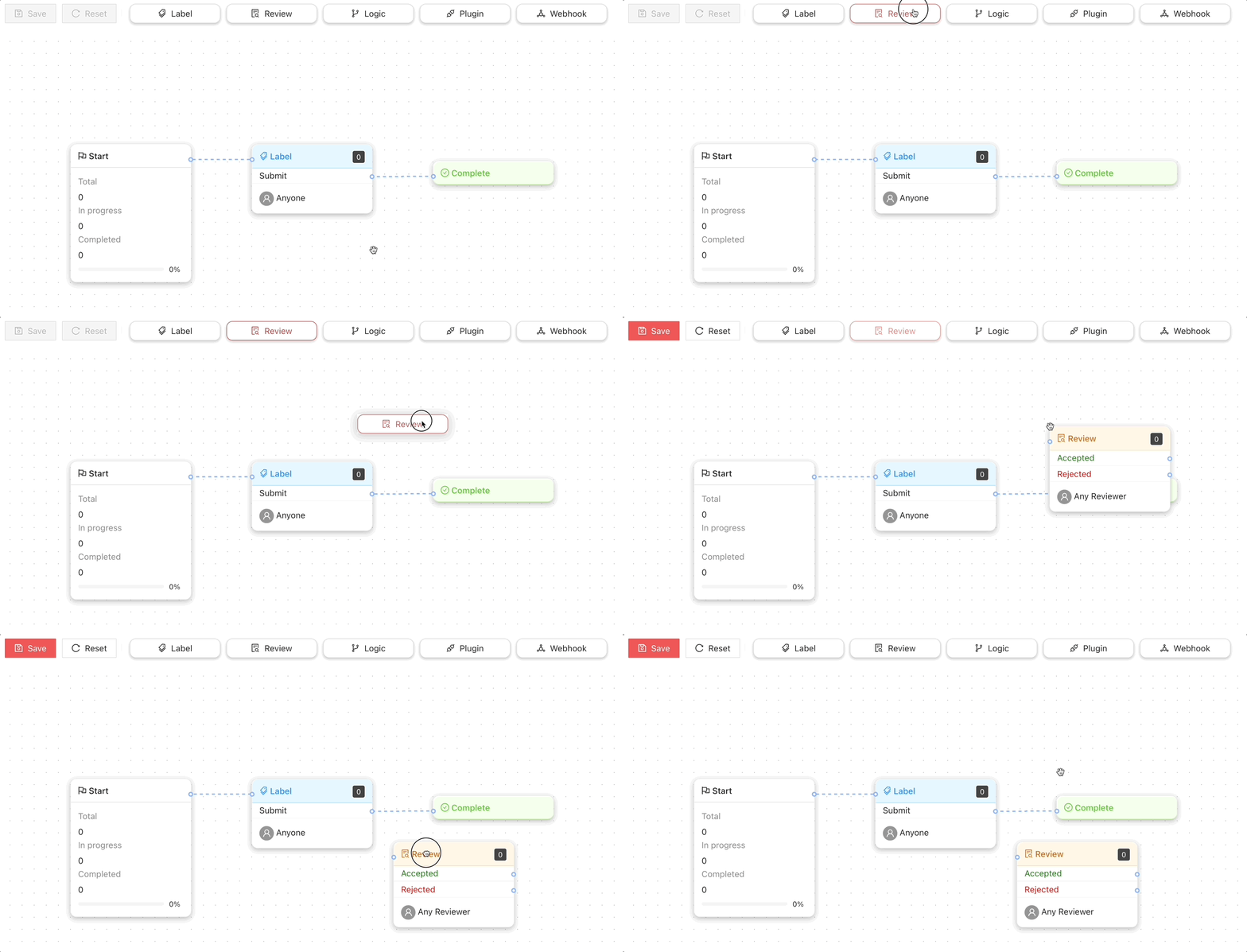
Where MTurk gave you access to a crowd, Scholars gives you access to credentials; a meaningful distinction when the work requires domain knowledge that an anonymous pool simply cannot guarantee.
The distinction matters more now than it did when Mechanical Turk launched in 2005. Generative AI has made synthetic output cheap and abundant. What becomes scarce in that environment is reliable evidence that a knowledgeable human actually made the judgment you are paying for.
What to Look for in an MTurk Replacement
Not every MTurk replacement will serve every use case. The right choice depends on what your tasks actually require.
For surveys, behavioral research, and general consumer studies, a broad crowdsourcing platform may still be the right fit. For AI data annotation, model evaluation, RLHF, chain-of-thought labeling, or any domain-specific task where incorrect labels have downstream consequences, the criteria change significantly. You need verified contributors, an annotation platform built for modern AI workflows, and a quality layer that produces an auditable record of who did what.
iMerit’s Ango Hub + Scholars is built for exactly that second category. Scholars sources domain-vetted experts; physicians, mathematicians, engineers, linguists, rather than opening tasks to an anonymous crowd. Ango manages the annotation workflow, qualification checks, reviewer layers, and audit trail around that workforce. The result is AI training data and evaluation output that teams can defend.
If you are currently evaluating your post-MTurk options, our guide to the best Mechanical Turk alternatives in 2026 covers the full landscape from general crowdsourcing platforms to expert networks, and what each is best suited for.
The Future of Human Data
MTurk helped establish the idea that human intelligence could be accessed programmatically at internet scale. That idea is not disappearing, it is evolving into something that demands far more from the platforms and workforces that deliver it.
The next generation of human-data infrastructure will need to combine software, workforce management, verification, and expertise. For organizations building AI systems, the question is shifting from “How many humans can we reach?” to “Can we prove the right humans produced this data?”
That is a much higher bar than what MTurk was ever designed to clear, and for organizations building AI systems today, it is increasingly the only bar that matters.