Every evals engineer at a frontier lab hits the same wall eventually: the public benchmark that used to separate strong models from weak ones stops doing its job. Scores cluster near the ceiling, the gap between a genuinely capable model and an overfit one collapses, and the leaderboard stops telling anyone anything useful.
This is benchmark saturation, and it’s not a rare failure mode, it’s the default lifecycle of any static, public evaluation set once frontier model testing catches up to it. The fix isn’t a harder public benchmark, it’s a custom, domain-specific evaluation set built to stay discriminative as models improve.
How Benchmarks Lose Their Discriminative Value
The mechanics are straightforward, even if the fix isn’t. Public benchmarks are, by definition, public, which means their questions, answer keys, and scoring rubrics are visible to anyone training a model. Once a benchmark is popular enough to matter, its items start showing up in pretraining and instruction-tuning corpora, whether by direct inclusion or by proxy through discussion, commentary, and derivative datasets that reference it.
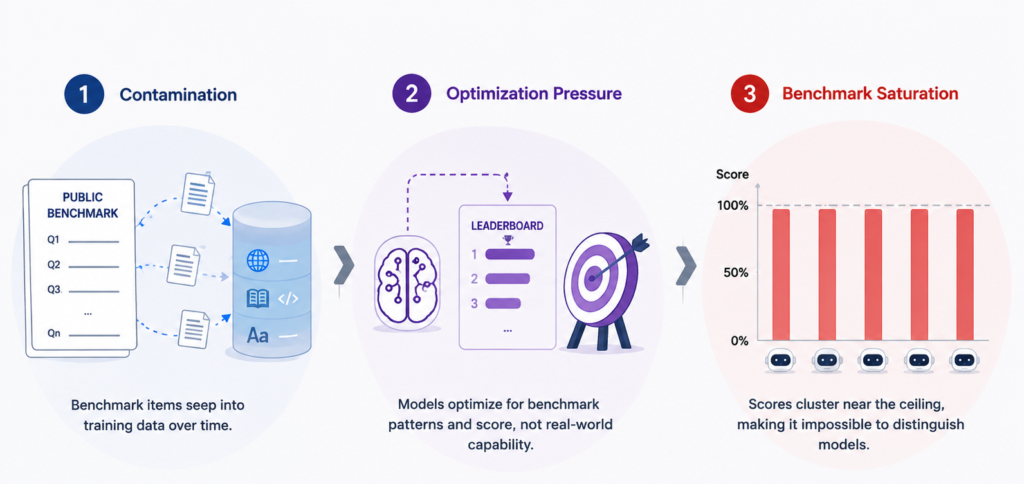
Contamination doesn’t need to be deliberate to be real, which is exactly why domains built on applied, expert-validated tasks like defect detection tend to resist it better than generic, publicly-scraped question sets.
Even without contamination, there’s a second failure mode: optimization pressure. Once a benchmark becomes a reference point that labs are measured against, there’s an incentive to tune toward its specific distribution of tasks, phrasing conventions, and difficulty curve, improving the score without necessarily improving the underlying capability the benchmark was meant to measure. This is a version of Goodhart’s Law playing out in real time: a measure that becomes a target stops being a good measure.
There’s also a structural problem: item difficulty calibration decays even when nothing about the benchmark itself has changed:
- A fixed-item benchmark is calibrated against the model generation it was built to test
- As frontier models improve, the same items shift from “discriminative” to “trivial”, not because the questions got easier, but because the population of models being scored against them moved
- This is distinct from contamination or overfitting: a fixed difficulty ceiling simply stops being a ceiling once the models being tested clear it
The result is a benchmark that saturates, not because every model has actually reached some true ceiling of capability, but because the benchmark can no longer separate models that have from models that have merely learned the benchmark, or that have simply outgrown its difficulty range. For the evals engineer making the real go/no-go call on a model release, a saturated benchmark is worse than no benchmark at all, it creates false confidence, and false confidence at the point of a release decision is expensive to unwind after the fact, whether that shows up as a regression discovered post-launch or as a capability claim that doesn’t hold up under scrutiny.
What A Durable Evaluation Set Actually Requires
Fixing this isn’t a matter of writing a harder version of the same benchmark. A durable alternative needs four things that most public benchmarks structurally lack, the same things a static set has no way to address once benchmark saturation sets in, and each one only holds up if it’s operationalized with specific mechanics, not just stated as a principle
Domain-specific Difficulty:
General models rarely encounter this kind of problem in typical training data, not just longer or more convoluted versions of familiar task types, but problems requiring applied, professional-level reasoning. Operationalizing this means difficulty stratification: tagging items by required expertise level and reasoning depth, then tracking model performance by stratum rather than as a single aggregate score. A model can look strong on an aggregate number while failing consistently on the highest-difficulty stratum, and stratification is what surfaces that gap instead of averaging it away.
For example: A model can score well on a standard public benchmark’s math or reasoning section while failing on a custom set built around a narrower, newer domain-specific scenario, an edge case that requires recognizing a specific real-world constraint the public benchmark never tests for. The public benchmark says the model is strong; the custom set shows exactly where it isn’t. That gap is the entire argument for domain-specific construction.
A Continuous Refresh Schedule:
A benchmark built once and left static has a shelf life no matter how well-constructed on day one. Operationalizing refresh means setting explicit item retirement thresholds, for example, retiring an item once a defined share of frontier models solve it correctly, rather than retiring items on a fixed calendar schedule regardless of whether they’ve actually become easy. It also means routine contamination checks: testing whether previously unseen items are being solved suspiciously well by models that shouldn’t have had exposure to them, which is often the first signal an item has leaked.
Defensible Scoring:
This is where most custom evaluation sets are weakest, and where the real technical difficulty lives. A rubric is only as strong as its construction process. That starts with expert-authored scoring criteria reviewed by a second expert for ambiguity, but the harder problem is evaluator disagreement. Domain experts scoring the same item can still disagree on partial credit, especially on multi-step reasoning where a model gets some steps right and one wrong.
This requires an adjudication process: a defined path for resolving disagreement, whether that’s a third expert reviewer or a documented tie-breaking rule, so a single evaluator’s judgment call doesn’t silently become the ground truth. Inter-rater agreement needs to be tracked on an ongoing basis, not just checked once at rubric launch, because agreement drifts over time as evaluators see more edge cases. Just as important is distinguishing genuine model failure from an ambiguous evaluation item: if multiple qualified evaluators disagree on what the correct answer even is, that’s a signal the item itself needs revision, not that the model failed.
Ongoing Evaluator Calibration:
Related to the above, but distinct, this is about domain experts scoring the same rubric consistently over time, not drifting from each other as they see more model outputs or shifting their bar without realizing it. This requires periodic recalibration sessions, not just a one-time inter-rater check at launch.
There’s a fifth problem underneath all of this that’s easy to overlook: statistical comparability across refreshes. When items are retired and replaced, a score change between two versions of the benchmark could mean the model genuinely improved, or it could mean the new item set happens to be harder or easier than the old one.
Distinguishing these requires holding a subset of anchor items constant across versions specifically so scores can be equated back to a common scale, similar to how standardized testing handles form-to-form comparability. Without anchor items or an equating method, a refreshed benchmark can’t actually tell you whether a score change reflects the model or the test, which defeats the purpose of refreshing it in the first place.
Multidomain Construction as the Actual Differentiator
This is where custom evaluation sets built with embedded domain experts, rather than generalist annotation teams, start to separate from anything a public benchmark can offer. iMerit’s Scholars network puts domain specialists directly into the benchmark construction process itself, and the Ango Deep Reasoning Lab extends that into structured chain-of-thought evaluation: building golden reasoning traces and iteratively correcting flawed intermediate reasoning steps, rather than scoring only the final answer.
The value of this shows up most clearly across domains that don’t reduce to a single evaluation format.
- In mathematics, this has meant constructing an original corpus of complex chain-of-thought problems spanning dozens of subdomains of formal and applied math, with step-wise correction built into the annotation process itself, not just answer-checking, but reasoning-checking.
- In healthcare, it’s meant physicians across specialties validating fine-tuned model outputs against real clinical encounter notes in a HIPAA-compliant environment, where the difference between a technically fluent answer and a clinically correct one requires a practitioner’s judgment to catch.
- In manufacturing, the same principle applies to visual and reasoning tasks around defect detection, subject matter experts evaluating edge cases against established inspection standards, the kind of nuanced call a general-purpose model has no exposure to from web-scale data.
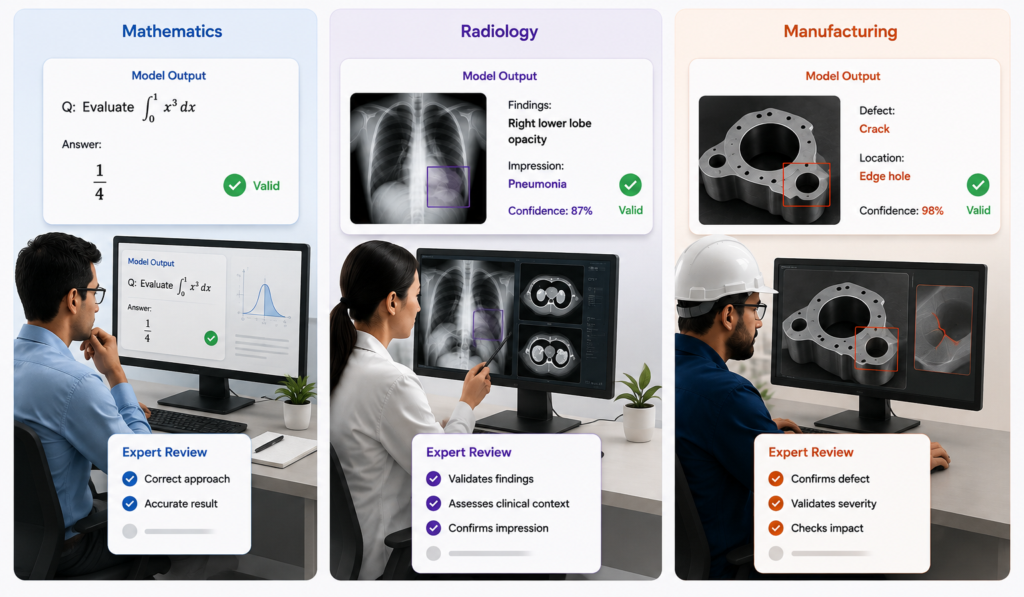
What connects these is not the subject matter, it’s the construction discipline. Domain-specific AI benchmarks built this way stay hard for the right reasons: not because the questions are obscure, but because they require expertise the model wasn’t trained on and can’t shortcut its way around.
The construction process itself looks different from how a general-purpose benchmark gets built. Instead of a single annotator producing a question and an answer key, an item moves through domain expert authorship, a second expert review pass, and, for chain-of-thought tasks specifically, a reasoning-trace validation step where intermediate steps are checked independently of the final answer. That matters because a model can reach a correct answer through flawed reasoning, and a benchmark scoring only the final answer will miss it. Scoring the trace is what makes an evaluation set useful for diagnosing why a model fails, not just whether it failed.
This also changes what “hard” means as a design goal. A general-purpose benchmark tends to get harder by adding more steps, longer context, or more obscure trivia. A domain-constructed benchmark gets harder by requiring the kind of tacit, applied judgment that professionals in that field develop over years of practice, the difference between a physician who can recite a differential diagnosis and one who knows which detail in a specific patient’s history changes the answer. That kind of difficulty doesn’t show up in a training corpus scraped from the public internet, which is exactly why it holds up as a discriminator for longer.
Operationalizing Continuous Refresh
Building a strong first version of a domain-specific benchmark solves the day-one problem. It doesn’t solve the six-months-later problem, which is really the point of this whole discussion, a benchmark that isn’t actively maintained will eventually saturate no matter how well it was constructed initially.
A working refresh cycle needs a few concrete mechanics: item retirement and rotation, so the benchmark doesn’t accumulate a long tail of items that have quietly become easy; contamination monitoring, checking whether previously-unseen items start looking suspiciously well-handled across multiple models, often the first sign of exposure; and version control on the evaluation set itself, so a score from six months ago and a score today are either genuinely comparable or explicitly flagged as not. This is the operational discipline iMerit builds into its Scholars-led benchmark programs; refresh isn’t a periodic project, it’s a standing part of how the evaluation set is maintained.
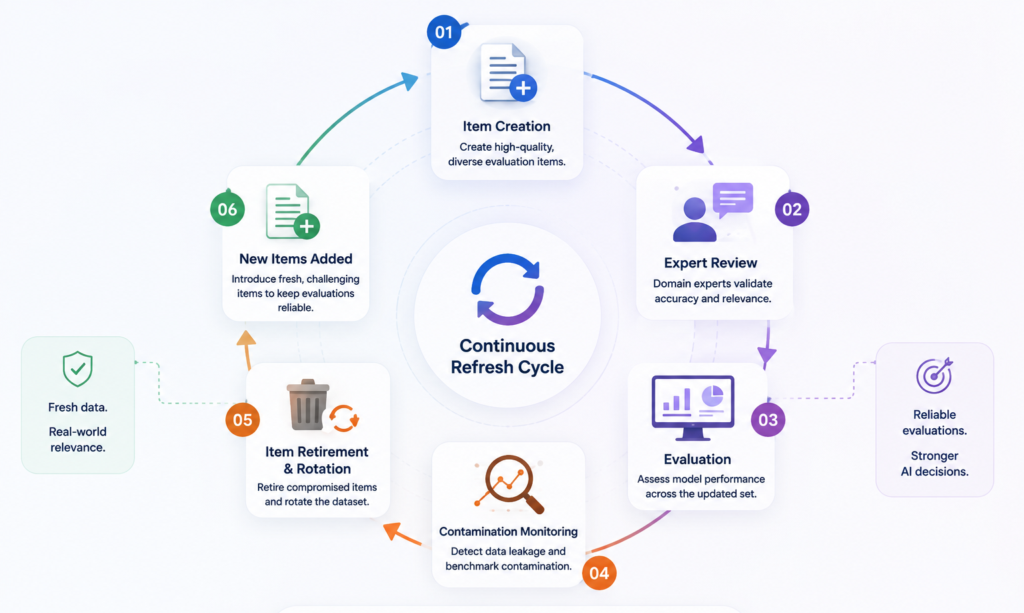
None of this is exotic engineering, it’s the same discipline applied to a training data pipeline, and it’s what separates a one-off benchmark from a true AI evaluation pipeline. Most public benchmarks were simply never built with this kind of maintenance loop in mind; they were designed to be a fixed, citable reference point, not a living evaluation asset.
Building an Evaluation Pipeline for Frontier Model Testing
For evals teams deciding how to keep frontier model testing meaningful as models improve, the practical question isn’t whether public benchmarks are useful, they still have a place for baseline comparison and public communication. The question is whether your evaluation infrastructure has a path to stay ahead of saturation as your own models improve past what static, public sets can measure.
That’s a construction problem as much as a scoring problem. This is the model iMerit has built its evaluation practice around: an AI pipeline that combines embedded domain experts, continuous refresh, and defensible multidomain scoring, so it doesn’t go stale the moment a model clears the current bar, because the bar itself is designed to keep moving. That’s the standard custom evaluation sets are built to meet, and it’s the standard public benchmarks were never designed to hold.
iMerit builds and maintains exactly this kind of custom, multidomain evaluation set for frontier labs, using its Scholars network to keep benchmarks discriminative as models improve. Contact iMerit to learn more.