CVPR 2026 took place at the Colorado Convention Center in Denver, and for the iMerit team, it was more than a conference; it was a window into where computer vision, robotics, and AI development are heading next. Drawing 12,200 registrants from 84 countries and receiving 16,092 paper submissions, a 24% increase over 2025 it was the largest CVPR on record.
The World Is Moving; Literally
If there was one sentence that captured the mood of CVPR 2026, William Black, Gen AI Data Solutions Executive, said it best:
“Robotics is everywhere. Computer vision used to be about recognizing objects in photos; now the entire field is oriented around machines that move, act, and interact with the physical world.”
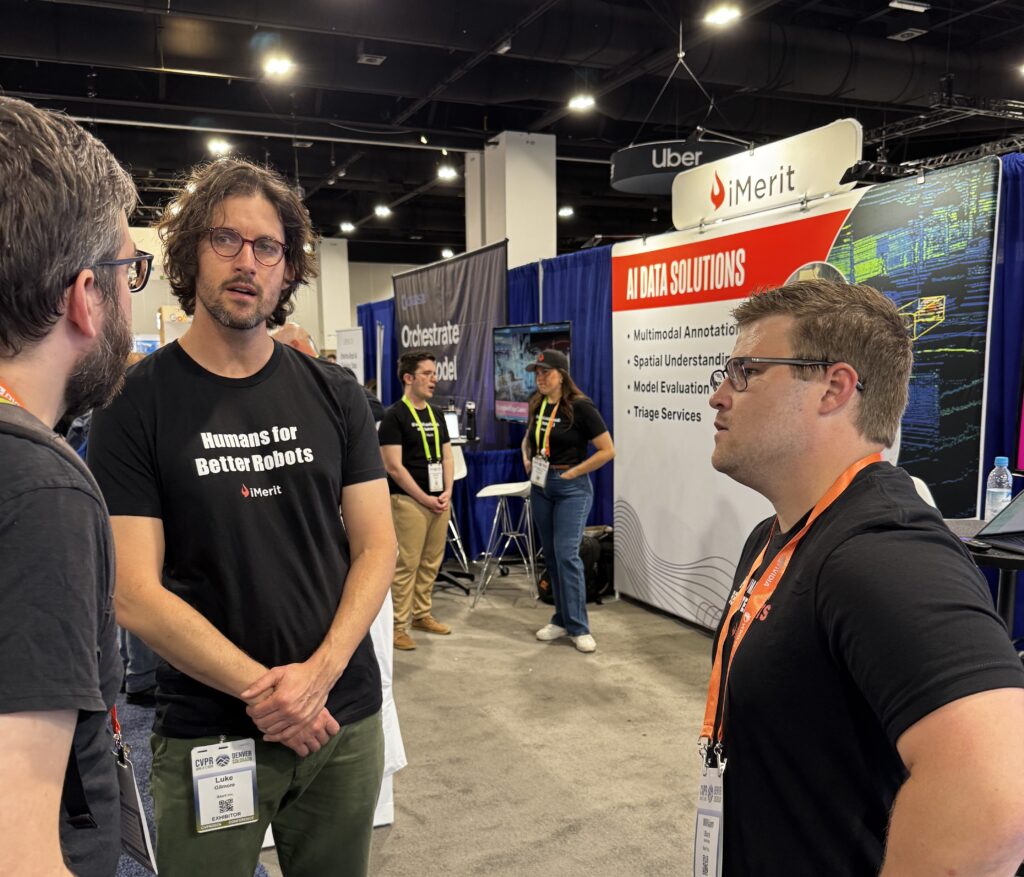
This was not a fringe observation. Across demos, workshops, and expo floor conversations, robotics dominated in a way that felt qualitatively different from previous years. Across the iMerit booth, roughly a third of demos focused on robotics compared to close to zero at CVPR 2025. Kyle Miller, Director of Sales for Robotics/AV, echoed this directly: “There was a bigger focus on Robotics and Physical AI this year, including Teleoperations services for robots.”
Physical AI; systems that perceive, reason, plan, and act in the real world is no longer a research aspiration. It is the organizing theme of the field.
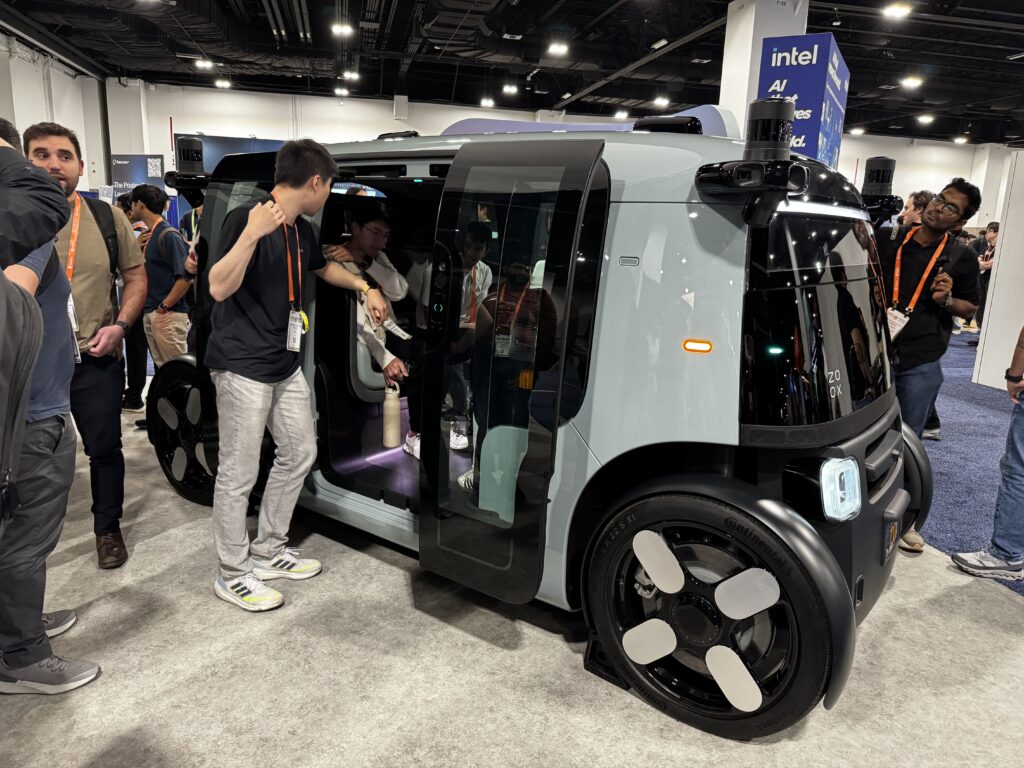
This shift was reflected across several CVPR discussions focused on the emerging Physical AI stack, from data collection and model training to deployment in real-world environments.
One of the more grounding observations across booth conversations was that despite all the excitement around agentic systems, most companies are still firmly in the data collection and training phase. A concept that came up repeatedly was teleoperation as a method for generating training data, not teleoperation in the autonomous vehicle sense, but a setup where human operators remotely control robotic arms in a lab to perform structured tasks picking up objects, folding fabric, unscrewing bottle caps while every motion is recorded and logged as training data. It is a reminder that behind every capable robot is an enormous, carefully constructed human effort.
Teleoperation is labor-intensive, slow to scale, and still requires significant human orchestration at every step. The fidelity of the resulting data depends heavily on the skill and consistency of the operator, and rare or dangerous scenarios are difficult to surface deliberately.
What also stood out is that unlike large language models, robotics does not have a vast, pre-existing repository of data to train on. That scarcity is pushing the field toward synthetic data as a serious alternative and the conversations at CVPR reflected exactly that shift. Much of the robotics space still feels exploratory; across the expo floor, many companies and researchers were still working out their specific use cases, each with genuinely unique data needs and constraints.
Tiffany Thompson, Sr. Manager, DataOps & Enablement, pointed to another theme that surfaced throughout the conference: the importance of purpose. The expo floor was filled with impressive demonstrations, from humanoid robots and robotic hands to warehouse automation systems and industrial robotics.
But beyond the novelty, many conversations returned to a more practical question: what problems are these technologies solving? The most compelling applications focused on improving safety, supporting healthcare workers, assisting people in dangerous environments, and helping individuals maintain greater independence.
Synthetic Data Moves Closer to Reality
The conversation around synthetic data felt notably different this year. Rather than being discussed as a future possibility, many teams were actively evaluating how simulated environments could supplement real-world data collection. For robotics developers, the challenge is straightforward: collecting large volumes of high-quality data in physical environments is expensive, time-consuming, and often difficult to scale. Synthetic data offers a way to generate rare scenarios, expand edge-case coverage, and accelerate model development.
Advances in foundation models for image and video generation are helping drive this shift. Across sessions and conversations, including discussions on generative simulation environments, researchers explored how generative models are being used to create realistic environments, interactions, and training scenarios that would otherwise be difficult or costly to capture. Discussions around world models further highlighted the industry’s push toward realistic simulation environments that can support training before systems are deployed in the physical world. While real-world validation remains critical, simulation is increasingly becoming an important part of the development workflow rather than a purely research-driven concept.
Synthetic data generation, however, shifts the problem rather than eliminating it. Instead of asking ‘how do we collect enough real-world data?’ the question becomes ‘how do we ensure the synthetic data we generate is actually useful?’ When generating images and video for foundation model training at scale, several failure modes become possible: rendering artifacts that corrupt model representations, distribution drift where generated data diverges from real-world conditions, and label-generation errors where synthetic ground truth does not accurately reflect what the rendered scene depicts. The practical answer emerging from these conversations is model-in-the-loop annotation, using automated checks to surface candidates for human review and building continuous feedback into the generation process.
Seeing the World from the Robot's Perspective
One of the clearest themes from the workshop sessions was that the field has, for many organizations, moved past the point where bigger models produce meaningfully better results. As Chetan Nadiger, Senior Engineering Manager observed after attending multiple sessions across the conference:
“Many organizations have reached a point where obtaining better data produces greater returns than developing larger models.”
This shift has real consequences for how AI development teams are structured and where investment is going. The conversation is moving from “how do we scale our model” to “how do we improve our data” and that includes not just volume, but quality, diversity, and the handling of rare and difficult edge cases.
Nandini Reddy, Lead Applied AI Scientist, captured the broader stakes well:
“What sometimes gets lost in the AI hype is that it’s never just about AI. Behind every successful system are years of mathematics, statistics, optimization, reasoning, engineering, data collection, evaluation, infrastructure, and human effort. The model itself has only one component.”
It is a point worth sitting with. Hardware matters. Data matters. Evaluation matters. Human feedback matters. These are not supporting roles, they are the foundation.
Why Human Reasoning Still Holds the Edge
Perhaps the most strategically significant theme at CVPR 2026 was the growing evidence of a gap between what AI models produce and how they get there.
Research presented at the conference found that vision-language models, when tested against benchmarks pairing localization accuracy with the quality of their reasoning chains, showed a troubling pattern: models frequently fabricate justifications for conclusions they have already reached. They rationalize rather than reason. Human experts, by contrast, work coarse-to-fine, apply heuristics they can be trained to articulate, and produce decision traces that are auditable.
Discussions around model interpretability reinforced the growing need to understand not just what models predict, but how they arrive at those decisions.
This is not just a research curiosity. It has direct implications for any organization deploying AI in safety-critical or high-stakes domains. The label is increasingly a commodity. What is not commodifiable is disciplined, traceable reasoning behind the label and that is still a distinctly human contribution.
For iMerit, this reframes the value of expert annotation: not as a slower alternative to model output, but as a qualitatively different kind of input. The goal is not to compete with models on speed, it is to provide the trustworthy reasoning that models cannot reliably generate on their own.
This challenge becomes even more important as foundation models expand into robotics and multimodal systems. Several discussions at CVPR highlighted the growing need for structured feedback that captures not only whether an outcome was correct, but why a decision succeeded or failed. As organizations build increasingly capable vision-language and vision-language-action systems, the quality of these feedback loops may become just as important as the models themselves. Human expertise remains essential for identifying failure modes, validating reasoning, and providing the context required to improve system performance over time.
Evaluation: From Afterthought to Core Infrastructure
Across sessions, workshops, and business conversations, evaluation emerged as one of the fastest-growing priorities in AI development. Chelsea Finn’s session on robotic foundation models put it directly: as models become increasingly general, evaluation increasingly becomes the bottleneck.
This resonated strongly with what Chetan observed on the expo floor. While most annotation vendors were competing on traditional services data collection, labeling, workforce scale a notable shift was visible. Companies are beginning to move toward higher-value offerings: edge-case mining, model-in-the-loop annotation, evaluation services, and data curation. The market is beginning to reward expertise over volume.
Evals or model evaluations refers to the systematic process of testing AI systems for performance, reliability, and safety before and after deployment. It is also emerging as an independent market category. The organizations best positioned for this moment are those that can move beyond throughput and offer clients something more defensible: auditable, benchmarked, human-validated quality.
iMerit at CVPR: Ango Hub, Demos, and a First-Place Win
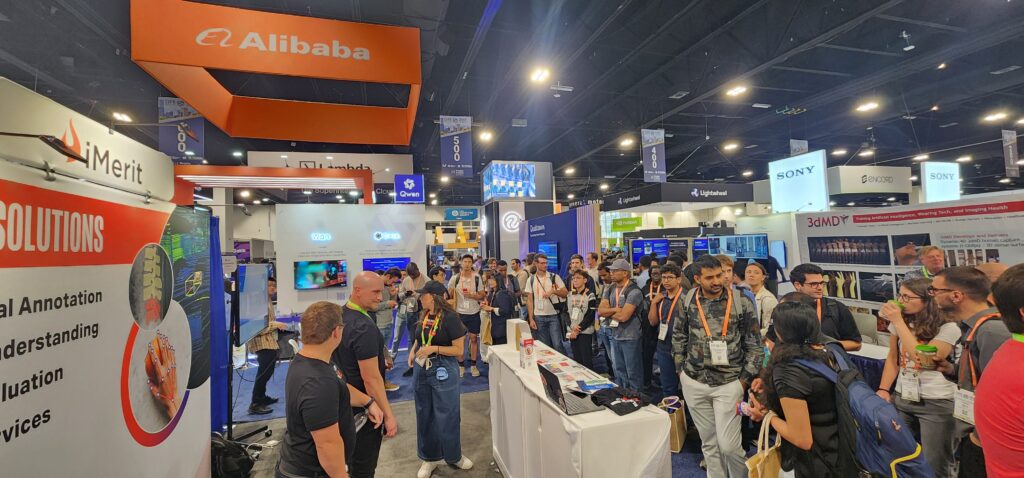
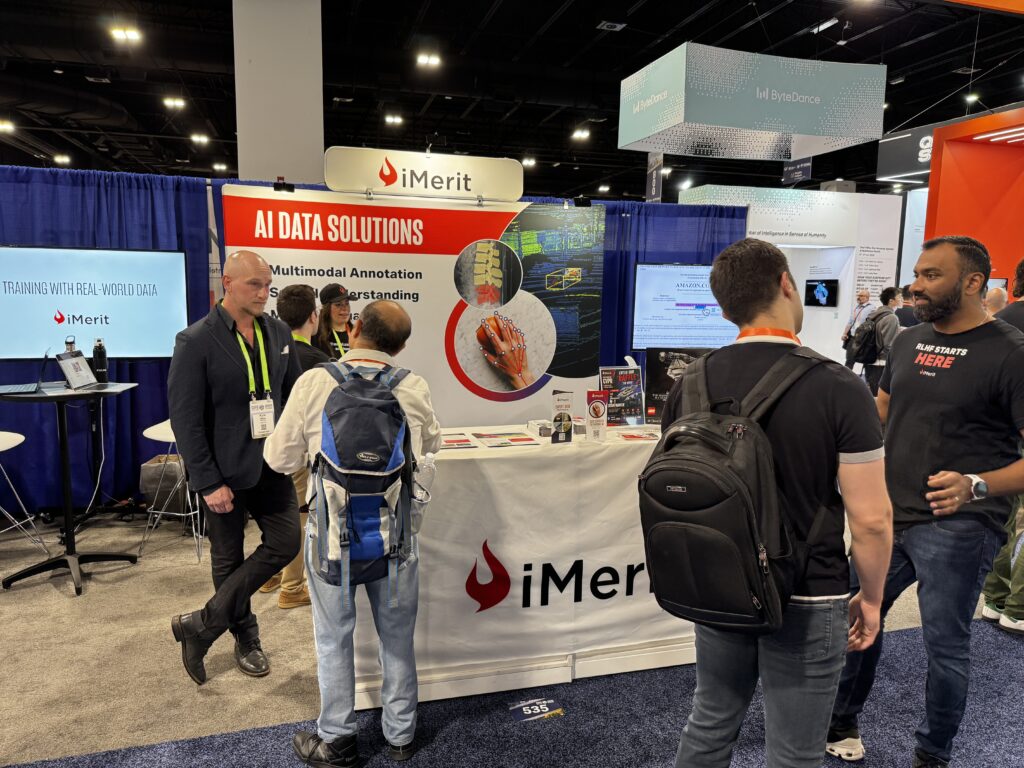
iMerit’s presence at CVPR 2026 was the strongest yet. The booth drew consistent traffic, with Ango Hub demos running across both days for a range of leading technology and research organizations. Lorenzo Gravina, Senior Product Manager, prepared a full Ango Hub demo reel tailored to CVPR which played throughout the expo and drew consistent foot traffic.
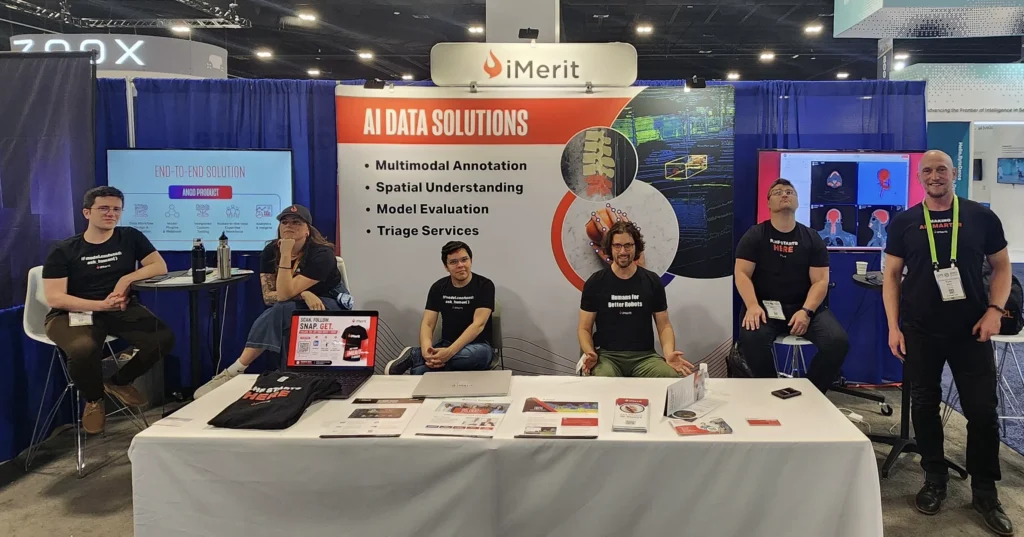
This year’s standout feature on the demo floor was the Skeleton tool, which generated strong interest given the robotics focus of the conference. Evergreen features like Workflow continued to draw visitors in.
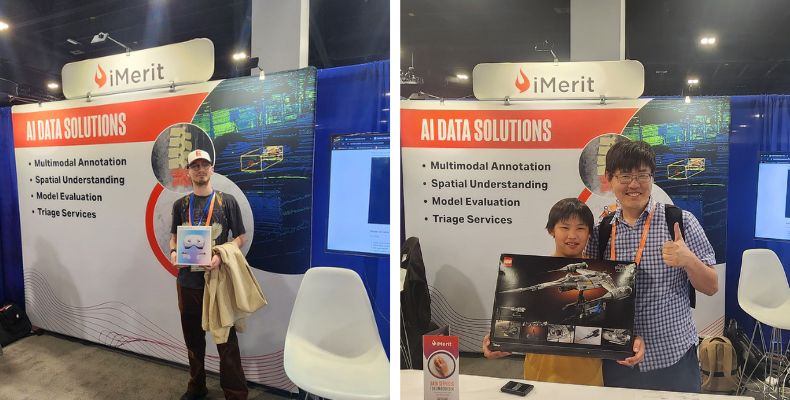
The booth wasn’t all business, either, visitors who stopped by had a shot at winning a LEGO Mandalorian N-1 Starfighter or a Meta Quest 3S 128G.
The biggest iMerit highlight of the conference, however, came from Gunjan Kholapure, ML Engineer, who took first place in the CVPR Auto-Annotation Challenge winning by a significant margin against 14 other competitors. It was a proud moment for the team and a concrete demonstration of iMerit’s technical depth.
The winning solution combined open-vocabulary perception, 2D-to-3D workflows, and automated annotation techniques to generate high-quality 3D labels with limited target-domain training data. Beyond the competition result itself, the achievement reflected a broader theme seen throughout CVPR: success increasingly depends not only on model innovation, but also on the quality of data pipelines, evaluation frameworks, and human expertise supporting them.
What Comes Next
Nandini offered a forward-looking take that stuck with the team: if robotics and evaluation are the major themes of today, the next wave may well be biology and biotechnology drug discovery, personalized medicine, virtual biological systems. The patterns are familiar: massive data requirements, rare and high-value edge cases, the need for human expertise to validate what models cannot reliably assess on their own.
Whether that prediction proves correct or not, the direction of travel is clear. That has always been the goal. CVPR 2026 made it more urgent.
Explore how iMerit and Ango Hub are building the tools and workflows the industry needs. Visit Ango Hub →