A single unexpected driving event can attract more regulatory attention than millions of successful autonomous miles. This reality became evident during Tesla’s robotaxi pilot in Austin, where vehicles were reported to enter the wrong lane, brake unexpectedly, and respond inconsistently in complex traffic situations. These reports prompted the U.S. National Highway Traffic Safety Administration (NHTSA) to seek additional information from the company. The incident showed how rare and complex edge cases can expose weaknesses that routine testing may never reveal.
This is one of the biggest challenges in robotaxi safety validation. While simulation and fleet testing cover many known scenarios, they cannot capture every unusual real-world event. These edge cases are often ambiguous, making it difficult for automated validation alone to determine whether the vehicle’s behavior was appropriate. That is why demonstrating how these scenarios are reviewed and validated has become an increasingly important part of regulatory safety evidence.
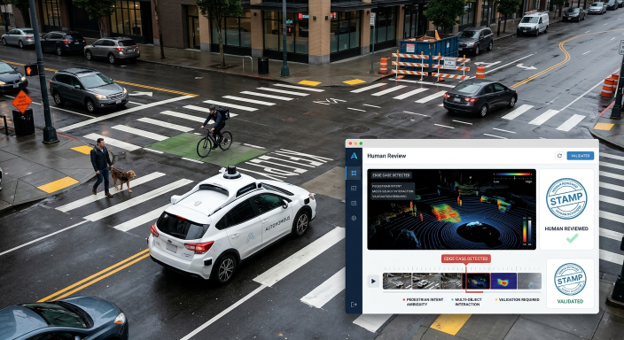
Human-in-the-loop (HITL) reviews provide the expert judgment needed to analyze complex events and resolve uncertainty. This helps create high-quality, regulator-ready safety datasets that support more reliable autonomous vehicle safety validation.
This article explores why identifying edge cases is one of the biggest challenges in robotaxi safety validation. It also explains how HITL review improves dataset quality and traceability for safety validation.
Why Automated Validation Pipelines Miss Edge Cases
Robotaxis generate terabytes of multimodal data each day from cameras, LiDAR, radar, GPS, inertial sensors, and vehicle telemetry. Reviewing this data manually is impossible. Automated validation pipelines can help automatically detect anomalies, cluster similar events, and rank clips for human reviewers to inspect.
However, they become less reliable when they encounter autonomous driving edge cases or situations they were not trained to handle.
Simulation Coverage Gaps
Simulation is a cornerstone of robotaxi safety validation because it allows developers to test thousands of driving scenarios at scale. However, simulation environments are typically built around predefined scenarios and known failure patterns. Real-world driving continually produces situations that fall outside these predefined categories.
Temporary road layouts, unexpected pedestrian behavior, unusual emergency vehicles, or sensor occlusions can combine in ways developers did not anticipate during testing.
Long-Tail Statistics Problem
Automated review pipelines also face the long-tail problem. Because safety-critical failures are rare, most review systems rely on event triggers to identify clips for inspection. Common triggers include low model confidence, collision warnings, disengagements, and safety interventions.
Yet many edge cases never trigger these alerts because they do not lead to a collision or another obvious safety event. The vehicle may complete the maneuver successfully, even though the perception or planning system made a decision that still requires review.
Limits of Confidence Based Filtering
Many automated validation pipelines use confidence scores or uncertainty estimates to decide which events need further review. However, a high confidence score does not always mean the prediction is correct. Models can make incorrect predictions with high confidence. As a result, important validation errors can pass through automated filters without human review.
Safety-critical scenarios often result from several factors occurring simultaneously. Heavy rain, faded lane markings, sensor degradation, and unpredictable road-user behavior can combine to create edge cases that automated systems struggle to classify. These situations often require expert human review.
The Hidden Cost of Poor Edge Case Validation
Poor edge case validation affects more than individual model performance. For AV engineering teams, it can slow development, reduce confidence in validation results, and increase the cost of bringing perception models into production. Common consequences include:
Repeated model regressions:
Without a structured escalation and tagging discipline, teams get stuck reacting to the same failure mode release after release. This creates a continuous cycle of retraining and regression testing before a release can be approved. An iterative validation approach, as promoted by ISO/PAS 21448 (SOTIF), helps ensure that previously identified safety-critical scenarios remain part of future validation cycles.Unstable benchmark results:
Incomplete or inconsistently labeled edge cases make it difficult to compare model versions fairly. This makes it harder to assess whether a new model performs better or if the observed differences stem from gaps in the evaluation data.Difficult root-cause analysis:
When edge case events lack consistent annotations or metadata, engineers spend more time identifying whether the failure came from perception, sensor fusion, prediction, planning, or vehicle control. This slows debugging and delays corrective action.Noisy retraining datasets:
Incorrect or inconsistent annotations for rare scenarios introduce label noise into retraining datasets. For example, if teams label a partially occluded pedestrian differently across similar scenes, the model learns conflicting patterns. This reduces performance on rare edge cases and makes the model less reliable in real-world driving.Weak traceability for safety validation:
Safety validation requires clear evidence of how teams identified, reviewed, and resolved safety issues. Without consistent documentation and links between edge cases and corrective actions, teams struggle to show that they have systematically addressed safety risks across model updates.Higher validation costs:
Missing robotaxi edge cases early forces organizations to revisit completed validation work. Additional data mining, expert review, simulation updates, and safety documentation increase engineering effort and consume resources that could otherwise be spent improving new capabilities.
Delayed release gates:
Engineering teams must demonstrate that software updates perform safely across critical edge cases before approving a release. When validation datasets lack sufficient edge-case coverage, teams must collect additional data, review more scenarios, and rerun targeted validation before they can meet internal release criteria or regulatory expectations.
For robotaxi developers, the goal is to produce defensible evidence that edge cases are correctly analyzed and addressed. Achieving that level of confidence requires combining automated validation with expert human review.
How Human-in-the-Loop Review Pipelines Close the Validation Gap
Human-in-the-loop review is not a replacement for automated validation. It is a structured quality assurance process that improves the quality, consistency, and traceability of the datasets used for robotaxi safety validation. Rather than reviewing every driving event, HITL focuses engineering effort on the scenarios where automated systems have the highest uncertainty or where the consequences of an incorrect interpretation are greatest.
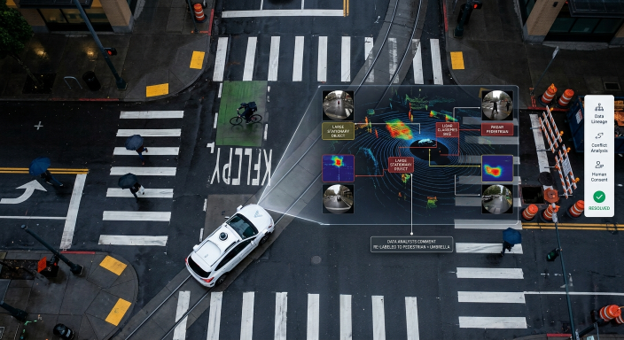
A typical review pipeline includes the following stages:
AI-Assisted Edge Case Triage
Automated systems analyze fleet data to identify edge cases or candidate events using signals such as unusual object interactions, planner uncertainty, sensor inconsistencies, or deviations from expected driving behavior. This reduces the review workload while making sure that important scenarios are retained for further analysis.
Expert Review Across Synchronized Sensor Data
Human reviewers examine synchronized camera, LiDAR, and telemetry data to reconstruct the event from multiple perspectives. Reviewing multiple sensor modalities together helps them distinguish sensor artifacts from genuine perception or planning errors that are not apparent from a single data stream.
Escalation of Ambiguous Scenarios
Complex situations such as conflicting sensor evidence, unclear road user intent, or unfamiliar traffic conditions are escalated to domain experts with expertise in traffic behavior or sensor fusion. This additional review helps establish accurate ground truth for scenarios that cannot be resolved through predefined rules.
Consensus-Based Annotation and Quality Assurance
Even after expert review, some edge cases remain open to interpretation due to incomplete sensor observations, occlusions, or multiple plausible driving responses. Teams address these cases through multi-pass reviews, where independent annotators and quality assurance teams verify labels using standardized annotation guidelines.
When reviewers disagree or a scenario is ambiguous, they escalate the event for a consensus review. Consensus-based annotation reduces label inconsistency and improves ground truth quality. It can also help to produce more reliable datasets for evaluating perception and planning models.
Scenario Taxonomy Refinement
When reviewers encounter unseen scenarios, they categorize and add them to the organization’s edge case taxonomy. As new edge cases emerge, these taxonomies also evolve. It helps developers to systematically identify similar scenarios across future fleet data and close previously unknown validation gaps.
Closed-Loop Dataset Improvement
Teams feed validated edge cases back into validation datasets, simulation libraries, regression test suites, and retraining pipelines. This closed-loop process ensures every identified failure is tested again in future evaluations. Over time, it reduces repeated regressions and improves coverage of long-tail driving scenarios.
This structured workflow also aligns with emerging safety guidance. The NIST AI Risk Management Framework highlights the importance of human oversight and traceable validation processes for managing AI risks. Together, these practices help transform rare edge cases into reliable validation assets rather than recurring engineering challenges.
Why This Matters for Tier 1 Partners Specifically
Tier 1 suppliers play an important role in developing the perception systems, sensor software, and validation datasets that original equipment manufacturers (OEMs) rely on to build their safety cases. Hence, they are expected to demonstrate that their data pipelines are governed by consistent quality controls, documented review processes, and traceable validation records.
This expectation is reflected in both regulatory and industry guidance. The National Highway Traffic Safety Administration Standing General Order requires reporting of crashes involving certain automated driving systems. California DMV’s Autonomous Vehicle Regulations also require structured reporting and oversight for AV testing and deployment on public roads, including collision reporting and permit-based operating conditions. This reinforces the importance of documented event investigation.
Similarly, frameworks such as UL 4600, ISO 26262, and the Autonomous Vehicle Safety Consortium Scenario-Based Safety Evaluation emphasize traceability and robust evidence to support autonomous vehicle safety claims.
To meet these expectations, many companies combine AI-assisted data processing with expert human validation to improve data quality at scale. iMerit’s human-in-the-loop triage service supports this approach by helping autonomous mobility teams identify, review, and validate complex perception and sensor fusion scenarios.
With domain-trained annotation specialists and rigorous quality assurance workflows, iMerit helps Tier 1 suppliers build more accurate, consistent, and traceable datasets that strengthen downstream safety validation and regulatory readiness.
Best Practices for Scaling Human-in-the-Loop Robotaxi Safety Validation
Scaling robotaxi safety validation requires more than adding reviewers. Leading autonomous vehicle programs focus on improving review quality, consistency, and traceability so that validation keeps pace with growing fleet data.
Define a standardized edge case taxonomy:
Use consistent categories and review criteria across teams so similar scenarios are classified and evaluated the same way over time.Treat edge cases as reusable validation assets:
Build searchable libraries of verified scenarios that can be replayed during regression testing and before expanding the operational design domain (ODD).Calibrate reviewers regularly:
Regular calibration meetings ensure consistent labeling decisions, as new types of scenarios appear and annotation guidelines change.Track data lineage:
Keep versions of annotations, review decisions, and dataset changes to ensure reproducibility, audits, and root cause analysis.Measure data quality and not just model performance:
Monitor metrics such as label consistency and review turnaround time. Also ensure edge case coverage alongside traditional perception metrics.Integrate validation into the development lifecycle:
Feed verified edge cases into simulation and release validation so every software iteration is evaluated against an expanding set of real-world scenarios.
Organizations that treat edge case validation as a continuous engineering discipline are better equipped to improve model robustness and support safer robotaxi deployments.
Conclusion
Routine driving scenarios can demonstrate baseline system performance, but it is the rare and ambiguous edge cases that determine whether a robotaxi is ready for deployment. Companies can identify issues sooner and reduce costly rework later by building structured review pipelines early.
Key takeaways
- Edge cases are the primary obstacle to scalable robotaxi safety validation.
- Automated validation alone cannot reliably identify or interpret every rare or ambiguous driving scenario.
- Human-in-the-loop review improves annotation quality, validation accuracy, and traceability for safety-critical AI systems.
- Continuous feedback from validated edge cases strengthens simulation, regression testing, and model retraining.
- Robust review pipelines help autonomous driving teams build stronger safety evidence while reducing validation delays and engineering rework.
The ability to identify and learn from rare driving scenarios is becoming a competitive advantage in autonomous mobility. iMerit’s autonomous mobility solutions combine AI-assisted workflows with domain-trained experts to help engineering teams triage edge cases, investigate perception failures, perform root-cause analysis, and build structured feedback loops that continuously improve model performance.
Powered by Ango Hub and scalable human-in-the-loop operations, iMerit integrates into existing ML pipelines to transform complex real-world scenarios into high-quality and traceable data that supports regression testing and safer autonomous driving systems