Robotaxi perception systems operate in complex, unpredictable environments. Things like unusual pedestrian behavior, temporary construction zones, sensor occlusions, bad weather, and other rare real-world situations can expose weaknesses that didn’t show up in training data. Because of this, perception models cannot remain static after deployment.
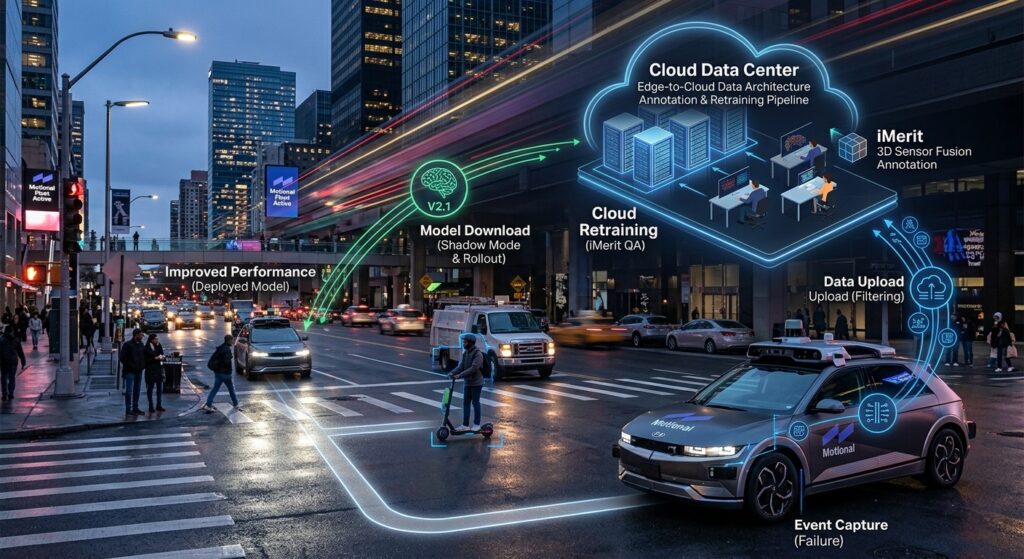
Robotaxi fleets generate millions of miles of sensor data across cameras, LiDAR, radar, and other perception systems. This continuous stream of operational data provides a valuable source of insight into perception failures, near misses, and uncertain model predictions. Leading robotaxi companies such as Waymo and Motional keep their fleets running while collecting new data. They identify failure events, convert them into training data, and use them to improve perception models continuously, often relying on expert annotation workflows to ensure dataset quality.
Robotaxi perception model retraining helps fleets continuously improve perception performance using real-world operational data. This allows autonomous driving systems to expand their capabilities while vehicles remain in active service. This article explores how robotaxi fleets identify perception failures in the field to continuously improve autonomous driving systems while vehicles remain in service.
The Perception Model Challenge in Autonomous Driving
Perception models are the deep learning neural networks such as Convolutional Neural Networks (CNNs), YOLO (You Only Look Once), and ConvNeXt, that serve as a robotaxi’s “eyes and brain.” These deep learning systems analyze raw sensor inputs to identify and classify objects in the vehicle’s environment. When a Waymo or Tesla robotaxi drives down a street, its perception model is simultaneously:
- Detecting objects: Identifying pedestrians, vehicles, cyclists, traffic cones, and construction equipment
- Classifying objects: Determining whether something is a car vs. a truck, a person vs. a statue
- Tracking objects: Following the movement of each object across time frames
- Predicting behavior: Estimating where objects will be in the next second, five seconds, ten seconds
In advanced stacks, perception also includes spatial reasoning through sensor fusion. These systems combine data from camera, LiDAR, and radar to generate a unified 3D representation of the surrounding world.
Although robotaxis and other autonomous vehicles rely on similar perception technologies, their operational requirements differ considerably.
| Area | Traditional AV Programs | Robotaxi Fleets |
|---|---|---|
| Operations | Controlled testing and validation | Continuous commercial passenger service |
| Driving Environment | Limited testing routes | Diverse urban environments and service zones |
| Edge Cases | Collected through planned testing | Encountered daily during live operations |
| Downtime | Testing pauses are acceptable | Downtime directly impacts fleet utilization |
| Model Updates | Periodic releases | Continuous retraining and validation cycles |
These operational differences create unique challenges for robotaxi perception systems. Because fleets remain active throughout the retraining cycle, operators must continuously identify, validate, and learn from perception failures while vehicles continue serving passengers.
Despite their rapid progress, perception systems continue to face persistent failure modes in real-world deployment. For example, detection failures occur when important objects, such as partially occluded pedestrians or fast-moving vehicles, are missed entirely. Tracking instability introduces issues such as ID switches or drift. This causes the system to lose consistency in identifying the same object over time.
Sensor fusion inconsistencies can arise when camera and LiDAR signals disagree. This can lead to conflicting interpretations of the same scene. Temporal failures can also complicate the perception when handling short-lived objects or changing occlusions.
These challenges persist in production due to several structural limitations. For example:
- Domain shift between cities, road layouts, and weather conditions reduces model generalization.
- The long-tail nature of driving data underrepresents rare but safety-critical events in training sets.
- Real-world sensor noise and hardware constraints introduce uncertainty that even large-scale datasets cannot fully eliminate.
These factors make continuous perception failure analysis essential for ongoing Robotaxi fleet operations and model improvement.
For robotaxi fleets, these challenges are amplified by operational scale. Robotaxis do not operate like privately owned autonomous vehicles that may repeatedly drive similar routes. They operate across diverse urban environments, serving different passengers throughout the day. They regularly encounter complex pickup zones, construction detours, crowded downtown corridors, airport traffic patterns, and other edge cases that are difficult to capture during pre-deployment testing.
Physical AI; systems that perceive, reason, plan, and act in the real world is no longer a research aspiration. It is the organizing theme of the field.
How Perception Failures Are Detected and Flagged In-Service
Detecting perception failures in a live robotaxi fleet relies on a combination of onboard intelligence and backend analysis systems. It is not feasible to continuously store or transmit all raw sensor data. Hence, the fleets implement selective mechanisms that identify potential anomalies in real time and retain only the most valuable segments for further analysis. These include:
Onboard Failure Detection Mechanisms
One of the primary signals comes from redundancy across sensor modalities. When the camera, LiDAR, and radar produce conflicting interpretations of the same scene, the system treats this disagreement as a potential anomaly.
Another key trigger is the confidence score in the perception model itself. The system automatically flags detections that fall below predefined confidence thresholds for logging. Planner intervention logs also play an important role. If the motion planning module overrides perception outputs or behaves cautiously due to uncertain inputs, the system marks those cases as potential perception failures.
Post-Trip Automated Triage
After a trip is completed, fleet management systems aggregate logs and identify segments with unusual perception behavior. Automated scene classification systems then categorize these segments into failure types such as false negatives, misclassifications, or bounding box regression errors. Each event is assigned a severity score to prioritize high-impact failures for inclusion in the retraining pipeline.
Passive vs. Active Data Collection
Most fleets rely on passive collection, where continuous ring-buffer recording retains only recent sensor history and uploads it when triggered by anomalies, low-confidence detections, or planner interventions. In contrast, active data collection involves intentionally targeting underrepresented scenarios by adjusting fleet routes or operational timing to capture rare conditions more effectively.
This ensures that autonomous driving datasets remain both diverse and failure-aware without disrupting live robotaxi fleet operations.
Robotaxi Perception Model Retraining Without Fleet Downtime
Capturing perception failures is only the first step. Robotaxi companies also need a reliable way to move that data from vehicles into training systems without affecting their daily fleet operations.
For robotaxi operators, downtime affects their engineering workflows along with fleet utilization, ride availability, and revenue generation. This makes uninterrupted retraining processes a business and technical requirement. The real challenge is what data to collect, what to upload and how to evaluate new models before they reach production vehicles.
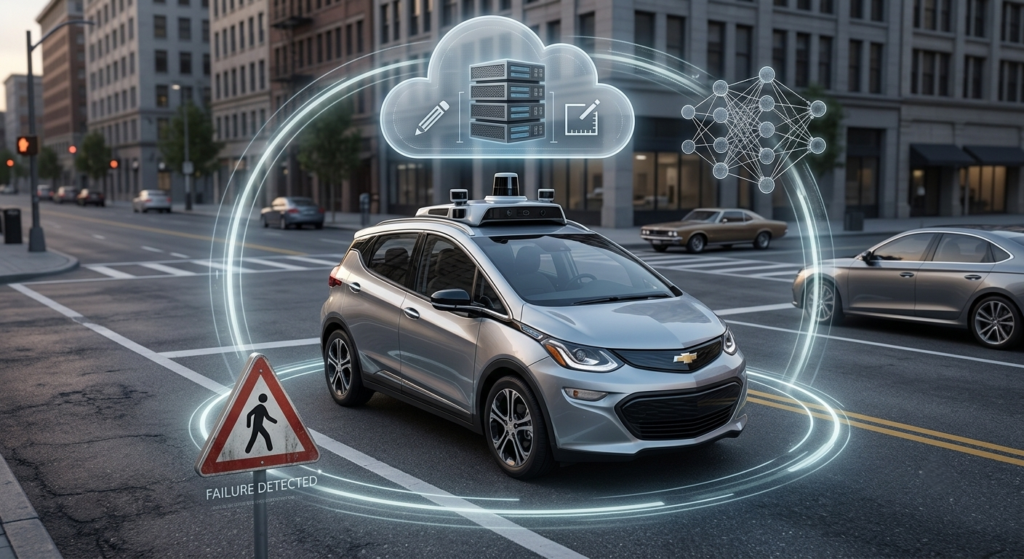
Edge-to-Cloud Data Architecture
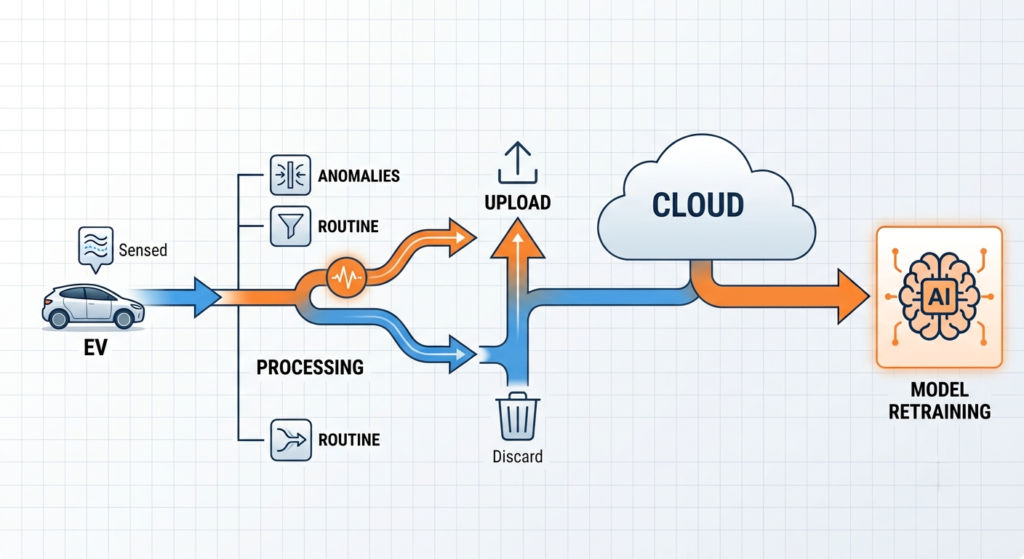
The foundation of this process is an efficient edge-to-cloud data pipeline. Vehicles generate terabytes of sensor data daily. This makes it impractical to upload everything to centralized training systems.
To reduce bandwidth requirements, onboard software compresses sensor recordings and prioritizes anomaly-related data. It transmits clips associated with perception failures, low-confidence detections, or planner interventions at high fidelity, while summarizing, downsampling, or discarding routine driving data.
Uploads usually happen when vehicles are idle. For example during charging sessions, overnight parking, or maintenance periods. This approach prevents data transfers from interfering with fleet operations.
Each uploaded clip also includes metadata such as vehicle ID, software version, location, time of day, weather conditions, and the trigger that caused the event to be flagged. This data provenance tagging helps engineers trace failures back to specific hardware and software configurations for reproducibility throughout the retraining process.
Robotaxi operators require high-throughput annotation workflows that can process multimodal sensor streams while maintaining quality across millions of frames. iMerit supports these continuous learning pipelines through high-precision 3D sensor fusion annotation across LiDAR, camera, and radar data, helping autonomous vehicle teams convert in-service failure clips into production-ready datasets for perception model retraining.
Shadow Mode Model Evaluation
After the new training data is incorporated into updated perception models, operators validate performance through shadow mode testing. In shadow mode, the new model runs alongside the production model on live driving data. It generates predictions, but those predictions do not control the vehicle. The production system continues to make all driving decisions.
The shadow model processes the same sensor inputs as the active system. This helps engineers compare outputs side by side. For instance, if the production model misses a partially occluded pedestrian while the shadow model detects it, the discrepancy is flagged. These predictions are then evaluated against human-reviewed annotations and validation datasets to confirm whether retraining improves performance without introducing new errors.
Staged Rollout and A/B Testing
Staged rollout ensures safe perception model validation across controlled fleet segments before full deployment. Operators do not update the entire fleet, instead they first deploy the retrained model to a small subset of vehicles. They then continuously monitor key metrics like detection accuracy, false-positive rates, intervention frequency, and operational stability.
Predefined rollback mechanisms provide an additional safety layer. When the retrained model’s performance drops below predefined thresholds, operators can roll affected vehicles back to the previous model version. This gradual approach enables validation of perception improvements step-by-step and continues fleet operations without interruption.
Model Retraining Infrastructure
Large-scale training infrastructure accelerates the improvement cycle behind the scenes. Simulation platforms such as CARLA and NVIDIA Drive Sim generate synthetic variations of real-world failure scenarios. This helps engineers test model behavior across a wider range of conditions than can be captured in operational data alone.
Many systems use multi-stage training that mixes supervised learning on labeled failure data with self-supervised and semi-supervised learning on large amounts of unlabeled fleet data. They also use techniques like hard example mining, class balancing, and temporal consistency to make detections more stable across frames.
Perception stacks also use multi-task learning, jointly optimizing object detection, segmentation, and motion prediction to strengthen shared representations. These pipelines improve over time through continual learning. New edge-case data is added gradually, while replay buffers help the model avoid forgetting what it already learned.
Annotation Workflows for In-Service Failure Data
Getting failure clips into the pipeline is only the first step. The actual difficulty is transforming them into useful training data through accurate data annotation workflows that perception models can learn from. This is where data annotation directly determines how effective the retraining process will be.
In-Service Clips Require Specialized Annotation
In-service failure data is more complex than standard autonomous driving datasets. Unlike routine driving clips, these scenarios often include ambiguity, partial visibility, and rare edge cases that are harder to interpret and require stronger domain expertise.
Annotators should follow detailed guidelines that account for uncertain object boundaries, occlusions, sensor noise, and uncommon road interactions that frequently appear in edge-case driving conditions.
Multi-Modal Sensor Fusion Annotation
Robotaxi failure clips often contain scenarios that are less common in other autonomous driving datasets. Examples include passengers entering or exiting vehicles at the curb, pedestrians approaching a robotaxi from unexpected angles, congested pickup zones, and temporary traffic patterns around events or transit hubs. These situations require specialized annotation guidelines because small labeling errors can significantly affect perception performance in high-density urban environments.
Failure clips typically require synchronized labeling across multiple sensor modalities. These include cameras and 3D LiDAR, and sometimes radar. Key requirements include:
- 3D LiDAR annotation: Spatial geometry reconstruction in the accurate 3D space.
- Camera labeling: Providing semantic context such as object class, traffic signals, and lane markings.
- Temporal alignment: Synchronizing data across time series.
- Sensor fusion alignment: Mapping labels of camera and LiDAR to a common coordinate system.
This alignment is important because perception models rely on cross-modal consistency. Misaligned labels can directly degrade model performance during Robotaxi perception model retraining.
Human-in-the-Loop Learning and Quality Assurance
The human-in-the-loop learning system is often used to control scale and complexity in modern annotation pipelines. Model-assisted labeling is used to pre-annotate data. This helps minimize manual efforts and empowers human annotators to concentrate on correction and refinement.
Active learning feedback loops prioritize the most informative failure samples for labeling. This ensures that annotation effort is concentrated on high-impact edge cases. QA-driven correction cycles further improve dataset quality by introducing multi-stage review processes before data enters the training pipeline.
In real-world deployments, this approach has shown measurable improvements. For instance, iMerit’s collaboration with a leading robotaxi program shows that structured human-in-the-loop QA workflows improved ground truth accuracy from 80% to 95% in complex multimodal annotation tasks. This directly boosts the reliability of perception model retraining outcomes.
Conclusion
Robotaxi perception model retraining enables fleets to continuously improve perception performance using real-world operational data without disrupting fleet operations.
Key Takeaways
- Robotaxi perception models improve by continuously learning from real-world in-service failure data instead of relying only on pre-deployment datasets.
- Onboard systems detect failures using signals like sensor disagreement, low confidence scores, and planner intervention triggers.
- Only high-value anomaly clips are sent to the cloud through edge filtering and bandwidth-optimized data pipelines.
- Shadow mode evaluation allows safe testing of new models in real driving conditions without affecting live vehicle behavior.
- Staged rollouts with automatic rollback ensure model updates are deployed gradually and safely across the fleet.
iMerit’s multimodal annotation and data validation processes enable autonomous vehicle teams to convert their fleet edge cases into high-quality training sets. Through expert human-in-the-loop operations, sensor-fusion annotation, and scalable QA processes, iMerit supports the continuous learning pipelines that power next-generation perception systems.
Schedule a call to turn your in-service failure data into high-quality training datasets at scale with iMerit!