Precision spraying is one of agriculture’s most commercially compelling applications of AI and also the most data-hungry. It uses computer vision systems to classify individual plants, weeds, and treatment zones, enabling farmers to save on chemicals and boost productivity.
The challenge is that crops and weeds rarely look the same throughout a growing season. Dense canopy overlap, seasonal variation, lighting changes, and soil diversity further introduce visual ambiguity that single-layer datasets cannot adequately represent. A model trained on crops at one stage may struggle to recognize them accurately just weeks later.
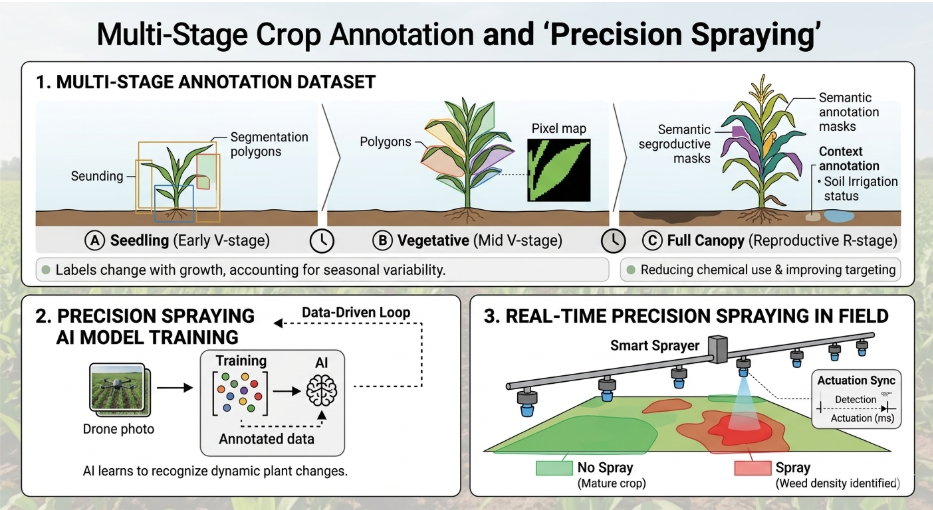
Multi-stage crop annotation allows AI models to learn how crops and weeds appear and change throughout the growing cycle. Annotation teams label images from different growth stages to create datasets that improve crop and weed detection accuracy.
This article explores how multi-stage crop annotation powers precision spraying systems and enables more efficient and data-driven crop management.
Why Precision Spraying Systems Depend on Computer Vision
Traditional broadcast spraying applies herbicides or pesticides uniformly across an entire field, regardless of whether weeds, pests, or stressed crops are present. This approach increases chemical waste and can damage the surrounding soil and crops.
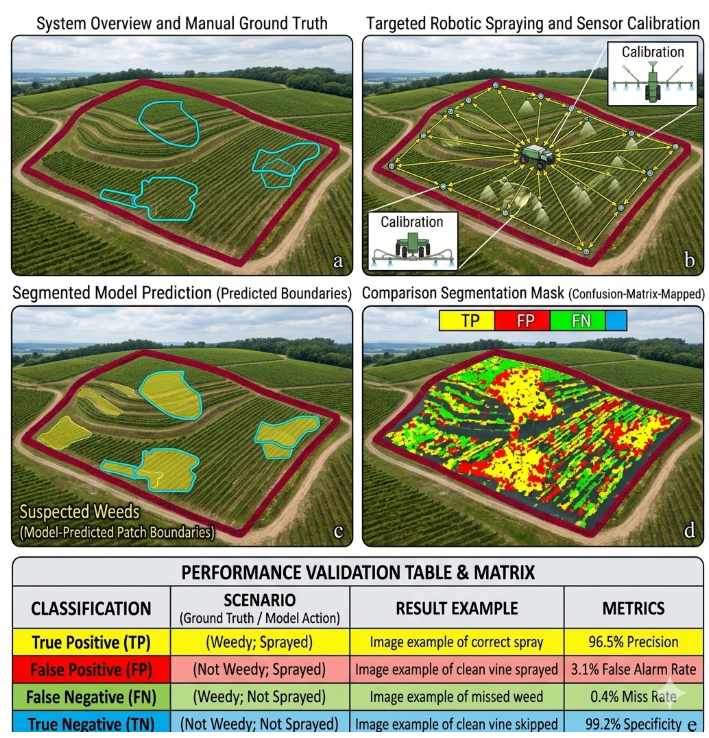
The modern precision spraying technology is based on plant-level computer vision models that locate weed, crop or treatment areas in real time. They typically operate in a low-latency loop:
- Image capture from boom-mounted, drone, or rover sensors
- On-device inference using lightweight detection or segmentation models
- Spatial mapping of predictions to field coordinates
- Actuation of individual spray nozzles within milliseconds
A key constraint is end-to-end latency, where inference must occur fast enough to synchronize with machine movement speed and nozzle spacing.
For example, John Deere’s See & Spray large-scale commercial system uses 36 industrial cameras spaced one meter apart across a 120-foot boom to scan more than 2,000 square feet per second. It identifies weeds and crops as the machine moves through rows. The system shows how tightly integrated hardware and AI must be to deliver real-time precision spraying at the field scale.
These systems rely heavily on their training data, which consists of diverse field conditions, such as crop growth stages, lighting, soil backsets, and weed densities. Even the most advanced hardware cannot deliver reliable field performance without accurately annotated multi-stage datasets.
Challenges in Multi-Stage Crop Annotation
Multi-stage crop annotation introduces several practical challenges that make dataset creation significantly more complex than standard image labeling. These challenges include:
- Annotation Complexity and Scale: Agricultural fields generate vast amounts of imagery across different growth stages. This requires large teams and structured workflows to label crops, weeds, and soil conditions consistently.
- Handling Temporal Variability: Crops can look drastically different at each growth stage. This can make it difficult to apply consistent annotation rules throughout the season. Changing weather conditions and differences in planting density create additional challenges for annotation teams.
- Class Imbalance Problems: Class imbalance is also common in agricultural datasets. Weeds may appear sparsely compared to crops or background soil. This leads to skewed training data that can reduce model sensitivity to rare but important cases.
- Maintaining Annotation Consistency: Annotation consistency is achieved through consistent labeling standards and robust quality control procedures. Small variations in object boundary drawing or growth stage labeling by annotators can cause significant differences in model accuracy and reliability for precision spraying systems in the real world.
- Inter-class Similarity: Certain weeds closely resemble young crops, especially in early stages. This makes accurate crop detection annotation highly dependent on expert-level visual judgment and strict labeling guidelines.
The Multi-Stage Annotation Pipeline: Stage by Stage
A multi-stage annotation pipeline treats crops as dynamic biological entities rather than static visual objects.
The multi-layer approach aids in the development of robust agricultural computer vision systems for precision spraying. It begins with coarse localization and gradually moves toward more detailed and context-aware labeling in each step.
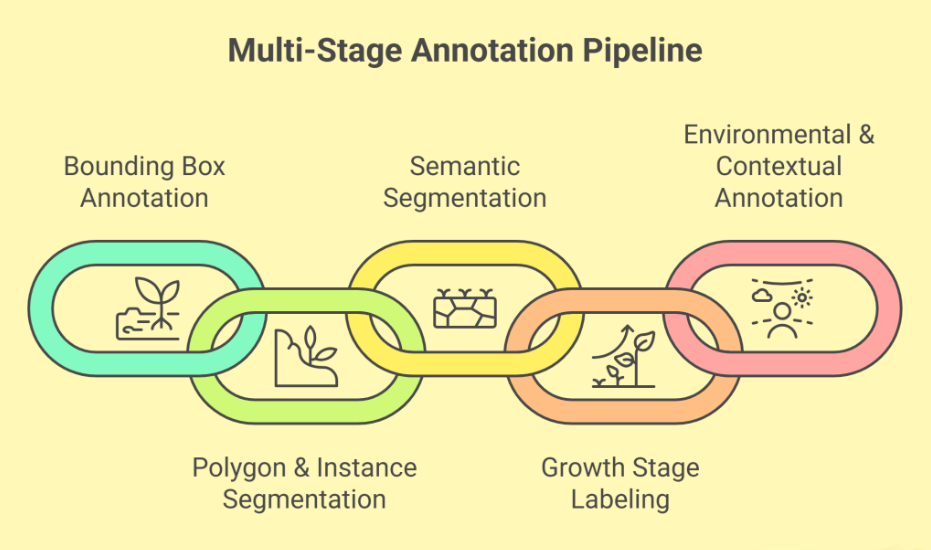
Stage 1: Bounding Box Annotation
At the first stage, annotators draw bounding boxes around crops, weeds, and other relevant objects. It is scalable and suitable for bootstrapping large datasets and processing drone imagery. This stage supports object detection models to localize vegetation quickly in field imagery, especially in real-time spraying systems.
Stage 2: Polygon & Instance Segmentation Annotation
Bounding boxes are refined into precise object boundaries using polygon annotation or instance segmentation. This is important in dense fields where crops and weeds overlap. It helps ensure that annotation teams can identify and label each plant individually.
Stage 3: Semantic Segmentation
Semantic segmentation assigns class labels to every pixel, typically including crop, weed, soil, and background categories. This enables variable-rate spray logic, which allows zones with high weed pixel density to receive a proportionally higher dose. The resulting pixel-level maps provide a detailed representation of field conditions, helping computer vision models estimate weed coverage, crop occupancy, and treatment zones with greater accuracy.
Stage 4: Growth Stage Labeling
Crops are then labeled to record where each plant is in its phenological development. This enables models to understand how plant appearance changes over time and improves robustness across the full growing season. Without this layer, models tend to overfit static representations and degrade under seasonal shifts.
Stage 5: Environmental & Contextual Annotation
The final stage incorporates contextual metadata such as lighting conditions, soil type, irrigation state, and field density. This enables models to account for domain variability that typically causes performance drift in field deployment. The dataset becomes more robust to real-world distribution shifts with embedded environmental signals alongside visual labels.
The stages are combined to form a structured data set for consistent detection of weeds, management of crops and precision spraying at scale.
Best Practices for Building Crop Annotation Pipelines for Spraying Systems
Building reliable annotation pipelines for precision spraying requires consistency, scalability, and alignment with real agronomic conditions. Annotation workflows must capture diverse field conditions to support accurate weed detection AI systems in real-world deployments.
Here are the best practices to build annotation pipelines for spraying systems:
Agronomist-in-the-loop Review
Domain experts validate species classification, especially at ambiguous early growth stages where crops and weeds often look visually similar. This reduces labeling errors that can propagate into model failures in production environments.
iMerit combines domain expert review with structured quality assurance workflows to help teams build more accurate training datasets, improving model reliability and reducing the risk of misclassification in field deployments.
Stage-Stratified Dataset Design
Training data should be balanced across phenological stages so that models do not overfit to a single growth phase. This improves temporal generalization and ensures stable performance across an entire growing season.
Multi-Sensor Annotation Consistency
Labels should be aligned across RGB, multispectral, and thermal imagery captured from the same field sessions. This will ensure robust agritech machine learning models that can use complementary data sources.
Ontology Driven Labeling Frameworks
Ontology driven labeling frameworks help standardize crop taxonomies, weed hierarchies, and growth-stage definitions. This reduces inconsistencies between annotators and improves interoperability across datasets and teams.
Standardized Phenological Staging Frameworks
Annotation teams align growth-stage labels with internationally recognized systems like the BBCH scale to maintain consistency across agronomy teams and machine learning pipelines. The standardized staging makes it easier to achieve temporal reproducibility and facilitates cross-region transferability of models in precision spraying systems.
Field-Representative Sampling
Field-representative sampling ensures that datasets include diverse geographies, seasonal variations, and equipment conditions. This improves real-world model performance in agricultural computer vision applications and reduces model brittleness in unseen conditions.
Conclusion
Precision spraying systems depend on high-quality and multi-stage crop annotation to work reliably in real field conditions. These systems become more accurate and adaptable in detecting weeds and targeting sprays by capturing crops throughout their growth cycle.
Key Takeaways
- Multi-stage crop annotation improves model accuracy across all growth stages
- Precision spraying systems rely on consistent crop and weed detection
- Temporal labeling helps models adapt to changing plant appearances
- High-quality annotation reduces chemical overuse and improves targeting
- Standardized, expert-reviewed datasets improve real-world performance
iMerit’s agricultural annotation capabilities, powered by Ango Hub and domain-expert annotators, help precision agriculture teams build high-quality multi-stage crop datasets. These datasets support applications like weed detection, disease mapping, and spray-targeting models across both ground-level and drone imagery.
Talk to an iMerit expert to learn how structured agricultural annotation workflows can improve model reliability and enable precision spraying systems to perform consistently across diverse crops, seasons, and field conditions.